SEARCH


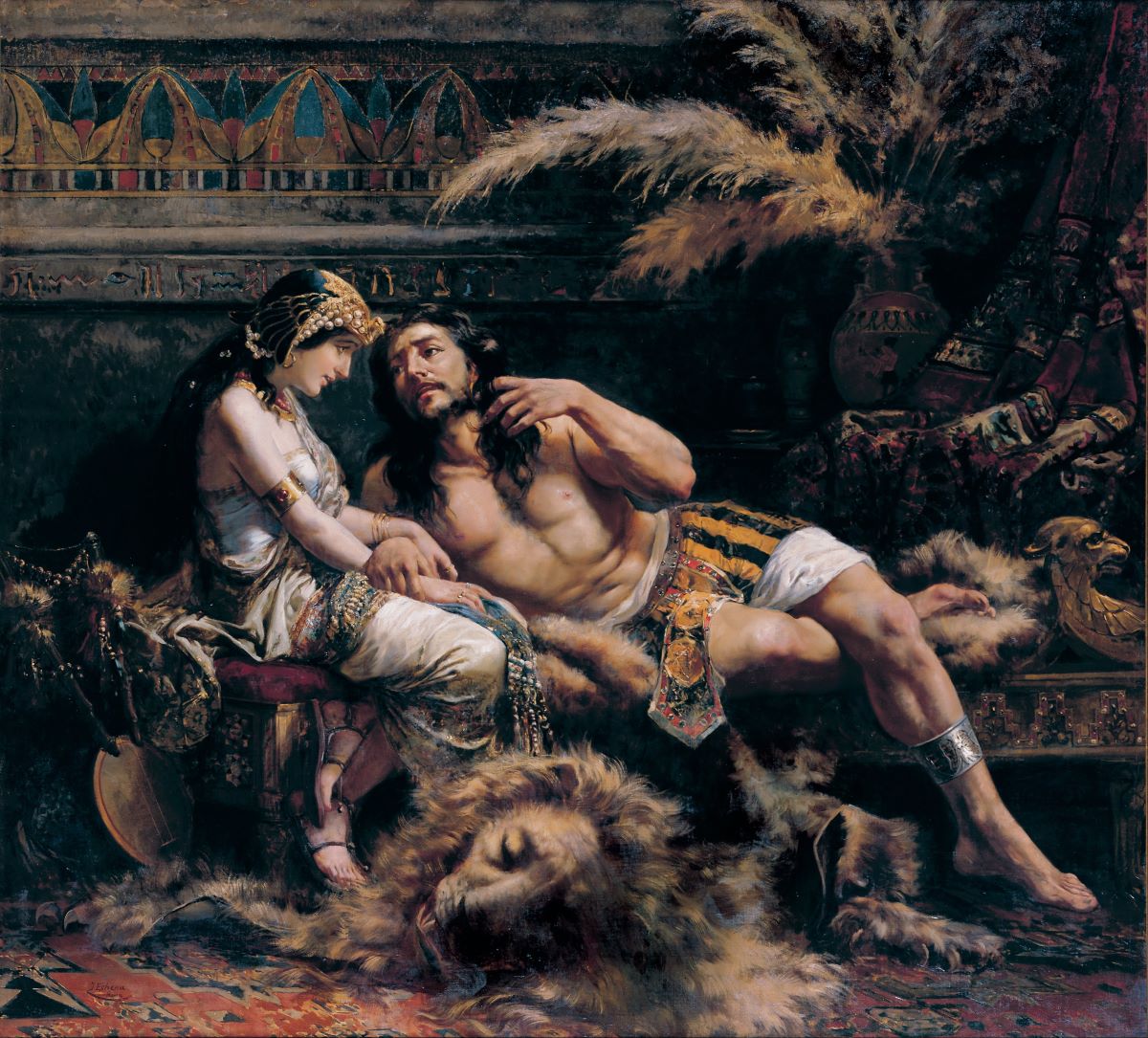
What is it about certain women that can bring even the most powerful men to their knees? Across the centuries, literature and history have returned repeatedly to this disturbing question, whether in the figure of Helen, whose beauty became the occasion for the Trojan War, Cleopatra, whose relationships with Julius Caesar and Mark Antony helped shape Rome’s destiny, or Delilah, whose name has become synonymous with the destruction of masculine strength through feminine allure. Indeed, so deeply has the last entered our cultural consciousness that when Tom Jones sang his famous song “Delilah,” the name alone evoked a drama of desire, jealousy, betrayal and murderous passion.
Yet the question is not whether women are stronger than men, but whether there exists a form of power against which physical strength, intellectual brilliance, and worldly authority provide remarkably little protection.
Consider the extraordinary downfall, in November 2026, of Jensen Huang, the billionaire co-founder of Nvidia, whose technological genius helped build one of the world’s most valuable companies. Huang resigned as chief executive amid revelations of extramarital relationships, including one involving Alice Huang, a Chinese businesswoman whose possible connections with Chinese intelligence are reportedly being investigated by American authorities. The allegations concerning espionage remain unproven and the CEO has been recently reinstated; nevertheless, the parallel with Samson and Delilah is astonishing.
For the biblical Delilah was not merely a woman who betrayed her lover: She was recruited by the Philistine rulers to discover the secret of Israel’s strongest weapon, Samson himself. Three thousand years later, we encounter allegations that a woman romantically involved with one of America’s most strategically important technological leaders may have been related to a rival power’s intelligence services.
Ancient Philistia and modern China are vastly different societies, of course; yet the underlying possibility is disturbingly familiar: that an adversary unable to overcome a nation’s strength directly might exploit the private vulnerabilities of the individual upon whom that strength depends.
Perhaps the archetype is older still, reaching back to Adam and Eve, where the first man allows his attachment to the woman to become entangled with disobedience. John Milton, in “Paradise Lost,” develops this theme with extraordinary psychological subtlety, portraying Adam as knowingly choosing to share Eve’s fate rather than endure existence without her.
Significantly, Milton, whose own relationships with women were troubled, subsequently wrote “Samson Agonistes.” Love, or what masquerades as love, becomes stronger than reason; and its consequence is nothing less than the loss of Paradise.
Samson presents an even more disturbing variation, because he does not merely fall in love with someone who will betray him; he repeatedly witnesses the evidence of her intentions and nevertheless remains within her power.
The Price of Betrayal
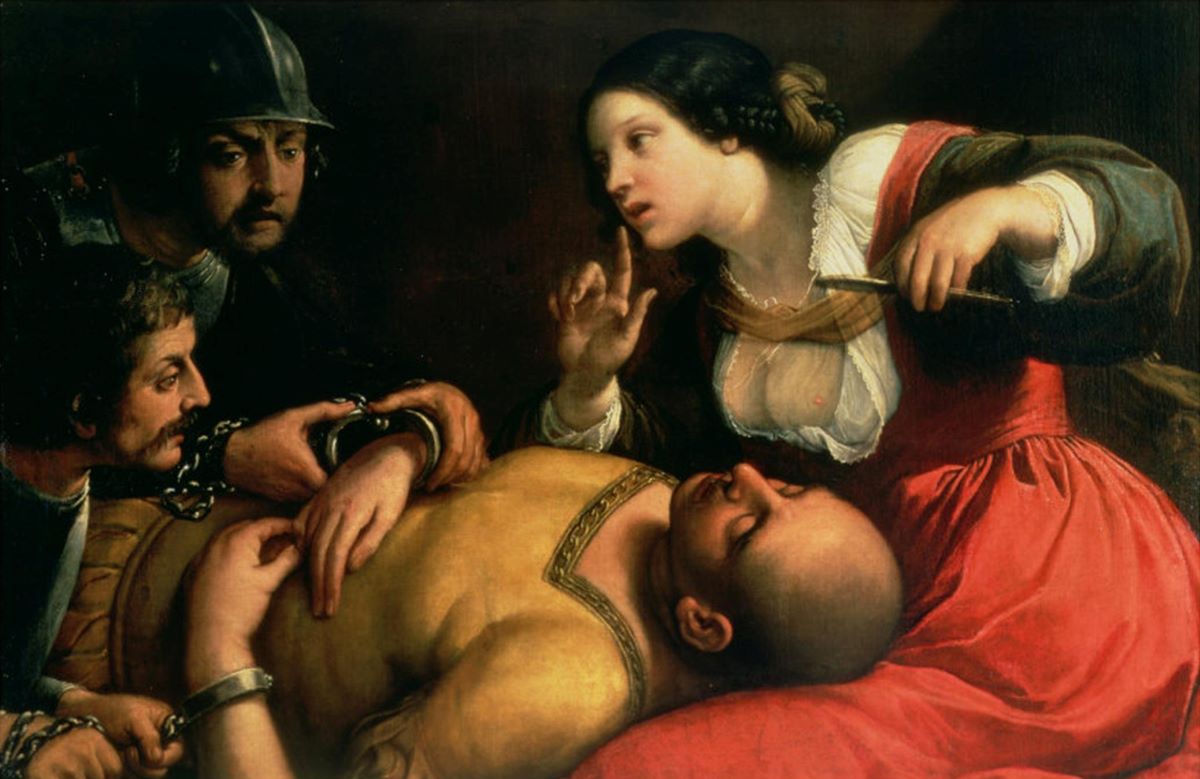
The biblical narrator introduces Delilah with remarkable economy: Samson loves “a woman in the valley of Sorek, whose name is Delilah” (Judges 16:4). We are told nothing about her appearance, family, or nationality, and although she is commonly assumed to be a Philistine, the text does not explicitly identify her as such.
Her name, as biblical scholar J. Cheryl Exum observes, suggests a wordplay on the Hebrew “laylah,” meaning “night.” Although this is not a certain etymology, its symbolism is striking, for Samson’s name is associated with “shemesh,” or “the sun.” Thus, in the names of these protagonists, we encounter night overcoming day, darkness extinguishing light. How appropriate that Delilah should ultimately bring blindness upon the hero whose name evokes the sun!
The Philistine rulers approach her with an extraordinary proposition: Each will pay her 1,100 pieces of silver if she discovers the secret of Samson’s strength. Whatever Delilah’s feelings towards him, their relationship becomes a commercial transaction, with betrayal as its object.
Even the numbers are suggestive: Eleven, unlike 12, that great biblical number of completeness associated with Israel’s tribes, might signify wholeness diminished by one. More strikingly, the silver anticipates Judas and his 30 pieces, for, in both cases, the betrayer is paid to provide access to someone whom his enemies cannot readily overcome. Delilah sells access to the secret of Samson’s strength; Judas sells access to the person of Jesus.
Three times Delilah questions Samson, and three times he deceives her. First, he claims that seven fresh bowstrings will render him helpless; next, that new ropes will overcome his strength; finally, that weaving the seven locks of his hair into a loom will accomplish the same purpose. Each time she tests his explanation, and each time Samson escapes.
Yet the numbers again seem significant: Three failures precede the fatal fourth attempt, while seven, the biblical number of sacred completeness (as distinct from twelve, which more often represents the completeness of an ordered whole, such as the twelve tribes of Israel), recurs in both the bowstrings and the locks of hair. Moreover, Samson’s successive answers move ever closer to the truth, as though his deceptions were gradually drawing him towards the revelation that will destroy him.
But why does he remain with her? Surely not because he fails to understand what is happening, since the evidence of her treachery becomes unmistakable. Rather, he seems unable to act upon what he knows. His desires have acquired an authority which his judgment cannot dislodge.
There is something reminiscent here of Keats’s “La Belle Dame sans Merci” (“The Beautiful Lady Without Mercy”), in which a mysterious and beautiful woman leaves her knight enthralled, abandoned, and spiritually desolate. Beauty becomes pitiless, while masculine strength dissolves into strangely passive helplessness.
Eventually, Delilah accuses Samson of withholding his heart from her, and her relentless questioning wears him down until, as the biblical narrator memorably expresses it, his soul is “vexed unto death” (Judges 16:16). He reveals the truth about his lifelong Nazirite consecration and uncut hair, whereupon Delilah arranges for his seven locks to be shaved while he sleeps. The strongest man in Israel has become a prisoner before his captors even arrive.
The Blindness Before the Blindness
But the hair is not some magical reservoir of power. It is the outward sign of a relationship with God, established before Samson’s birth, and, when he awakens, confidently expecting to escape as before, he discovers that the Lord has departed from him. Samson has mistaken the possession of extraordinary gifts for the permanent guarantee of divine favor.
The Philistines seize him, put out his eyes, and carry him to Gaza, where he is bound with bronze fetters and made to grind grain in prison. The man who once roamed freely, following whatever attracted his gaze, is now deprived of sight altogether; and the man who could defeat a thousand enemies with the jawbone of an ass is reduced to the repetitive labor of a captive.
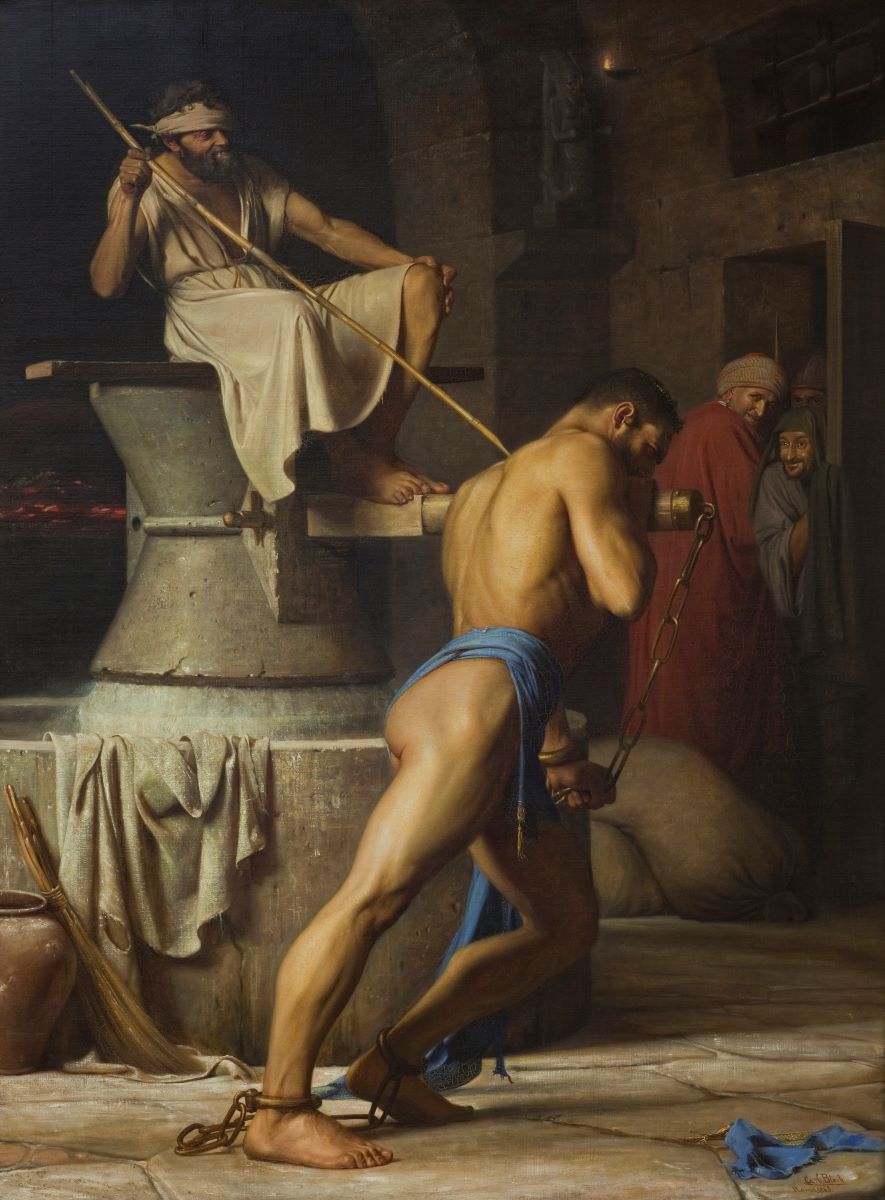
But is this not the culmination of a blindness that has characterized his life from the beginning? Again and again, Samson has seen what he desires without perceiving its consequences. He saw the Philistine woman at Timnah and demanded her for his wife; he saw the honey in the lion’s carcass and took it; and now, in Delilah, he has encountered the final object of a desire that overrides every warning. His eyes have been instruments of appetite rather than understanding, and their destruction makes visible the spiritual blindness that preceded it.
Yet one small, almost inconspicuous detail changes the direction of the story: Samson’s hair begins to grow again (Judges 16:22). In Greek mythology, Nisus, king of Megara, likewise possesses a miraculous lock of hair upon which his power depends. When his daughter betrays him by cutting it, his destruction follows.
But Samson’s story takes a different turn, for what has been shorn begins silently to restore itself. Some interpreters have seen here the symbolism of the sun, whose rays diminish in winter only to return with renewed strength in spring.
Given Samson’s association with the Hebrew word for “sun,” the image is extraordinarily suggestive: blinded and imprisoned, the hero appears to have descended into perpetual darkness, yet the first intimations of returning light are already stirring. His enemies have conquered him, but not extinguished the possibility of renewal.
The Child and the Final Prayer
The Philistines gather in the temple of Dagon to celebrate their triumph, praising their god for delivering Samson into their hands. The defeated hero is brought from prison to entertain them and, standing between the building’s great supporting pillars, asks the boy guiding him to let him rest against them (Judges 16:26).
The presence of this child is intriguing. Samson, whose adult life has been dominated by violent passions and frustrated desires, must now depend upon someone who possesses none of his extraordinary strength and, presumably, none of his consuming appetites. Might the child represent something Samson has lost: innocence, simplicity, the capacity to trust without seeking to possess? At the very least, the reversal is extraordinary.
The man who once needed nobody must now be led by a boy; and the hero whose eyes governed so much of his existence must entrust himself to another’s sight. Childhood and death stand at opposite ends of human experience, yet both lie beyond the ordinary pursuits of adult desire; Samson is being guided towards his death by one who has scarcely begun to live.
Then comes his final prayer. Samson calls upon the Lord to remember him and strengthen him once more, so that he may avenge the loss of his eyes (Judges 16:28). There is something deeply moving in this appeal, for the man who has so often acted as though his strength belonged entirely to himself now acknowledges that it must be given to him. But there is something troubling, too, since his stated motive remains personal revenge rather than Israel’s liberation; although, paradoxically, in seeking his revenge he is simultaneously advancing the divine intention to begin that liberation.
We must resist turning this moment into an uncomplicated conversion. Samson does not explicitly confess his sins or declare that he finally understands his calling. Rather, he asks God for strength to accomplish one last act of destruction. Nevertheless, the biblical narrative presents that strength as granted, and the consequences extend far beyond his individual grievance.
Samson braces himself against the pillars and brings down the temple upon himself and the assembled Philistines. The narrator records that he kills more people in his death than during his life; thus Israel’s strongest man achieves his greatest victory at the precise moment of his own destruction.
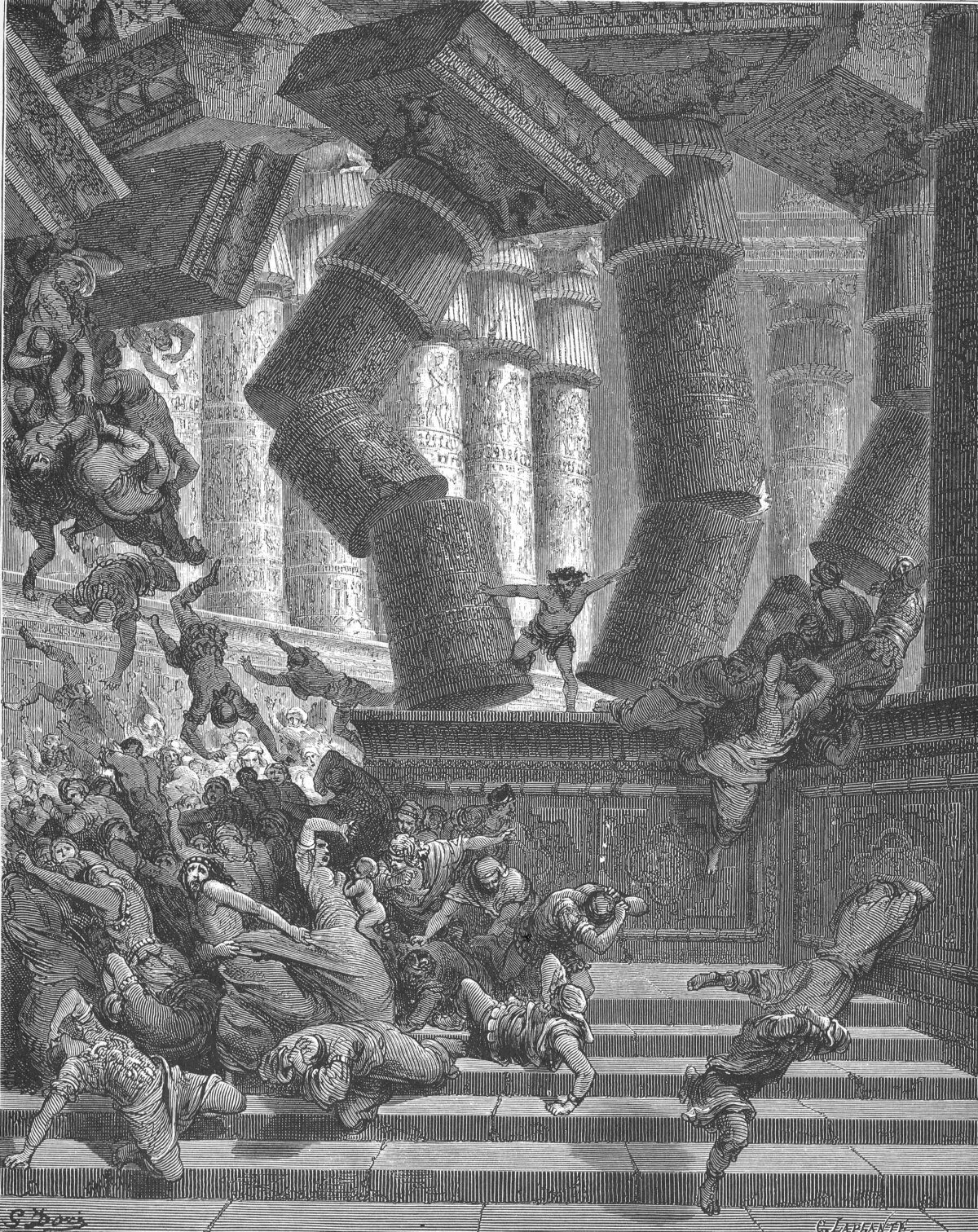
Christian readers may discern here a distant prefiguration of Christ, whose death likewise accomplishes a victory his enemies could not have anticipated, although the contrast between Samson’s vengeance and Christ’s self-sacrifice remains profound.
The Final Riddle
What, then, are we to make of this extraordinary life? Samson was called before his birth to begin Israel’s deliverance from the Philistines, yet almost everything he accomplished arose from personal quarrels, wounded pride, frustrated desire, or revenge. He possessed gifts that ordinary men could scarcely imagine, but lacked the self-knowledge necessary to govern them. And although he could defeat armies, he could not sustain the relationships upon which an ordinary human life depends.
And here lies the enduring mystery of Samson: that divine purpose may be accomplished through a human being whose motives remain imperfect, whose victories are inseparable from his failures, and whose greatest act of strength is also his final surrender. For perhaps the ultimate riddle of Samson is not how a strong man could become weak, but how a man so deeply flawed could nevertheless fulfil the destiny for which he had been chosen. Truly, it could be said: God works in mysterious ways!
The quotations from the Bible are from the King James Version.
Visti the first of the 3-part series on Samson.
What arts and culture topics would you like us to cover? Please email ideas or feedback to features@epochtimes.nyc.