SEARCH


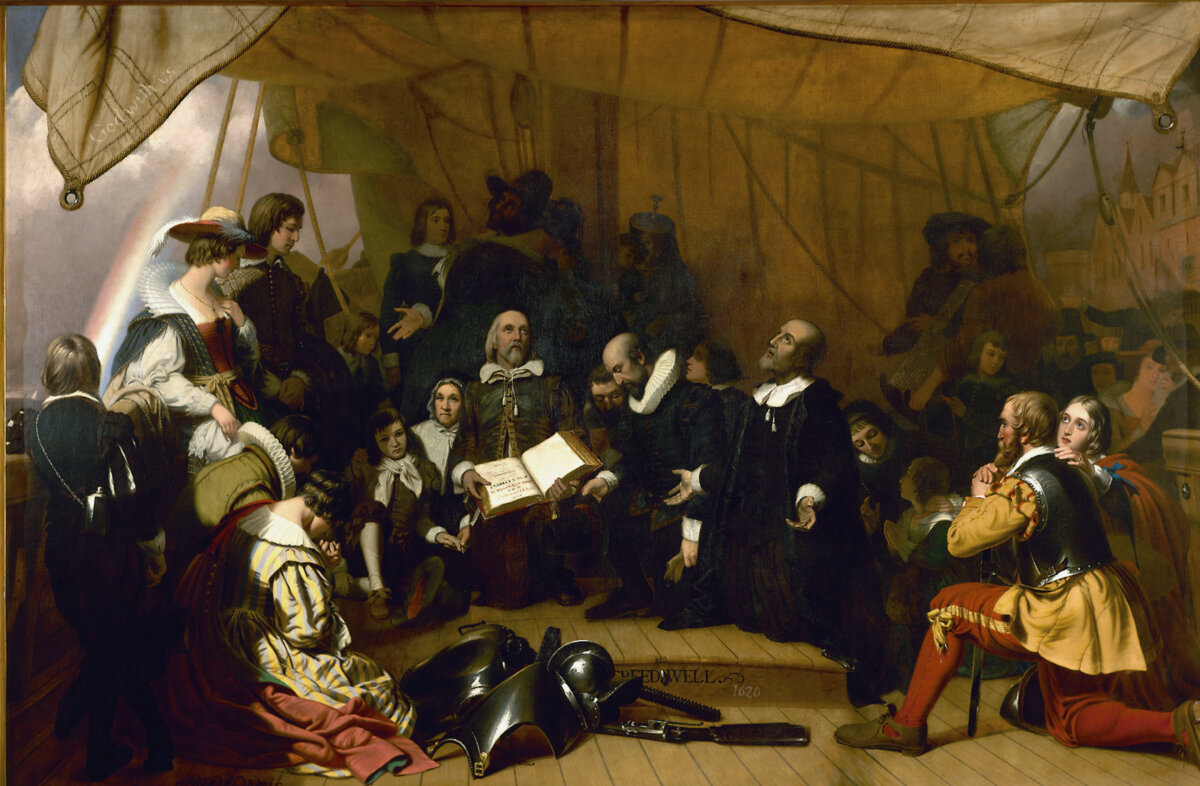
By the time the Pilgrims finally sailed for the New World, they had already lived aboard the Mayflower for about six weeks. Twice they had left England with their sister ship, the Speedwell, and twice they had returned after the Speedwell failed to live up to its name, springing leaks on each attempted voyage. Some of the passengers then crowded aboard the Mayflower, and on Sept. 6, 1620, the ship sailed solo toward America.
That voyage of 66 days brought miseries almost unimaginable to us today. Of the 102 passengers, 41 were Pilgrims and 61 were those the Pilgrims called “strangers,” those who didn’t share their faith. The strangers were skilled craftsmen or indentured servants. All were crammed into a gun deck, a space measuring 58 feet long by 24 feet wide.
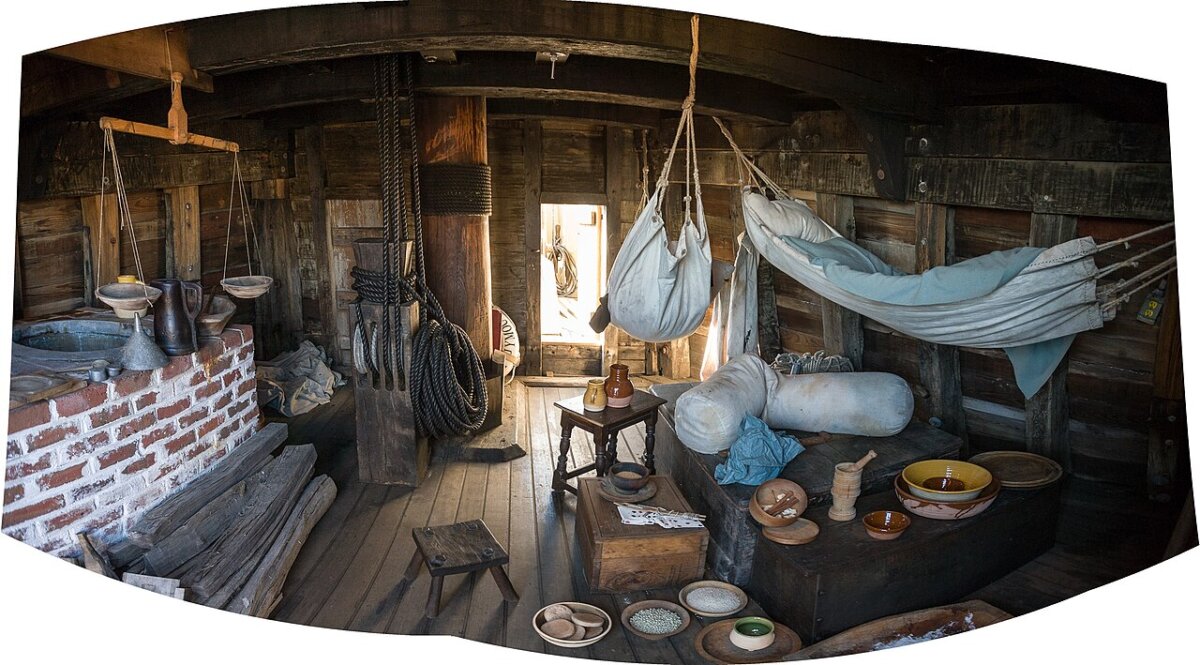
Among these passengers were three pregnant women and some 30 adolescents and children under the age of 18. A boy, Oceanus, was born on the voyage. Constant illness and sickness from the rolling seas meant buckets of bile and vomit alongside waste from natural bodily functions. Besides the foul air, the ship ran out of fresh food soon after leaving Plymouth, leaving only salted pork, hardtack, beans, and beer.
Remarkably, only one passenger, an indentured servant, died on the voyage by the time they arrived at Cape Cod on Nov. 11.
But their real ordeal had only begun.
Sometimes Two or Three Died a Day
Though they were bound for Virginia, supplies aboard ship were running low and the Pilgrims elected to stay at Cape Cod. As one of their leaders, William Bradford, later wrote:
“They fell upon their knees and blessed the God of Heaven, who had brought them over the vast and furious ocean, and delivered them from all the perils, and miseries thereof; again to set their feet on the firm and stable earth, their proper element.”
It took them days to repair the “shallop,” the 30-foot sailboat that served as their shared living quarters. Consequently, early December had arrived before a party took to the water to look for a suitable place of settlement. Finally, on Dec. 11:
“[These men] found they were on an island secure from the Indians, where they could dry their stuff, fix their arms, and rest themselves and give God thanks for His mercies in their manifold deliverances. This being the last day of the week they prepared to keep the Sabbath there.”
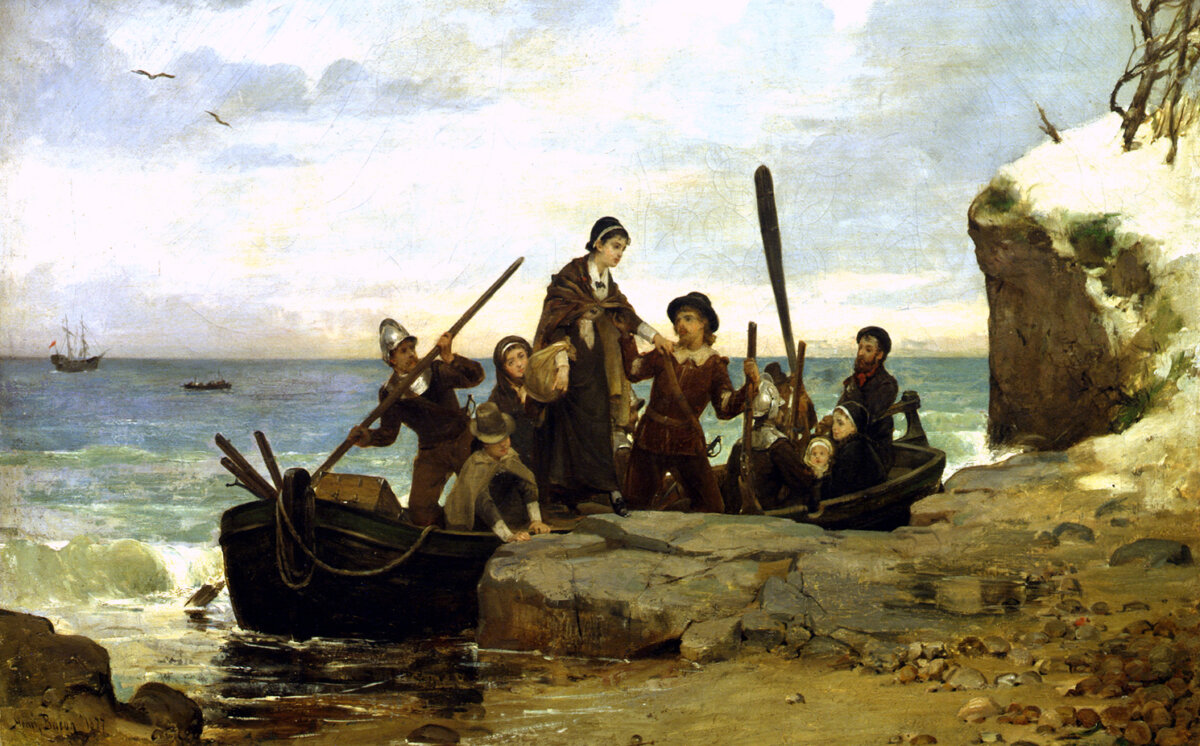
Having received this good news, the Mayflower then sailed to what they then called Plymouth Harbor. They unloaded goods and tools from the ship, and the men set to work. Over the next several months, they laid out the street of their town and built a common house where many of them lived while building their own dwellings. Slowly the settlement came into existence.
Yet the New England winter had now clamped down, and starvation, disease, and exposure to the elements took a toll on bodies already weakened by the trials of crossing the Atlantic. Four had already died during the wait at Cape Cod, and now others followed them to the grave, about 40 or 41 by the time April arrived. At one point, only seven settlers were well enough to take care of the survivors.
With the spring, however, came this astonishing development. When the Mayflower set sail for England in April, not one of the Pilgrims or strangers were aboard. All decided to remain with the colony. These survivors included four married women, 14 adolescent boys and girls, 13 younger children, and 22 men. Six months later, these same hardy souls celebrated a harvest thanksgiving to which they had invited members of the Wampanoag tribe, 90 of whom attended the three days of feasting.
Here, two questions arise: How was it possible after that horrific first winter to regard the prospects of a successful colony with any sort of hope? What qualities in this remarkable band came to the fore and allowed them to keep moving forward even after death had carried half their number to the grave?
‘A Special Instrument’
From March of 1621 comes this account of what the Pilgrims considered a miracle. “Friday the 16. a fair warm day. … [Samoset] very boldly came all alone and along the houses straight to the Rendezvous … he saluted us in English, and bad [bade] us welcome.”
Here we must use our imaginations to understand the Pilgrims’ shock at this man appearing out of nowhere, greeting them in English, and asking them for a beer. It wasn’t an apparition. Samoset had picked up English while dealing with fishermen and traders on the New England coastline. Less than a week later, he returned with a tribal sachem, or king, Massasoit, and a band of men that included Tisquantum, known today to most Americans as Squanto, who spoke even better English.
In an article about Squanto, editor and writer Melissa Gouty untangled some of the mystery of this happenstance. She investigated how Squanto was kidnapped and lived in England for a time, learning the language and the customs; his voyages between Europe and America; and how, in his absence, his entire tribe, the Patuxet people, died from pestilence.
She made clear that Squanto shared with the English colonists agricultural techniques practiced by the Native Americans, as generations of schoolchildren have learned. Perhaps even more important to the colonists was his knowledge of the language and English customs, which made him an invaluable interpreter between Massasoit and the Pilgrim leaders.
Because of this skill, peace was made between these two groups. The Pilgrims learned that the land where they had settled had belonged to the Patuxet. Because of the plague that had wiped them out, the Indians considered the place cursed and so were more inclined to allow the Pilgrims to live there.
Later, colonist William Bradford praised Squanto as “a special instrument sent of God for their good, beyond their expectations.”

Servant-Leader and Man of Faith
When the governor of Plymouth, John Carver, died in the brutal winter of 1620–1621, William Bradford was elected as his successor. He was an ideal choice. He was endowed with a keen mind, a good grasp of details, faith-based optimism, and insight into human nature.
In the introduction to the 1920 “Bradford’s History of the Plymouth Settlement,” editor Harold Paget, who also rendered Bradford’s book into modern English, gives readers an excellent overview of that governor’s impact on Plymouth and his abilities as both author and leader.
As becomes quickly apparent in Bradford’s history, Bradford was also a man of deep religious faith, which he blended into his daily duties. He wrote constantly of the goodness of God, quoted Scripture frequently, and saw God’s hand in certain events, like Squanto’s friendship. Moreover, unlike so many other colonizers, Bradford showed the Native Americans with whom he dealt great respect. His generally positive descriptions of them reveal his admiration.
Nor was Bradford hesitant about changing course when things went awry. In an inclusion timely to the modern-day debate about socialism and communism, Paget mentioned in the introduction a passage taken from Bradford on this very subject. Bradford was under orders from English supporters to have his followers share all food and goods in common. Seeing that this was a recipe for disaster, after three years, he discarded this approach. Instead, each family or single man received a plot of land to plant and harvest as they wished. In his “History” he wrote:
“The failure of this experiment of communal service, which was tried for several years, and by good and honest men, proves the emptiness of the theory of Plato and other ancients, applauded by some of later times,—that the taking away of private property, and the possession of it in community by a commonwealth, would make a state happy and flourishing; as if they were wiser than God. For in this instance, community of property (so far as it went) was found to breed much confusion and discontent, and retard much employment which would have been to the general benefit and comfort.”
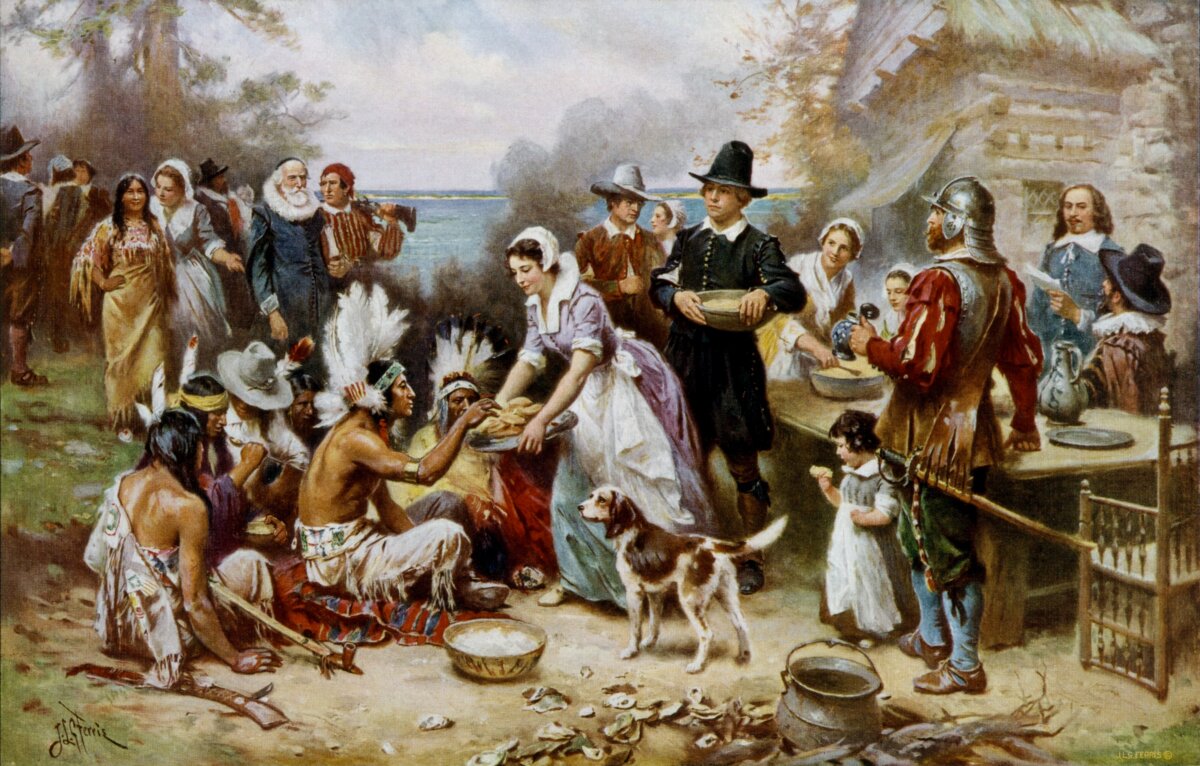
The help from Squanto and other Native Americans, the Pilgrims’ religious faith, and a leader who truly cared about his followers, these go far in explaining why and how these few were able to battle on to establish a colony. Other factors, especially human instinct and the drive for survival in the face of horrendous odds, also played their part.
Our Thanksgiving Day
This year, when we celebrate Thanksgiving, we might remember and take heart from the examples of these Pilgrims. We might also keep close at hand two thoughts from William Bradford. President Kennedy cited Bradford in a 1962 address about America’s space mission: “All great and honorable actions are accompanied with great difficulties, and both must be enterprised and overcome with answerable courage.”
The second comes from the “History”:
“Thus out of small beginnings greater things have been produced by His hand that made all things of nothing, and gives being to all things that are; and, as one small candle may light a thousand, so the light here kindled hath shone unto many.”
Thanksgiving is a time for gratitude. It’s also a grand time to light that one small candle.
What arts and culture topics would you like us to cover? Please email ideas or feedback to features@epochtimes.nyc.