SEARCH


“The Birds of America” by artist and naturalist John James Audubon (1785–1851) is the greatest ornithological record ever produced. A landmark work in its day that is still considered a standard, it inspired early conservation efforts. In addition, it retains a fundamental place in American art history.
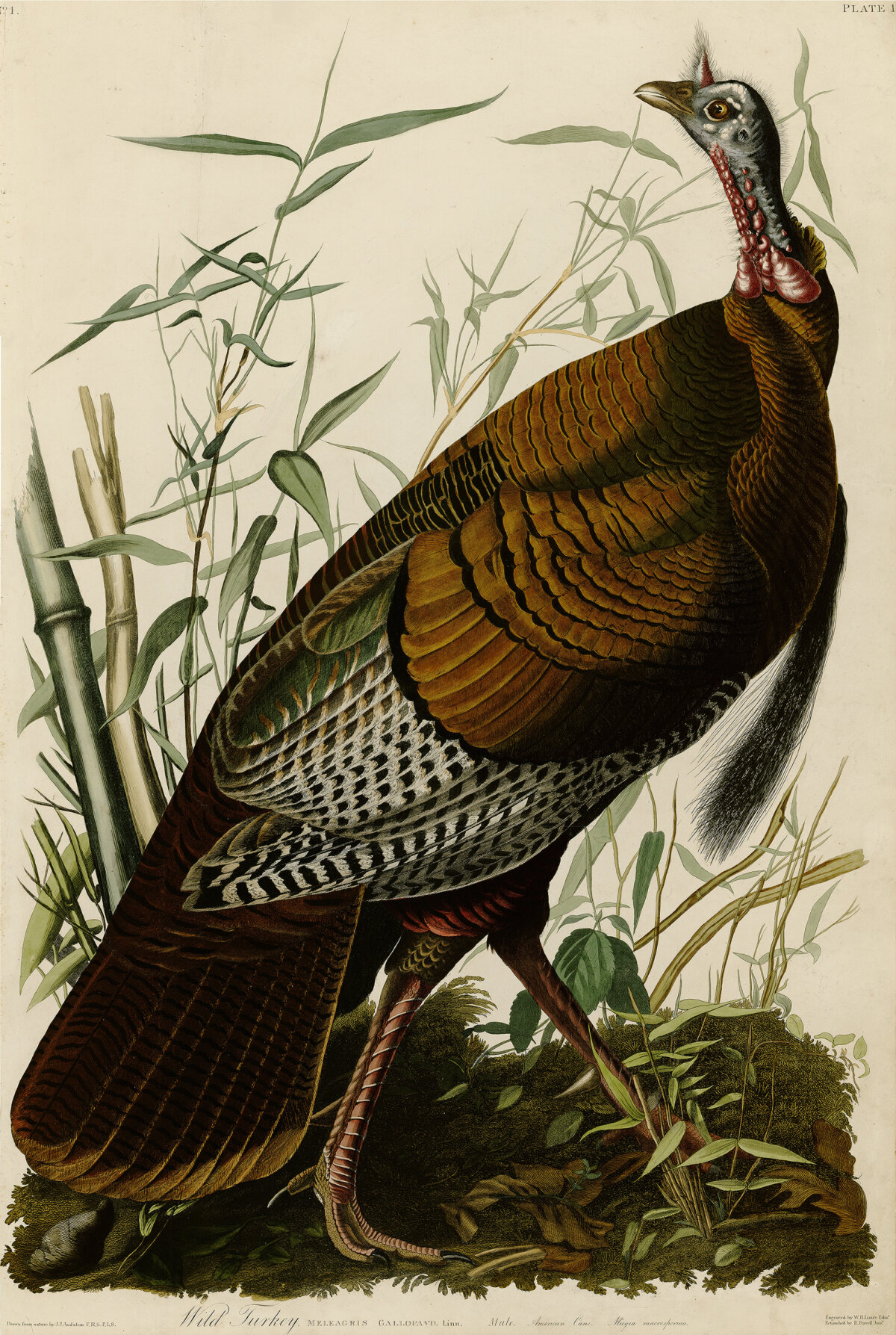
The most famous image from this seminal tome of 435 lifelike and life-sized plates is arguably the wild turkey (“Meleagris gallopavo”). This fowl was given pride of place as the first plate in “The Birds of America.” Audubon made multiple artworks depicting the turkey, reflecting the fact that the bird was a deeply meaningful symbol for him. An image of the wild turkey graced the personal seal in his signet ring as well as his calling card.
The turkey is a quintessential symbol of American culture, community, plenty, and, of course, Thanksgiving. Ironically, there is no evidence that turkey was served at the first Thanksgiving feast held between the Pilgrims and the Wampanoag in 1621. The foods on offer for the 140 or more people are believed to have included seafood, corn, venison, and goose or duck. Turkey became associated with Thanksgiving only after President Abraham Lincoln made the celebration a national holiday.
Audubon’s Passion Project
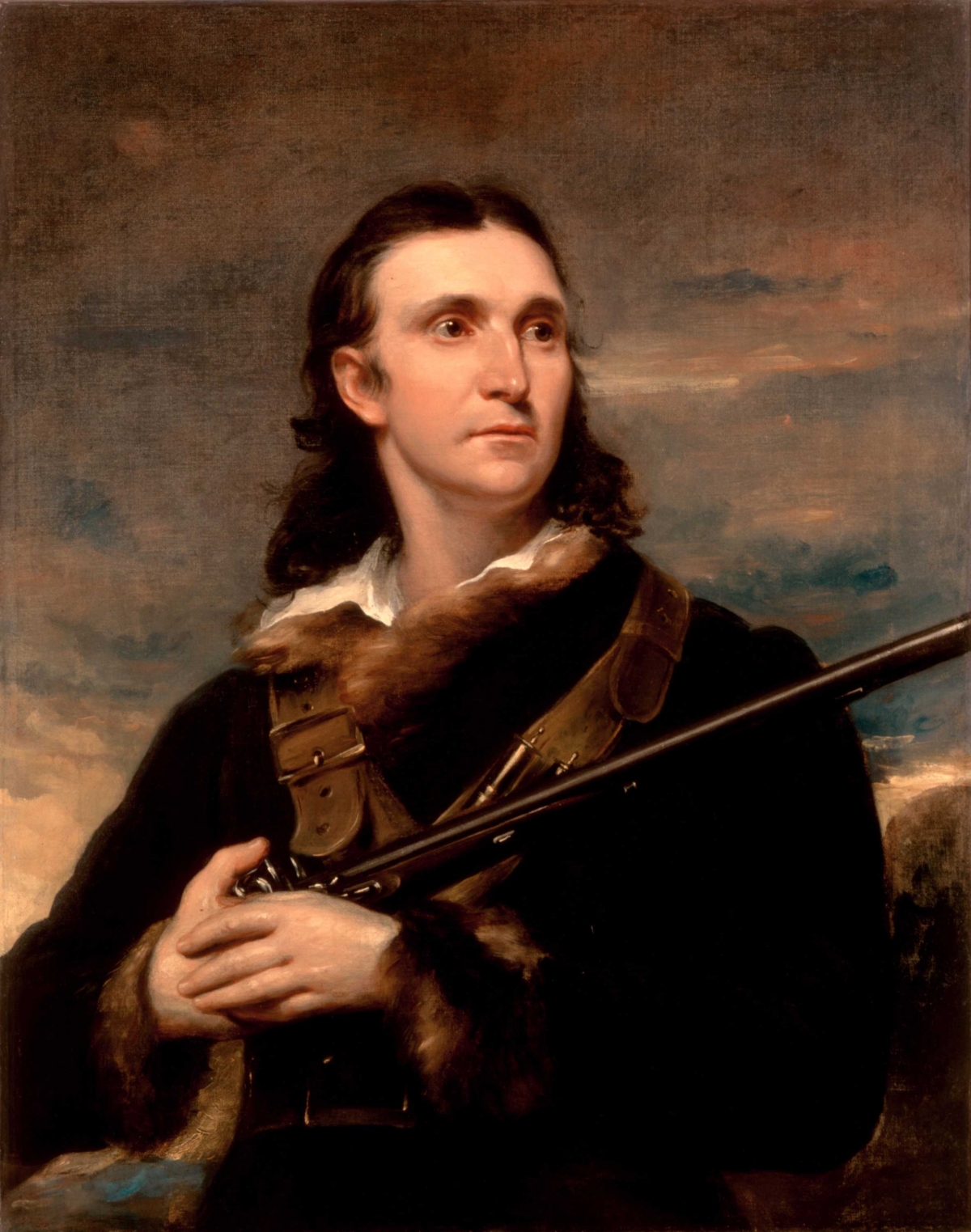
Audubon was born the illegitimate son of a French sea captain in what is now Haiti. As a young child, he was sent to Nantes, France and raised by his father’s wife. It was there that his interest in nature, especially birds, and art ignited. At the age of 18, he moved to America and later became a citizen in 1812.
While he hunted, studied, and drew birds as a hobby, his profession was that of a merchant. He operated a dry-goods store in Henderson, Kentucky. When his business went bankrupt, Audubon turned his personal passions into a career by creating dramatic bird portraits. He traveled throughout the United States gathering material for his project, and the publication of “The Birds of America” brought him fame.
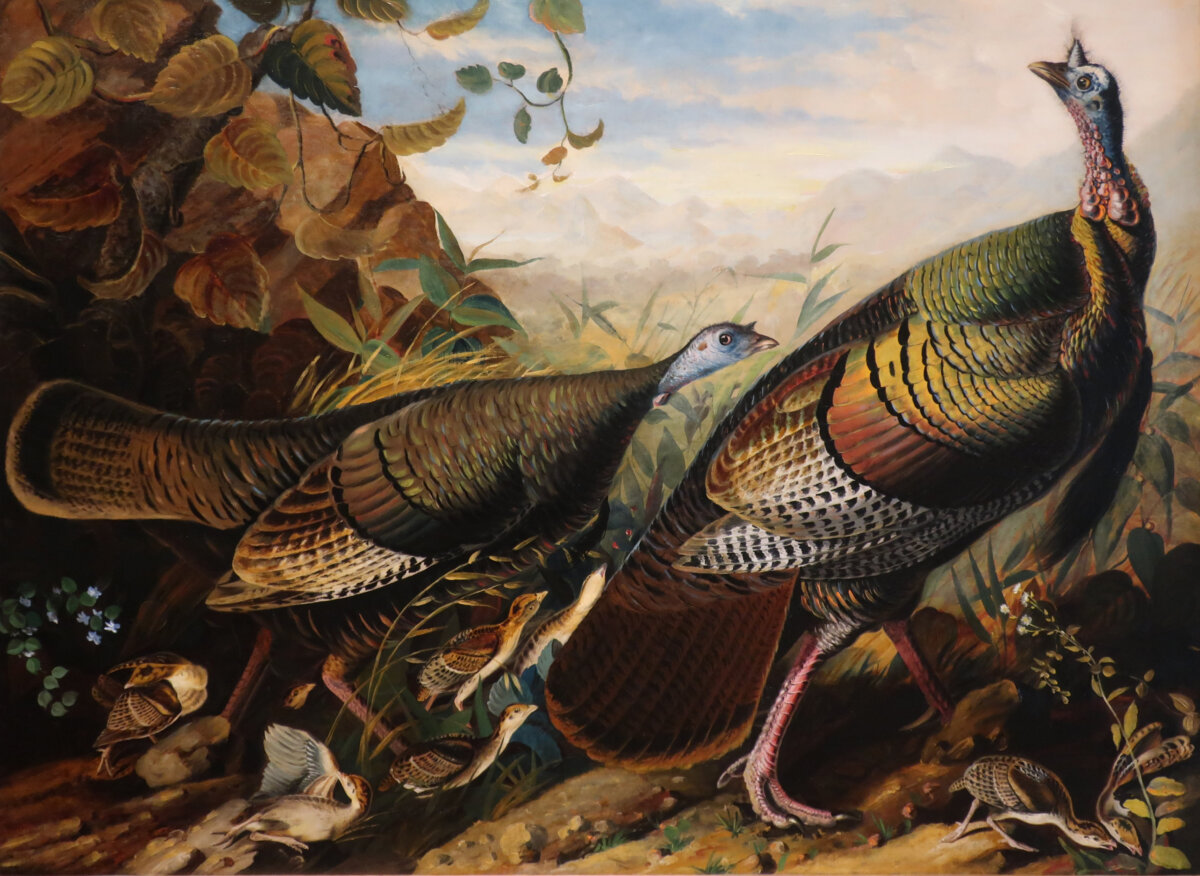
The book’s engravings have their origins in paintings and watercolors by Audubon himself. One of the first oil paintings he made related to the project was the 1826 “Wild Turkey, Cock, Hen and Young” at Crystal Bridges Museum of American Art. The museum notes that while the landscape in which he situated the turkeys was idyllic, native populations had already begun to decline; Audubon observed and wrote about this trend.

Decimation of the turkey population began when European settlers and early Americans vigorously hunted them. Further devastation came from frontier expansion: Logging and land clearing destroyed the turkey’s habitat. By 1920, turkeys could no longer be found in 18 of their native 39 states. A decade later, the continental population was only about 30,000 birds.
Subsequent massive conservation efforts centered around a trap-and-transfer model have restored the wild turkey population in America. Now, they number around 7 million. This undertaking is considered the greatest wildlife conservation success story of the 20th century. However, numbers have been tumbling in recent years, particularly in the Southeast. Biologists believe more measures are needed to maintain their habitat.
Life-Size Renderings
The New York Historical owns the world’s largest Audubon collection, including his original watercolors for “The Birds of America” and each corresponding plate. The copperplate used to make the published turkey engraving is in the collection of the American Museum of Natural History.
In 2017, The New York Historical launched an ongoing exhibition related to their important Audubon holdings. Visitors can see the artist’s original watercolor models and the corresponding plates engraved by Robert Havell Jr., along with other supporting objects. Items are switched on a bimonthly rotation due to light-sensitivity, and the display features an audio of corresponding bird calls.
The stunning watercolor model of the turkey features metallic paint that captures the fowl’s plumage. Both the model and plate are on double-elephant-size paper, an Imperial paper size that is officially 40 inches by 26 1/2 inches. Havell used a slightly different-sized sheet, specifically 39 1/2 inches by 26 1/2 inches, but Audubon’s printed engravings are still described as double elephant. While Audubon encountered suggestions to scale down his drawings for print, the wildlife artist persisted in his decision to depict each species life-size, as he was committed to accuracy.
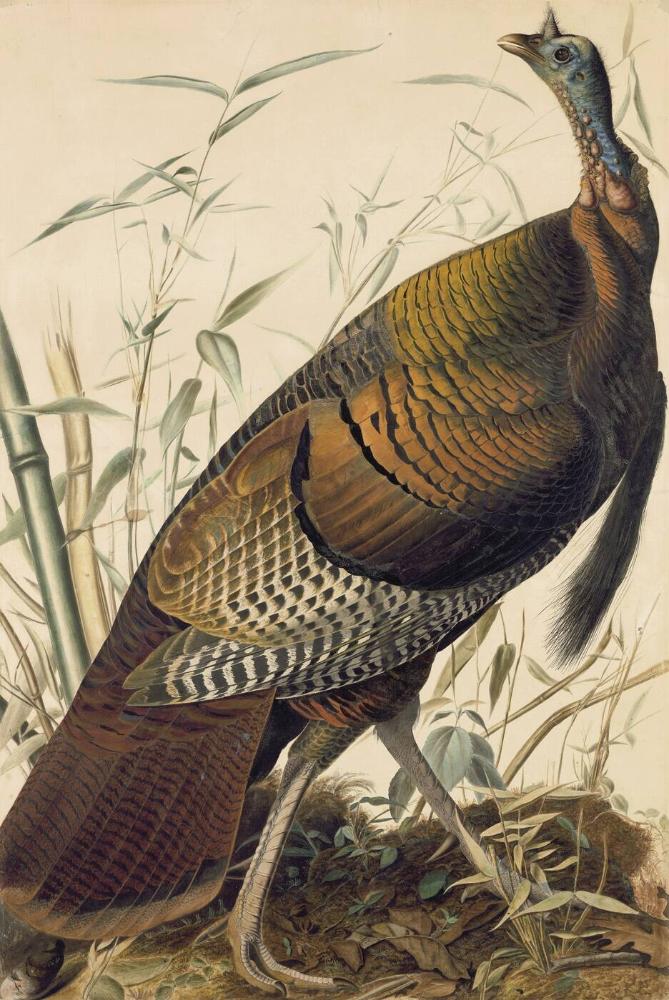
Scholars have long assumed that Audubon’s positioning of the life-size male turkey in contrapposto with a curved neck looking backwards was to fit the form on the 40-inch-tall paper. However, Roberta J.M. Olson, Curator of Drawings Emerita at The New York Historical, has compellingly argued that the pose is actually accurate. She writes that it is “a characteristic species behavior as a pater familias, looking over his shoulder protectively at his family following behind. That this was Audubon’s intention is supported by no less than three oil paintings in which he portrayed the entire turkey family.” An example of this is the Crystal Bridges painting.
Audubon was a pioneer in his translation of meticulous and direct observation of birdlife into brilliant scientific and artistic images. The watercolors, paintings, and engravings he produced remain captivating due to their intimacy, immediacy, and realism. Regarding the turkey, Audubon praised it as “one of the most interesting of the birds indigenous to the United States of America.”
Like Founding Father Benjamin Franklin, he preferred the turkey to the bald eagle as an emblem of America. In any case, on Thanksgiving, the turkey rules the roost.
What arts and culture topics would you like us to cover? Please email ideas or feedback to features@epochtimes.nyc.