SEARCH


On most technological fronts, we have the Romans beat, but there are a few areas in which these innovative people continue to confound and outdo us—a remarkable feat for an empire that has been gone for some 1,500 years.
For instance, it was only recently that a team of investigators from MIT, Harvard University, and laboratories in Italy and Switzerland unraveled the secrets of the Romans’ incredibly durable, self-healing concrete.
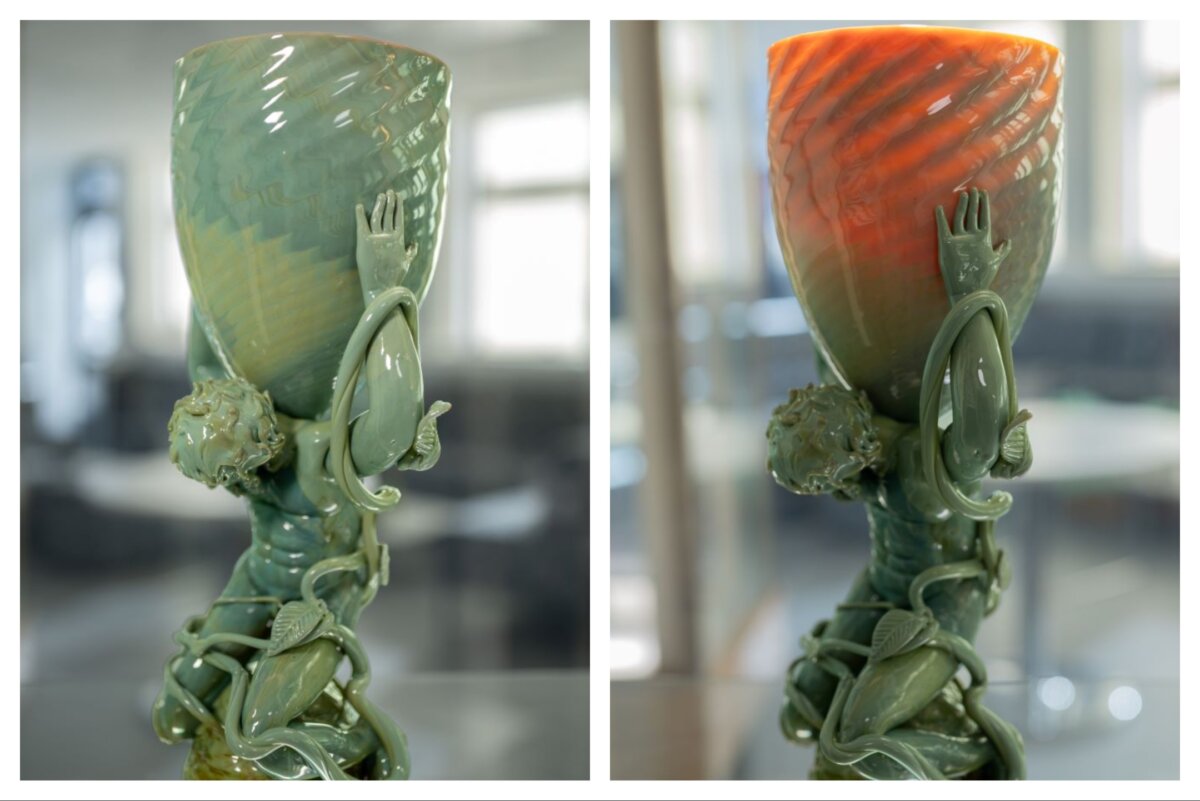
Now, scientists from the University of Sheffield have, at last, replicated another mysterious Roman technique, one that involves an early form of nanotechnology. The Romans developed a form of color-changing glass that appears jade green or blood red, depending on the lighting.
A famous example can be found in the British Museum’s Lycurgus Cup, a 1,600-year-old chalice depicting scenes from Homer’s “Iliad.” It has long fascinated and bewildered scientists. When light passes through the green cup, it suddenly seems to glow with an otherworldly red flame.
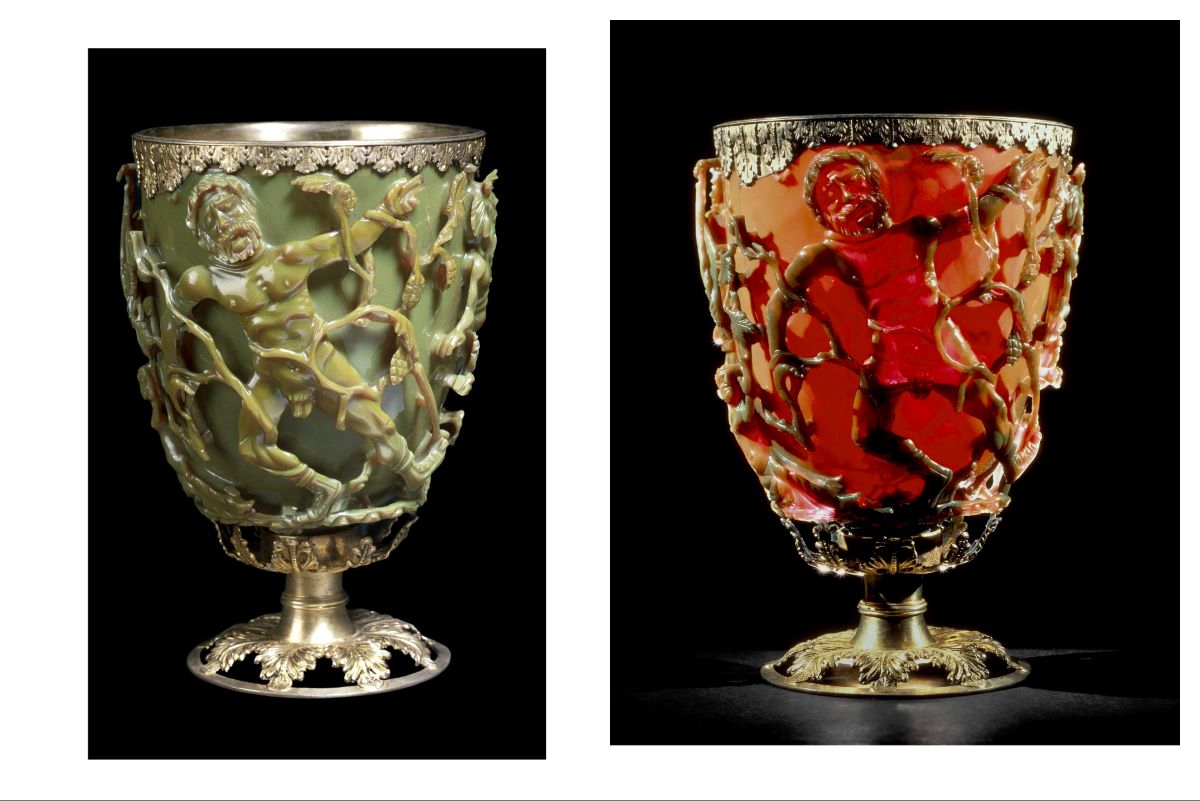
“[The Lycurgus Cup’s] colours, artistry and almost perfect condition have intrigued and confounded historians and glassmakers alike for centuries,” a press release from the University of Sheffield noted:
“Its exceptional colours and narrative, depicting a mythical Thracian king ensnared in vines because of his misdeeds, led to the artefact being recognised as one of the seven glass wonders of the world by an international panel of artists and conservators in 2022.”
It seems likely that cups such as the Lycurgus Cup were used for special occasions. There is a letter attributed to the emperor Hadrian, writing to his brother-in-law in Rome, mentioning this type of cup. It reads, “I have sent you parti-coloured cups that change colour, presented to me by the priest of a temple. … I would like you to use them at banquets on feast days.”
Previous attempts to replicate the Lycurgus Cup’s color-changing properties met with limited success, but now a team led by Lisa Hollands, a technician at the University of Sheffield’s School of Chemical, Materials and Biological Engineering, has succeeded.
“To me, it’s magic,” Hollands told The Guardian.

Hollands and her team were asked by project manager Christina Metcalfe to replicate the Romans’ bewitching glass for the University’s LightFest in 2025, and they rose to the challenge.
“I knew that making a glass of this type was likely to be a complex task, as it is not just a case of adding nanoparticles to glass,” Hollands stated in the press release.
It’s believed that the Romans achieved the mysterious color-shifting effect by adding tiny nanoparticles of gold and silver to the glass. These nanoparticles are smaller than the wavelengths of light, causing them to absorb light in intricate ways, blocking some colors while allowing others to shine through, depending on the shape and size of the particles.
“I’ve studied and worked with glass for over 25 years, so I used the knowledge and experience I’ve gained, coupled with a modern scientific understanding of what I was trying to achieve,” Hollands said.
Hollands also consulted a leading expert in Roman glass, professor Caroline Jackson. Together, they formulated a base glass, very similar to what the Romans would have used, to which they added small amounts of gold and silver. To achieve the right effect with the gold and silver, Hollands experimented with many configurations, turning the dials on many variables, including starting materials, furnace types, and oxygen levels. She restricted herself to the types of raw materials that Roman artisans would have used.
Eventually, she found the winning combination. In the final form of the glass, when light shines through it, the gold and silver nanoparticles block blue and green light, allowing only red through—causing the glass to blush and gush with a rich ruby color. If, on the other hand, light reflects off the surface, the gold and silver causes it to scatter, creating the opaque green.
To celebrate the achievement, the researchers commissioned a glass sculpture, using the Roman recipe, to be crafted by Elliot Walker, a premier glass artist in the UK and winner of Season 2 of the glassblowing competition reality show “Blown Away.” The piece—which will retain classical forms and the original story told on the Lycurgus cup—will be revealed to the public at the Millennium Gallery as part of the University’s Festival of the Mind from Nov. 6 to 15, 2026.

The discovery constitutes a remarkable intersection of science and history, art and chemistry. Using modern tools and scientific understanding, Hollands has shed light—quite literally—on an ancient artifact of wondrous beauty. The discovery also impresses on us the remarkable skill and technological advancements of 4th-century Roman craftsmen, whose secrets, as this story proves, are still being discovered more than a millennium later.
What would the Romans think of our attempt to imitate their glass? No one can say, but Hollands has a theory. She jokingly said, “If the Romans could have seen me experimenting, they’d probably laugh and ask: ‘Why does she not know how to make this?’”
What arts and culture topics would you like us to cover? Please email ideas or feedback to features@epochtimes.nyc.