SEARCH


The American artist Frederic Edwin Church (1826–1900) is best known for landscape paintings that are majestic in terms of both compositional scope and physical size. An outlier in his body of work is the hand-sized “Our Banner in the Sky.” Although depicted on a small scale, its subject soars to grand heights. This patriotic work is a quintessential visual of America for both the art historical canon and the general public.
Scholars believe that Church created this compelling composition in response to the start of the Civil War (1861–1865) and that it was directly inspired by the April 1861 Confederate attack on Fort Sumter, South Carolina. The American flag was shot at during this battle, and Union troops lowered it as part of their surrender. After this defeat, the flag became a particularly powerful patriotic symbol for Northerners, including the artist. The phenomenon was termed “flag-mania” by one contemporary journalist.
A Passionate Patriot
Church was a prominent supporter of the Union cause. The Fort Sumter bombardment occurred two weeks before his exhibition was scheduled to debut his masterpiece “The Icebergs.” Not only did the artist retitle the painting “The North,” but he pledged the exhibition fees to a fund for Union soldiers’ families.
The following month, May 1861, Church painted “Our Banner in the Sky.” There are several known oil sketches of this composition, including an oil on paper mounted on cardboard at the Fine Arts Museums of San Francisco, an oil on paper in the collection of Fred Keeler, and an oil on canvas in a private collection. The identification of the “original” artwork remains debated.
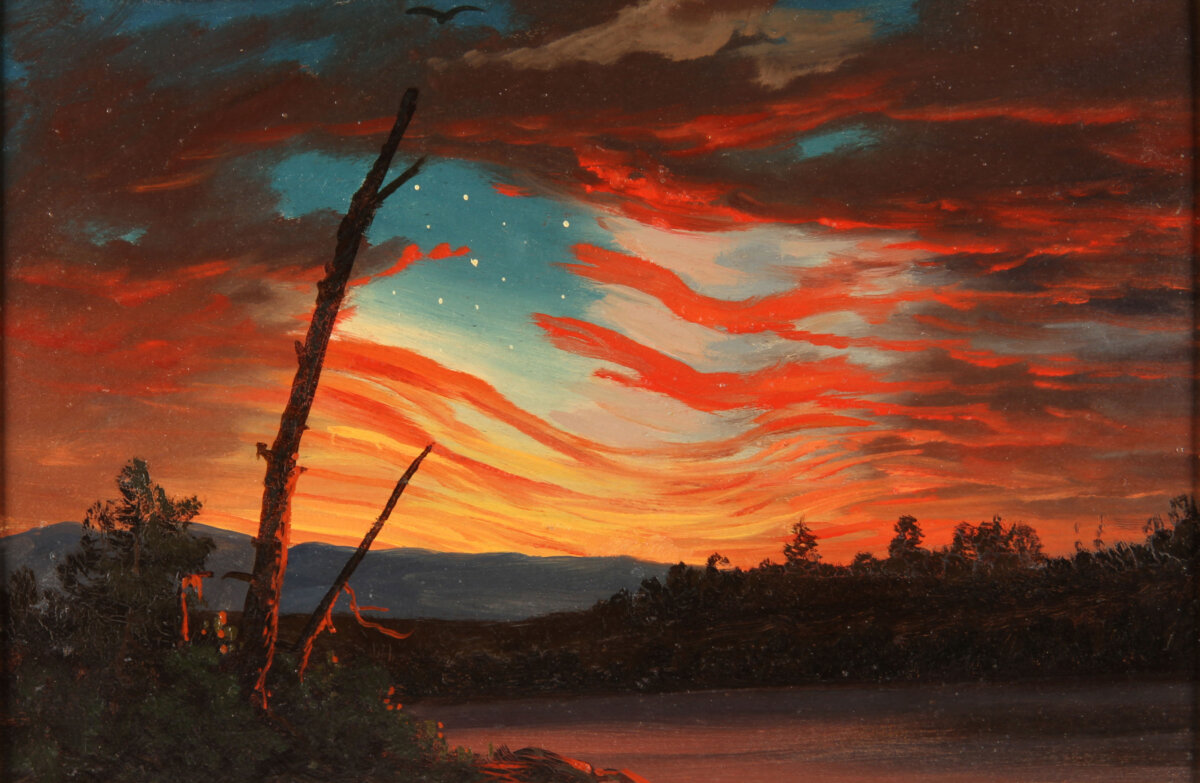
Vibrant color, glowing atmospheric effects, and distinctive brushwork mark this dramatic scene. In the sky is a celestial apparition of the American flag. The positioning of the sun behind a distant mountain generates an ethereal atmosphere. An opening in the clouds reveals stars in the position that they would be on the flag. Clipped red brushstrokes provide the illusion of the banner’s stripes. Although its edges are tattered from the war, it is still high in the sky. The flagpole is a barren tree on the left, and the mast-top is an eagle, another symbol of the United States. The river valley resembles the Catskills and the Hudson River, the setting for much of Church’s oeuvre.
In the 19th century, it was common for landscape painters to realistically depict nature as well as imbue their scenes with political and religious messaging. In “Our Banner in the Sky,” the heavenly light communicates Church’s belief that the North was guided by divine righteousness.
In June 1861, Church was paid $200 to produce a chromolithograph (multi-color print) of his “Our Banner in the Sky” oil sketch. Issued by the New York branch of the publishing firm Goupil & Co. as a subscription fundraiser for families of Union soldiers, the print became a hugely popular, mass-circulated image in the North.

The Terra Foundation for American Art owns a rare version of an “Our Banner in the Sky” print done as a black-and-white lithograph that Church retouched with oil paint. Another print that was later painted by Church is in the collection of the Olana State Historic Site—the artist’s self-designed home, studio, and surrounding landscape bought by New York State in 1966 and beautifully preserved. An additional question for art historians is why he painted over these lithographs. However, what is unequivocally clear is that Church was a passionate patriot who crafted an enduring representation of the country’s nationhood.
What arts and culture topics would you like us to cover? Please email ideas or feedback to features@epochtimes.nyc.