SEARCH


A majority of Americans have never served in the nation’s military. In 2023, there were 18 million veterans in our country, a figure that represents about 6 percent of our adult population.
Consequently, Americans often take their impressions of the military from movies such as “Saving Private Ryan” or “Lone Survivor,” combat films that show armed men facing death in battle. One popular 2016 movie, however, “Hacksaw Ridge,” featured a Marine hero, Pvt. Desmond Doss, who, because of his religious convictions, refused to kill or carry a weapon. As a medic, his heroism under fire at Iwo Jima saved approximately 75 lives and earned him the Medal of Honor.
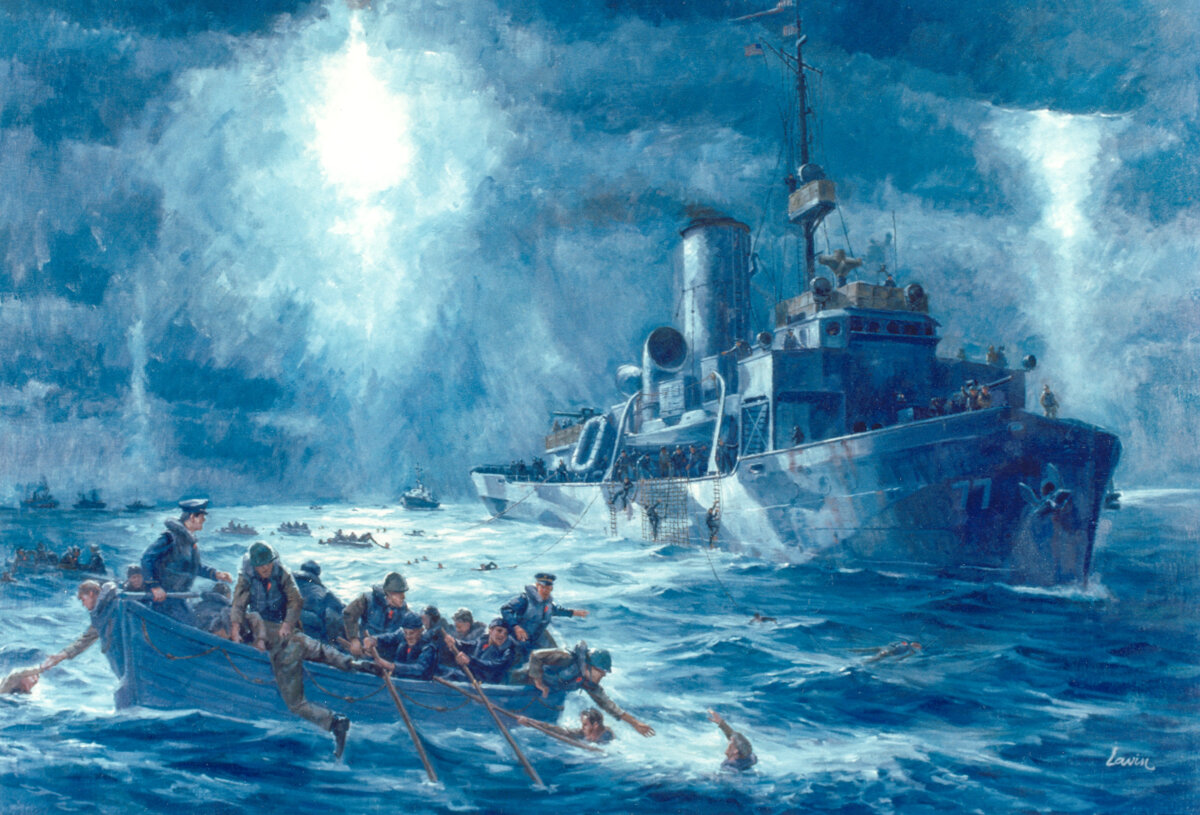
In another World War II combat action that is still begging for a movie, four Army chaplains, along with more than 900 other men, were on board the USAT Dorchester, a troopship bound across the Atlantic for Greenland. These four were Methodist minister George L. Fox, Dutch Reformed minister Clark V. Poling, Rabbi Alexander D. Goode, and Catholic priest John P. Washington.
Just after midnight on Feb. 3, 1943, a German torpedo slammed into the Dorchester and exploded. In the chaos, the four chaplains helped the wounded, tried to calm terrified men, and handed out life jackets. When that supply ran out, they took off their life jackets and gave them to the men. As the ship went down—672 of the men aboard died from the explosion or exposure in the freezing Atlantic—some survivors in lifeboats witnessed the chaplains standing with their arms linked, praying together.
Congress later created a special “Four Chaplains Medal” for the four heroic men, presented to their next of kin.
It’s Veterans Day. Let’s take a look at the combat medics and chaplains so respected and loved by many of their comrades.
The Docs Who Never Went to Medical School
From the Army’s “Combat Medic’s Creed” comes an informal motto, used as well by the Air Force Pararescue and the Coast Guard: “So That Others May Live.” Following those words are the last lines of the Creed: “Combat Medics never stand taller than when they kneel to treat the wounded! Saving Lives in the midst of utter chaos!”
The Navy and Marine Corps medic is known as the hospital corpsman, or more simply as corpsman. Combat corpsmen and medics who are respected and trusted by the men they serve are sometimes addressed as “Doc.”
Both specialties require intensive training. Here, we will take the army as our example.
Following 10 weeks of basic training, soldiers who qualify and want to be medics are sent to Advanced Individual Training at Joint Base San Antonio-Fort Sam Houston. There, for 16 weeks, they work and study for Military Occupational Specialty 68W, usually referred to as “68 Whiskey.” They learn emergency trauma procedures, learn such skills as sterilizing instruments, and gain experience working in military hospitals. Contrary to some perceptions, combat medics are also armed and expected to participate in combat if the situation requires.
Graduation finds them assigned to their units, where in peacetime they treat troops for such things as dehydration and foot injuries, educate soldiers on how best to care for themselves, and staff hospitals and infirmaries. As their time in service progresses, advanced courses are available as well.
When Faith Wears Fatigues
The pathway to service for chaplains is quite different from the paths of most others in the military. In this case, the branches basically follow the same pattern of requirements for those seeking chaplaincy posts. Here we will use the Navy’s template for admitting and training clerics for military service.
All chaplains begin as officers. To join the Navy in that position, they must meet the following qualifications: a bachelor’s degree from a four-year college or university, “a graduate degree in theological or related studies from an accredited educational institution,” two years of full-time religious and pastoral leadership that are “relevant to the settings of military chaplaincy,” and finally, a stamp of approval from “a religious faith organization registered with the Department of War.”
Once admitted to the chaplaincy program, prospective Navy clerics—they serve the Marine Corps as well—must attend Officer Development School, where they learn the procedures and basics of military life, and the Navy Chaplaincy School and Center, both of which are located in Newport, Rhode Island.
Advanced training and credentialing are later available in areas like family counseling.

Healers as Heroes
Of medics and corpsmen engaged in combat, 79 have won the Medal of Honor.
Army Staff Sgt. Ronald Shurer II was the most recent of these recipients. Soon after the 9/11 attacks, inspired by others in his family who had previously served in the military, Shurer joined the Army and became a Special Forces medic. In April 2008, he was with a special detachment out to kill or capture high-ranking targets in the mountains of Northwestern Afghanistan. As his detachment of Americans and Afghan commandoes were climbing one of the mountain hillsides, they came under intense machine gun and rocket fire.
Hearing the cries of men ahead of him, Shurer—the mission’s only medic—climbed the mountainside, fighting the enemy and treating men, at times shielding them with his own body from debris caused by explosions. Once a bullet ricocheted off his helmet, causing him later to comment, “It felt like I’d been hit in the head with a baseball bat.”
Having treated the wounded, both the Americans and their Afghan allies, he and several other soldiers then had to lower them down a 60-foot cliff to avoid enemy gunfire. At the base of the mountain, he set up an aid station and continued assisting the injured until the evacuation helicopters arrived.
Like so many such men, Shurer gave credit to others.
“This award is not mine,” he said when he received the medal. “This award wouldn’t exist without the team. If they weren’t doing their job, I wouldn’t have been able to do my job.”
Faith Under Fire
A Maryknoll priest and a missionary to Taiwan, Father Vincent Capodanno became a Navy chaplain in 1965 and soon began serving with the Marines in Vietnam. There he ate with the grunts—slang for the combat foot soldiers and Marines in that place—slept in the same barracks, joked with them, and heard confessions at any hour, thereby earning the nickname of “Grunt Padre.”
With his deployment nearing an end, Capodanno asked for a six-month extension. During this time, he would earn a Medal of Honor.
On Sept. 4, 1967, learning that a platoon of Marines was fighting a desperate battle nearby, Capodanno left the command post and dashed to their aid. Under heavy fire, he moved around the battlefield, giving last rites to the dying and helping treat the wounded. Even after a mortar shell blew fragments into his arms and legs and tore off part of his right hand, he refused to leave and kept up his efforts by directing medics and shouting encouragement to the men. Seeing a badly wounded corpsman under enemy fire, Capodanno ran to help him but was cut down by enemy fire.
Later, his niece, Linda Sergent, told a Catholic media outlet: “When he died, there were so many Marines and their families who wrote and came to his funeral. Thousands of people wrote about what he meant to them in their lives and their sons’ lives at the time in Vietnam, and what comfort he brought to them and how he shared God with them in very difficult times.”
As journalist Tom Hoopes noted, “In other words, he was exactly the kind of chaplain the families of servicemen and women pray for.”
Hoopes is on target with that remark. Yet we might broaden it to include all Americans. Whether on the battlefield or in the barracks, we should all pray that the young men and women who join our country’s military can find the necessary help and counsel of well-trained, dedicated, and caring medics and chaplains.