SEARCH


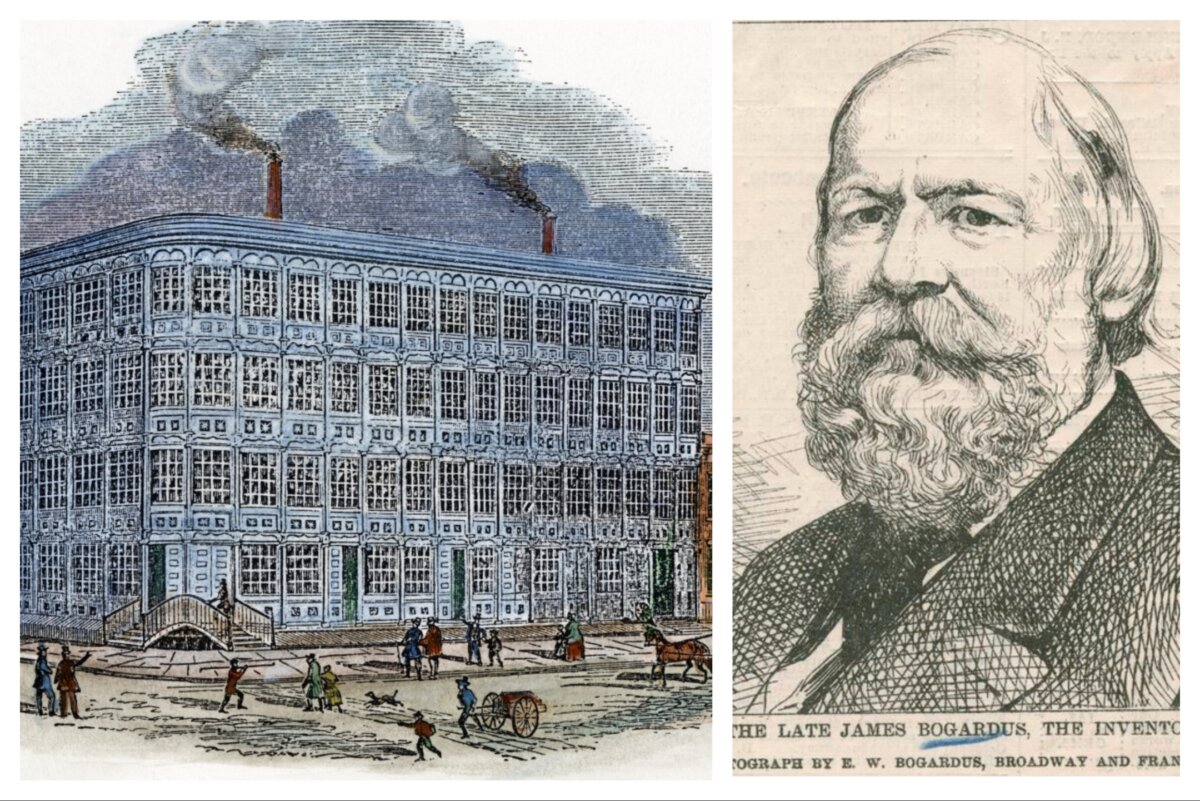
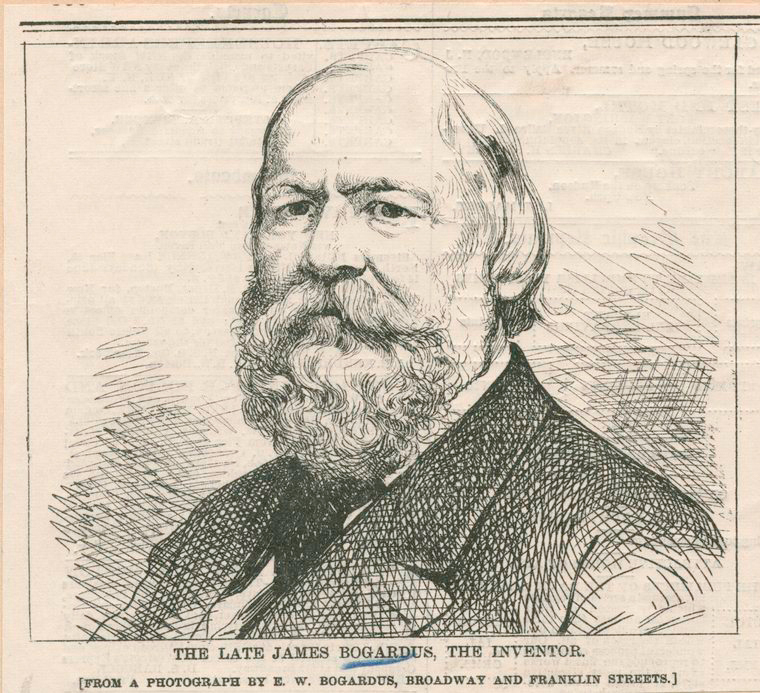
James Bogardus (1800–1874) helped make cast iron a practical option for American commercial buildings. He designed iron facades and structural components that could be cast in sections and assembled at a construction site. His early New York projects demonstrated how the method could be used for shops and warehouses.
Bogardus was born in Catskill, New York, on March 14, 1800. As a teenager, he learned the watchmaker’s trade before moving south to Savannah and eventually making New York City his base. His inventive work ranged from a dry gas meter and machinery for spinning cotton to an iron grinding mill and specialized engraving equipment for banknote production. Over the course of his career, he secured 13 patents in the United States and one in Britain.
Assembling a Building
In 1836, Bogardus traveled to London to seek a British patent for his gas meter. He remained in Europe for about four years, working as an engraver in London before visiting France and Italy. He studied historic architecture and later recalled conceiving the idea of reproducing architectural facades in cast iron in 1840.
By 1848, his mechanical business had grown enough to warrant a new factory at Centre and Duane streets in Manhattan. Bogardus intended to construct the building entirely of iron. Work on its foundations and frame began in 1848, but he interrupted the project to complete two commercial commissions.
The factory was finished around 1849 and dismantled in 1859 when Duane Street was widened. Bogardus promoted it as the first building made entirely of cast iron in America, perhaps even the world. Historians have questioned that claim: The structure had an iron frame, but its floors reportedly rested on wooden beams.
His first major architectural commission was the Milhau Pharmacy at 183 Broadway, completed in 1848. The five-story building used a cast-iron facade with broad windows for displaying merchandise.
In 1849, Bogardus completed the Edgar Laing Stores at Washington and Murray Streets. The four-story structure housed five stores behind a common iron frontage. Construction began on Feb. 25 and finished about two months later.
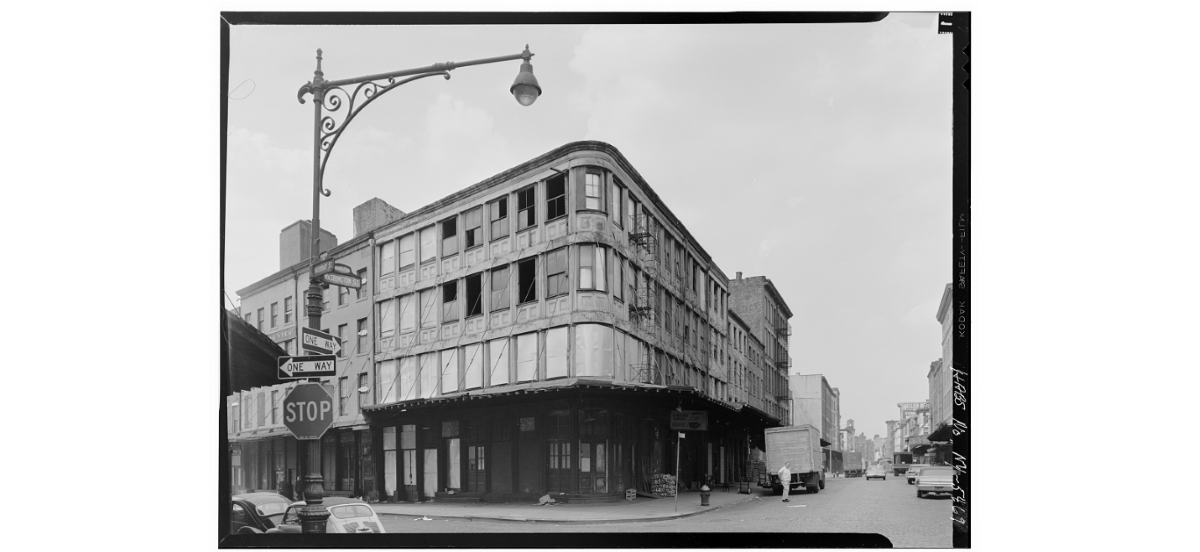
Bogardus contracted New York foundries to cast the components, which were then transported to the site and bolted together. The Laing Stores demonstrated that a substantial commercial frontage could be assembled from manufactured parts instead of being built entirely by traditional masonry methods.
On May 7, 1850, Bogardus received U.S. Patent No. 7,337 for his design of the frame, roof, and floor of iron buildings. The patent documents the construction system he envisioned, although the extent to which he put every feature into practice remains uncertain. The distinction is notable: His surviving buildings and the records of his projects document what he built, while the patent records what he proposed.
Building More Efficiently
Merchants had practical reasons to consider the method. Iron columns could support wider windows than thick masonry piers, giving shops more space for displaying goods. Molds also made it possible to reproduce elaborate decorative details without paying for extensive hand carving in stone. Merchants could give their buildings an elaborate street frontage without commissioning costly masonry ornament.
The work soon extended beyond New York. The five-story Sun Iron Building in Baltimore, completed in 1851 for the newspaper The Baltimore Sun, was designed in collaboration with architect Robert G. Hatfield. Its ironwork came from several firms, including local foundries. The building, which used iron in its frame and exterior, was destroyed in the Baltimore fire of 1904.
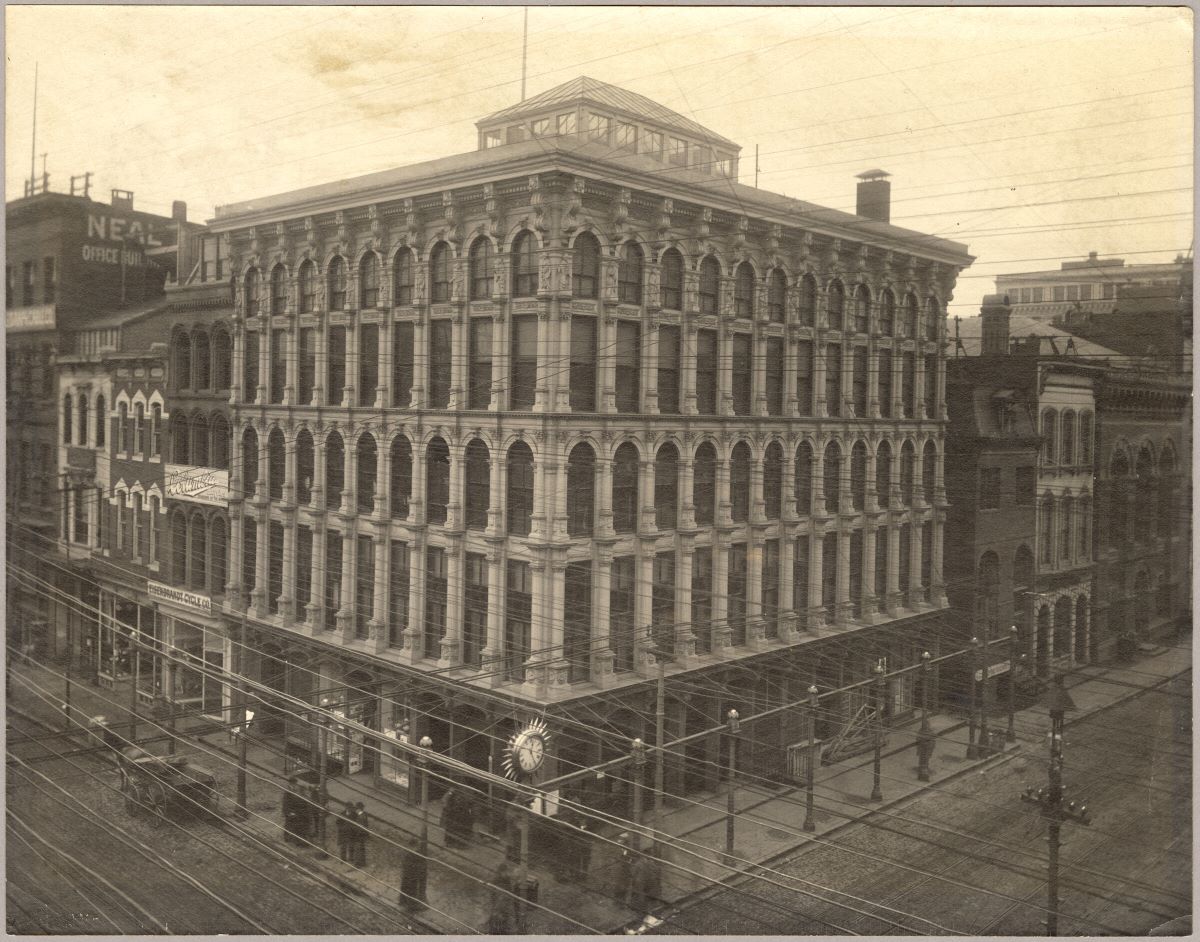
Bogardus also worked with architect Hamilton Hoppin on commercial projects in Washington, including Iron Hall on Pennsylvania Avenue. Their partnership, Bogardus & Hoppin, operated from 1850 to 1854. The commissions show that Bogardus was working beyond Manhattan at a time when iron fronts were gaining wider commercial use.
Other architects and iron manufacturers developed the trade as well. The E.V. Haughwout Building on Broadway, completed in 1857, provides a useful comparison but was not a Bogardus project. John P. Gaynor designed it, and Daniel D. Badger’s Architectural Iron Works supplied its ironwork. The building also had a passenger elevator developed by Elisha Otis.
Cast iron had limitations. It could fracture under certain stresses, and exposed iron posed serious problems during fires. Many buildings combined iron facades with brick walls and timber floors. The degree to which iron supported a building’s weight varied by project; an iron frontage did not necessarily mean that the entire structure had an iron frame.
Bogardus died in New York City on April 13, 1874, aged 74. Most of his early buildings have disappeared, including his experimental factory and the Laing Stores. The latter was dismantled in 1971, but many of its kept pieces were subsequently stolen. Among the surviving New York buildings documented or attributed to Bogardus are the Bruce Building at 254–260 Canal Street and the building at 85 Leonard Street. The city’s preservation records identify only a small number of extant buildings associated with his work.
Bogardus began as a maker of mechanical devices and applied that experience to construction. He arranged for foundries to cast standardized components, then designed ways to assemble them into building facades and, in his proposals, structural frames. The results were not uniform, and some of his most ambitious ideas were never fully realized.
Bogardus did not manufacture the ironwork himself. He depended on outside foundries to cast the parts to his specifications, then coordinated their use in the finished buildings. That arrangement placed him between the designer and the manufacturer, a role that became increasingly important as cast-iron construction developed into a commercial trade.
His record nonetheless shows how an inventor working with foundries and architects helped develop a new method of commercial construction. Indeed, the surviving buildings and the patent drawings offer different kinds of evidence of his work: one records what was built, the other what he believed could be built. His contribution is perhaps best understood through that combination.
What arts and culture topics would you like us to cover? Please email ideas or feedback to features@epochtimes.nyc.