SEARCH


By Peter Larsen
The Orange County Register
ANAHEIM, Calif.—On a desolate highway in the middle of the Mojave Desert, a 50-foot-tall neon sign that reads “Roy’s Motel Cafe” glows in the night sky over Amboy, California.
If the place looks familiar, it’s probably because this spot on an abandoned stretch of historic Route 66 has appeared on some kind of screen—movie theater, TV, cellphone—you were watching.
Films such as “The Hitcher,” “Kalifornia,” and “Beneath the Dark” shot scenes at Roy’s Motel & Cafe, the isolated desert oasis perfect for vampires and serial killers and desperate people on the run.
Commercial directors have shot spots here for Nissan and Honda, and last year, a California tourism commercial included a scene at the Googie-styled cafe on the weather-beaten two-lane highway that fronts it.
Pop star Olivia Rodrigo filmed a performance of her song “Traitors” there for her 2022 documentary “Driving Home 2 U.” Artists such as Enrique Iglesias, Queens of the Stone Age, Armin van Buuren, and LANY have also shot videos there.
As Route 66 celebrates its 100th birthday on Nov. 11, the highway exists in scattered fragments these days; its era as America’s Main Street or the Mother Road long since shattered by the speed and convenience of the interstate highway system.
Thirty-six years ago, I stopped by Roy’s to chat with its owner, Herman “Buster” Burris, who’d worked there with his father-in-law, Roy Crowl, since 1937, and remembered how the tiny crossroads town once teemed with life around the clock.
“This was bumper to bumper,” Burris said, as he stood in the door of the cafe looking out at the desert brush and volcanic cones in the distance. “I did more business in a day than I do in six months now.”
“But when the highway was shut down in ’72, you could have put a gate across that road,” said Burris, who died at 90, in 2000. “There was nothing. Everything went overnight.”
Still, he insisted Amboy, which he owned in full and was trying to sell for $2.5 million in 1990, was “a hot spot,” ready for a resurrection. “It was before, and it’s coming back.”
Hey, if Olivia Rodrigo digs it, maybe he’ll be proven right one of these days. Because in pop culture, Route 66, as it was and as it is, remains eternal in the imagination and the creative works it inspired.
We’ve plucked highlights from a century of getting our kicks on Route 66 in movies, television, music, books, and kitschy Americana. So get your motors running, easy riders, and head out on this pop culture highway now.
Road Stories: Books and Route 66
When John Steinbeck published “The Grapes of Wrath” in 1939, Route 66 had been a highway for 13 years, woven together from county roads, small-town Main Streets, crushed-rock farm roads, and Native American pathways, including a portion of the Cherokee Trail of Tears in Missouri.
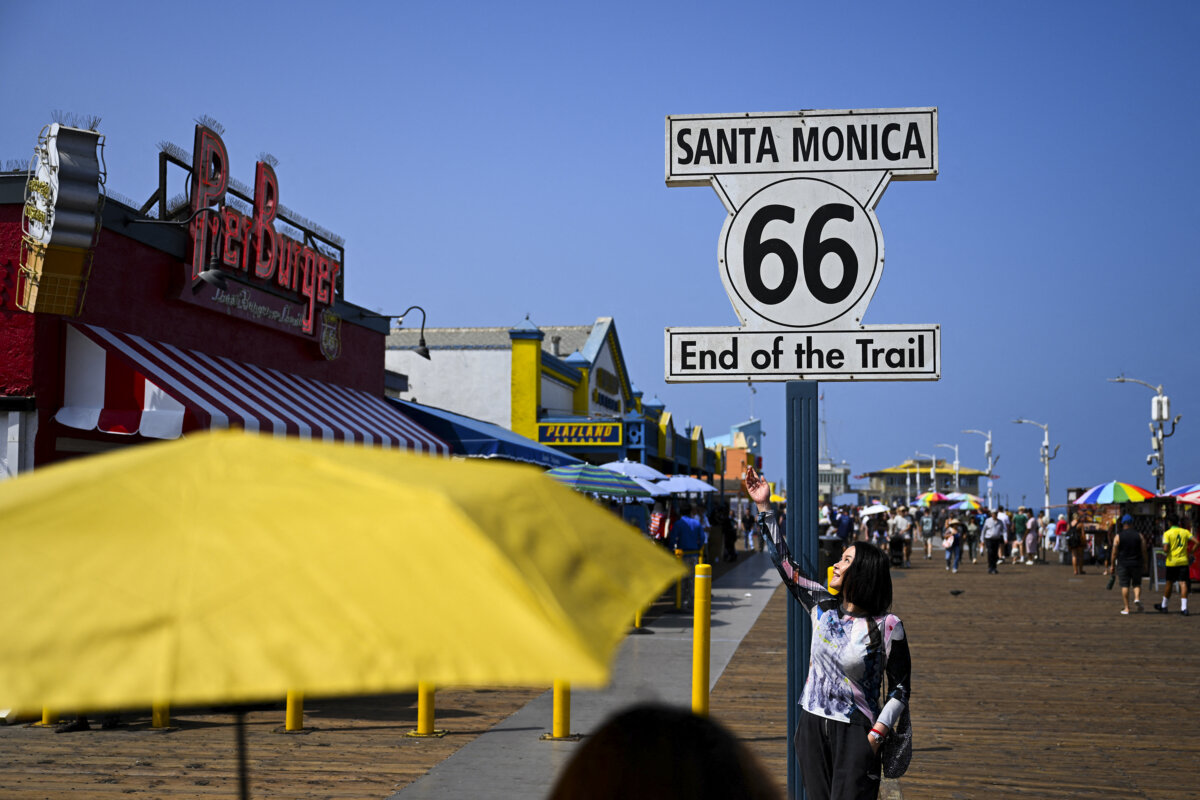
Only a year earlier, in 1938, Route 66 had been paved in its entirety from East Adams Street and Michigan Avenue in Chicago to Seventh Street and Broadway in downtown Los Angeles. Years later, its terminus would be changed to Santa Monica at the base of the pier.
In telling the story of the Joad family, a poor Oklahoma farm family driven from their land by the Dust Bowl to seek a better life in California, Steinbeck helped shape the mythology of Route 66, with the highway at times almost a character of its own.
“Highway 66 is the main migrant road,” Steinbeck wrote in the novel. “66—the long concrete path across the country, waving gently up and down on the map, from the Mississippi to Bakersfield—over the red lands and the gray lands, twisting up into the mountains, crossing the Divide and down into the bright and terrible desert, and across the desert to the mountains again, and into the rich California valleys.
“66 is the path of a people in flight, refugees from dust and shrinking land, from the thunder of tractors and shrinking ownership, from the desert’s slow northward invasion, from the twisting winds that howl up out of Texas, from the floods that bring no richness to the land and steal what little richness is there. From all of these the people are in flight, and they come into 66 from the tributary side roads, from the wagon tracks and the rutted country roads. 66 is the mother road, the road of flight.”
You can see it, right? The highway winding its way through hills and flatlands to the paradise that dreams allow and humans crush? “The Grapes of Wrath” gave Route 66 its name as the “Mother Road” and established in the imagination the idea of the highway as a means of escape from hard times best left behind.
In “On the Road,” Jack Kerouac traveled many highways, not just the one in Steinbeck’s book. In his vision of America, Route 66 was an escape, too, though less an escape from something than to something: freedom, hope, excitement, and discovery.
“I was always surprised, as always, by how easy the act of leaving was, and how good it felt,” Kerouac wrote as the narrator Sal Paradise in his 1957 novel. “The world was suddenly rich with possibility.”
Elsewhere, he saw the open road as many saw Route 66, a path to a new beginning: “Nothing behind me, everything ahead of me, as is ever so on the road.”
Get Your Kicks: Road Songs
Bobby Troup too found freedom and rebirth on the road. After serving in World War II, Troup and his then-wife Cynthia left Pennsylvania on a road trip to Los Angeles in hopes of boosting his already somewhat successful songwriting career.
In a 1985 radio interview, Troup recalled how over dinner at a Howard Johnson’s early in the trip they were looking at a roadmap when the idea of writing a song about the journey arose.
“So we’re driving, and she said, ‘Get your kicks on Route 66,’ and I said, ‘God, that’s a marvelous idea for a song,’” he said.
By the time they reached Los Angeles, Troup had half the song written. Soon after, he played the half-finished song for singer Nat King Cole, who loved it, recorded it with the King Cole Trio, and took it to No. 11 on the pop charts in 1946.
It’s a deceptively simple song that swings with a jazzy melody beneath memorable lyrics.
“If you ever plan to motor west,” the song began. “Travel my way, take the highway that is best / Get your kicks on Route 66!”
And later, after name-checking cities along the route, including Barstow and San Bernardino, the song wraps up with a full-throated endorsement of this adventure of the road.
“Won’t you get hip to this timely tip,” the singer asks. “When you make that California trip? / Get your kicks on Route 66!”
Bing Crosby with the Andrews Sisters covered the song later in 1946, and over time, everyone from Chuck Berry and the Rolling Stones to the Manhattan Transfer and Depeche Mode have had hits with it, too.
Though perhaps only the Rolling Stones played their version live in one of the in-between cities of the lyrics, performing it in June 1964 at the Swing Auditorium in San Bernardino in their first-ever show in the United States.
Folk singer Woody Guthrie wrote at least two songs, “Will Rogers Highway” and “66 Highway Blues,” specifically focused on the kinds of working-class concerns that “The Grapes of Wrath” observed.
“66 Highway Blues” was co-written in 1940 with folk singer Pete Seeger, whom Guthrie had taken under his wing in New York City and invited to drive and hitchhike around the U.S. on his way home to Oklahoma.
“Been on this road for a mighty long time / Ten million men like me,” one verse begins. “You drive us from yo’ town, we ramble around / And got them 66 Highway Blues.”
It came together like a train fixing to head west, according to Guthrie’s colorful introduction in his songbook “Hard Hitting Songs for Hard-Hit People.”
“I had part of this tune in my head, but couldn’t get no front end for it,” he explained. “Pete fixed that up. He furnished the engine, and me the cars, and then we loaded in the words and we whistled out of the yards from New York City to Oklahoma City, and when we got there we took down our banjo and git-fiddle and chugged her off just like you see it here.
“She’s a high-roller, an easy rider, a flat wheel bouncer and tight brake lady with a whiskey driver,” Guthrie finished, and we’re just gonna take his word for that.
There are other, less famous, songs that also drop Route 66 references into the lyrics.
“Cruising down Route 66 / Where the guys and gals used to get their kicks / In the old days,” sings Neil Young in the song “When Worlds Collide.”
“Out on Route 66, way back to the sticks / Out on the old Chisholm Trail,” opens Vince Gill’s “The Old Lucky Diamond Motel,” a song that traces the Lucky Diamond from its heyday to its demolition, a Route 66 story as real as they come. “Just east of El Reno next to Ted’s Escondido / Sat the old Lucky Diamond Motel.”
And then there are songs where the Route 66 is implicitly understood.
The Eagles’ “Take It Easy” famously has its protagonist “a-standin’ on the corner in Winslow, Arizona / With such a fine sight to see / It’s a girl, my lord, in a flatbed Ford / Slowin’ down to take a look at me.”
The girl in the Ford is surely on Route 66, where it passed through Winslow as Second Street, and where today a bronze statue of the unnamed troubadour stands waiting for his sweetheart to return. [The long-haired bronze nearby is a statue of the song’s co-writer Glenn Frey, erected after his 2016 death.]
Finally, Steppenwolf’s “Born To Be Wild” doesn’t mention Route 66 either, but its use under the opening scene of 1969’s “Easy Rider,” as Peter Fonda and Dennis Hopper’s characters ride their choppers through the California desert over the Colorado River and into Arizona, is saying it without saying it out loud.
“Get your motor runnin’ / Head out on the highway,” Steppenwolf singer John Kay sings as the song and the movie begin. “Looking for adventure / In whatever comes our way.”
Lights! Camera! Route 66!
Nelson Riddle’s “Route 66 Theme” might be the second-best-known song with the highway in its title after Bobby Troup’s song. As an instrumental, it literally has nothing to say about the road, but as one of the earliest TV themes to become a hit single, it certainly added to the allure of the Route 66 name.
The crime-adventure TV series “Route 66” is that odd piece of pop culture that isn’t really about anything its title might suggest. Martin Milner and George Maharis star as Tod and Buz, two 20-something friends who decide to head out on the road to explore the United States.
But they almost never mention Route 66 and, after one early episode in Arizona, aren’t explicitly on Route 66 for the rest of the series, venturing off to Maine, down to Florida, up to Toronto, and—well, you get the picture. But as with the theme song, the name helped Route 66 thrive in the public imagination.
“Easy Rider,” meanwhile, was just one of many movies and TV shows that saw Route 66—whether as a new, living highway in the past, or the preserved remnants it is today—a setting for storytelling.
“The Grapes of Wrath” shot scenes of the Joads and other migrants traveling the Mother Road through New Mexico and Arizona, including a scene at the same Colorado River bridge seen in “Easy Rider.”
Sometimes it makes for historical accuracy, as when “The Blues Brothers” opens with a scene shot at the Old Joliet Prison on Route 66 in Joliet, Illinois. John Belushi’s character is literally “Joliet” Jake Blues, and his brother Elwood Blues is there to pick him up after doing three years for armed robbery.
Other times, not so much. The motel in the climactic shootout of “No Country for Old Men” is supposed to be in El Paso, Texas. In reality, the Coen Brothers found the look they wanted at the Desert Sands Motor Hotel on Route 66 in Albuquerque, New Mexico.
“Bagdad Cafe” was shot at a diner in Newberry Springs, California, on the same bypassed section of Route 66 where Roy’s Motel and Cafe is located.
“Starman” shot its stars Jeff Bridges and Karen Allen having pie at the Meteor City Trading Post before their ultimate farewell at the Meteor Crater Natural Landmark just west of Winslow, Arizona.
It’s possible that the cinematic version of Route 66 that the largest number of people have seen doesn’t exist in real life, but rather in the fictional town of Radiator Springs in the Pixar “Cars” universe.
Writer Michael Wallis, who cofounded the non-profit Route 66 Alliance in Tulsa, Oklahoma, is probably the preeminent historian of the highway today. That and his 1990 book, “Route 66: The Mother Road,” brought him to the attention of John Lasseter, then the chief creative officer of Pixar, who invited him to California to talk “Cars,” a world of anthropomorphic vehicles on a fictional version of Route 66.
“He said, ‘We want to do a movie about a race car that needs to learn to slow down sometimes and smell the flowers,” Wallis said in an interview with the Oklahoma Historical Society. ” ‘It’s got to be on your road. You’re the go-to guy for Route 66.’
“So I became their consultant for many years,” he continued. “I took them out on the road and gave them my road. They so got it. If you’ve seen that movie, it’s all about Route 66 and the way we used to travel and the way we travel now.”
In the end, Wallis also became a permanent part of “Cars,” voicing the role of the Sheriff of Radiator Springs as a 1947 Mercury, the likes of which surely tootled down the highway for years in its golden years of the ’40s, ’50s, and ’60s.
Get Weird on Route 66
Pop culture doesn’t have to be a book, a movie, a song. Sometimes it’s as simple as the world’s largest ketchup bottle, which, c’mon, who doesn’t want to see that?
The Brooks Catsup Bottle Water Tower, informally known as the World’s Largest Catsup Bottle, was built in Collinsville, Illinois, near Route 66 in 1949 to supply water to the nearby Brooks Catsup factory. At 70 feet tall, atop a 100-foot platform, it holds 100,000 gallons of water, which Atlas Obscura helpfully calculated equals 640,000 standard-sized bottles of ketchup, er, catsup.
That’s just one of the delightful, weird, unexpected roadside attractions that Route 66 and various oddballs and entrepreneurs provided motorists passing by.
Of those that survive, Cadillac Ranch outside of Amarillo, Texas is likely the best-known. Ten vintage Cadillacs, buried nose first in a row, fins to the sky, bodies covered in spray-painted graffiti? Yeah, that’ll attract folks to your roadside. Add to that Bruce Springsteen’s song “Cadillac Ranch,” and you’ve got a winner.
Route 66 only passes through a 13-mile-long sliver of Kansas, but Galena is well-known in the Route 66 world for its period downtown and restored businesses, including Cars of the Road, a former Kan-O-Tex service station, which is now a tribute to the movie “Cars.” The old red tow truck parked outside was an inspiration for the tow truck Mater in the movies.
Sometimes a person has a vision and if it’s by the highway, people notice. Ed Galloway’s Totem Pole Park in Foyil, Oklahoma, is exactly what you’d think it’d be. The Blue Whale of Catoosa is an 80-foot-long by 20-feet-tall cement and iron whale. It was built in 1970 by a man named Hugh S. Davis for his wife, who loved whales, and when the public couldn’t resist, Davis opened it to everyone.
Not all roadside attractions are kitsch. The Threatt Filling Station on Route 66 at Pottawatomie Road in Luther, Oklahoma, was built in 1915 and was the highway’s first and only Black-owned service station known to be on Route 66. As such, it was listed in the Green Books that helped Black travelers know where they’d be welcome while traveling during the Jim Crow era.
More than 100 years after it was built, the filling station is still owned by the Threatt family, and though it’s not open or functional as a gas station, a restoration of the building has been underway in recent years.
Is roadside architecture pop culture? Sure, drive on into the historic 1946 Munger Moss Motor Court in Lebanon, Missouri, the 1939 Blue Swallow Motel in Tucumcari, New Mexico, or the Wigwam Motels in San Bernardino and Holbrook, Arizona. [There’s actually one other Wigwam Motel still in operation, but Cave City, Kentucky isn’t on Route 66.]
Years ago, on that same trip that I met Buster Burris in Amboy, I also stumbled across Miles Mahan at Hulaville, a now-gone roadside attraction just south of Victorville.
Mahan had lived there since 1953, collecting road debris to make folk art trees out of glass bottles, displaying castoff treasures he’d rescued like the 35-foot-tall metal hula dancer that gave his place its name and a homemade billboard of a bowlegged cowboy who waved howdy to passersby.
On weathered boards he displayed poems he’d written to old hobo friends with names Amboy Fats or Stink Foot Red, or people he’d known from his days as a weight-guesser at the carnival on the Santa Monica Pier, just steps from the western end of Route 66.
When the interstate paved over Route 66 and encroached on his property, Mahan sensed his days were numbered and wrote a poem about how it felt.
“On hi-way ’66’ there’s a little truck stop, where you feel good with a bottle of pop,” it began. “Sit at the counter if there’s empty seats, listen to the truckers telling of their feats.”
But the diner where you were greeted with a smile by a very friendly waitress has changed, the poem continued.
“Truckin’ thru now it looks sad ‘n forlorn, for heavy equipment has the road all torn,” the final stanza read. “This new freeway will never leave a trace, like the inviting aroma from Mina’s place.”
Mahan, who was born in 1896, died in 1997. Within a few months, Hulaville was demolished, replaced by a self-storage facility. Three years later and about 20 miles north, Elmer’s Bottle Tree Ranch, the vision of the late Elmer Long, started a similar kind of folk art attraction that remains open to this day.
Mahan’s hula girl made of sheet metal, the bowlegged cowboy sign that was almost as tall, and many other pieces Mahan’s art were saved by the California Route 66 Museum in Victorville, where you can still see them today.
Miles Mahan, Amboy Fats, and Stink Foot Red would surely be pleased that their contributions to the pop culture of Route 66 live on.
Copyright 2026 MediaNews Group, Inc. Visit ocregister.com. Distributed by Tribune Content Agency, LLC.