SEARCH


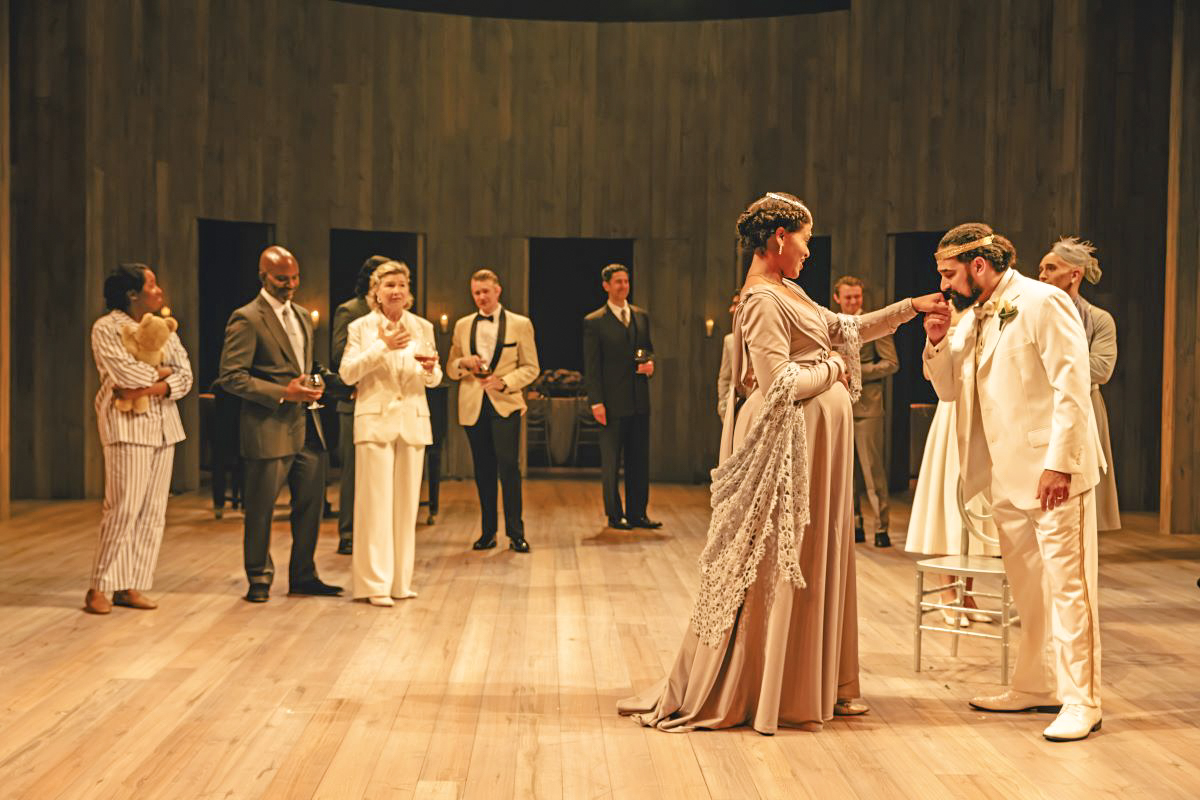
CHICAGO—A first impression of “The Winter’s Tale” seems at odds with Shakespeare’s previous works. It comes across as a fable that differs from his great tragedies, histories, comedies, and romances, which makes it difficult to place in the Shakespearean pantheon.
In their book, “The Winter’s Tale,” published by England’s Royal Shakespeare Company, Shakespearean scholars Jonathan Bate and Eric Rasmussen explain why it differs from his previous plays. The drama was written during the final four years of Shakespeare’s life, between 1608 to 1612, and reflects an older Shakespeare looking back on his life with a mature understanding of complex human emotions.
From Tragedy to Comedy
“The Winter’s Tale” is a challenging work because it switches style from tragic to celebratory, which can be jarring. But there’s more to it than meets the eye. The new staging at the Chicago Shakespeare Theater handles the dichotomy beautifully.
The play begins as a psychological tragedy with King Leontes (Demetrios Troy) accusing his childhood friend, Polixenes (Chiké Johnson), of having an affair with his wife. Leontes’s wife, Queen Hermione (Jessica Dean Turner), is pregnant with his second child, but, in a fit of destructive, paranoid jealously, Leontes falsely accuses her of infidelity. He charges her with adultery, punishable by death, imprisons her, and when a baby girl is born sends her off with Antigonus (Ronald L. Conner) to be abandoned in the forest.
Fast forward 16 years into the second act; King Leontes is filled with remorse. Time is almost a character here. It is used to demonstrate that Leontes has spent every day of those years bemoaning his bloodguilt. The years have caused the jealous monarch to lament his past actions and to feel remorse, but he believes it’s too late to repair the damage to those he loved, as well as to himself.

As in a fairy-tale, Leontes’s tragic decisions are revised in the Act 2. The difference between the two acts is not just important to the show’s meaning and plot but to its atmosphere as well. While the first act was dark and somber, the second features laughter, happiness, and farcical hijinks by clownish Autolycus (Sean Fortunato).
The final scene is the most important. It brings everything into a climactic resolution that allows us to grasp what Shakespeare was trying to accomplish. The passage of time changed King Leontes’s court. In a powerful moment, he repents and reunites with his teenage daughter, Perdita, and, in a stunning fairy-tale climax, the statue of his once-loving wife, Queen Hermione, miraculously comes to life.
“The Winter’s Tale” begins with pain and tragedy but ends joyfully with heartfelt resolution, forgiveness, and redemption.
The Creative Team
Director Edward Hall has done a masterful job trimming the original five-act play to its essentials in two acts. The streamlined play is clearer and more accessible. Throughout the play, Emily Hayman’s sound design ensures that Shakespeare’s dialogue is clearly heard.
Furthermore, the artistic talents have created a palpable atmosphere that clearly delineates the time and place of the two acts. Michael Pavelka’s stark scenic design in the first act provides a setting that fits Act 1, then festoons the second with an uplifting backdrop. And Marcus Doshi’s light design uses dark shadows in the first act but shifts to sunlit shafts of light in the second.
Powerful and illuminating, “The Winter’s Tale” demonstrates that getting older has a way of softening our hearts and teaching us a lot more about life than what we once understood. By the play’s end, we realize that Shakespeare’s play contrasts the insecurity of youth with the wisdom of age. It’s not as perplexing as we once thought.

‘The Winter’s Tale’
Chicago Shakespeare Theater
The Jentes Family Courtyard Theater
800 E. Grand Ave., Chicago, Ill.
Tickets: 312-595-5600 or ChicagoShakes.com
Runs: 2 hours, 35 minutes (one intermission)
Closes: Dec. 12, 2026
What arts and culture topics would you like us to cover? Please email ideas or feedback to features@epochtimes.nyc.