SEARCH


The year was A.D. 523, and Anicius Manlius Severinus Boethius lay stricken, languishing in a prison in Pavia, Italy. Yet this painful situation would give rise to something beautiful. His search for hope in the face of impending execution manifested in a philosophical work that illuminated centuries of thinkers and contained lessons still relevant today.
Boethius held a pivotal place in history. It was a time of upheaval and transition, when Rome had finally succumbed to the barbarians and was ruled by a Gothic king, Theoderic. He has been described as “the last of the Romans, first of the scholastics” by the Renaissance humanist and scholar Lorenzo Valla. That is to say, Boethius formed a bridge between the ancient and medieval worlds.
Much of what the early medieval world knew about Greek philosophers such as Aristotle was due to Boethius’s work. He preserved classical learning at a time when its light was in danger of flickering out and passed on a current of ancient wisdom to medieval thinkers, who in turn adapted it to the Christian faith.
Boethius’s celebrated work “The Consolation of Philosophy” influenced Western philosophy and literature in immeasurable ways. Its strains were picked up by Dante, Chaucer, Aquinas, and other Medieval luminaries, as well as later figures such as Shakespeare and George Herbert. In short, it formed a cornerstone of Western thought.
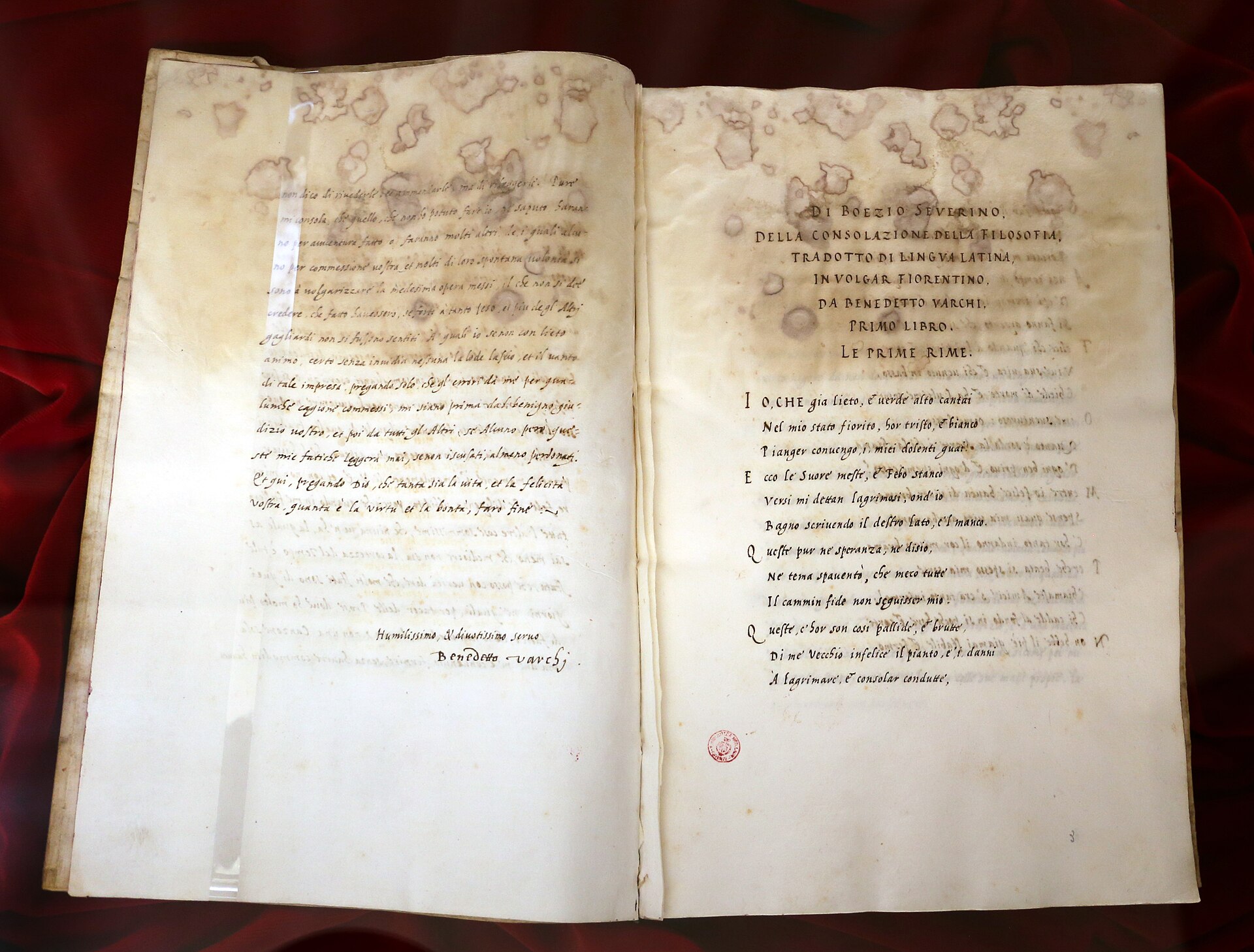 Pages from a 1550–1551 copy of the “Consolation of Philosophy” by Boethius. (Sailko/CC BY 3.0)
Boethius composed the work in prison, due to trumped-up charges of treason, while awaiting torture and execution at the hands of Theoderic. Theoderic was the Ostrogothic ruler of Italy, who came to power after overthrowing the Germanic leader Odoacer, who, in turn, had deposed the last Western Roman emperor, Romulus Augustulus, in A.D. 476. While he appreciated some aspects of Roman culture, Theoderic was no Roman. He grew paranoid that aristocrats of the old guard—like Boethius—would conspire with the Eastern Roman Emperors to overthrow him.
Boethius soon found himself in prison, wrestling with the reality of what had happened to him, and his sudden reversal of fortune. He had been a senator, a consul, and then an advisor to Theoderic himself. Without the reference materials, he turned to his old acquaintance, Lady Philosophy, for guidance and comfort.
“The Consolation” takes the form of an imagined dialogue between himself and Lady Philosophy, who comes to enlighten and encourage him. She reassures him of the value of virtue, reason, and philosophy even in the face of injustice and misfortune and directs his eyes toward true happiness instead of its transitory imitations.
Stripped of his rank, riches, and freedom, Boethius had to ask hard questions about the meaning of life and its seeming injustices. He tackled those questions head-on.
The Transience of Riches, Pleasure, and Honor
One of Boethius’s first conclusions was that the loss of riches, pleasures, or honors shouldn’t impact a person’s happiness too much since true happiness doesn’t consist of these things.
Lady Philosophy admonishes him, “O mortals, why do you seek outside yourselves for the happiness that has been placed within you?” For Boethius (in the voice of Lady Philosophy), happiness was more internal than external. It was something permanent, stable, and non-contingent, so it could not reside primarily in external goods—like money or beauty—that come and go with the spinning of Fortune’s wheel.
“Blessedness does not rest in the things of Fortune,” Lady Philosophy insists. She asks rhetorically, “Must you seek your good in things that are external and not your own? Is your condition such that you, an animal made godlike by your reason, think you can gain glory only through the possession of lifeless objects?” The brevity of glory, the tenuousness of riches—these things can’t form the heart of human happiness. So, when they’re gone, they shouldn’t grieve one too much.
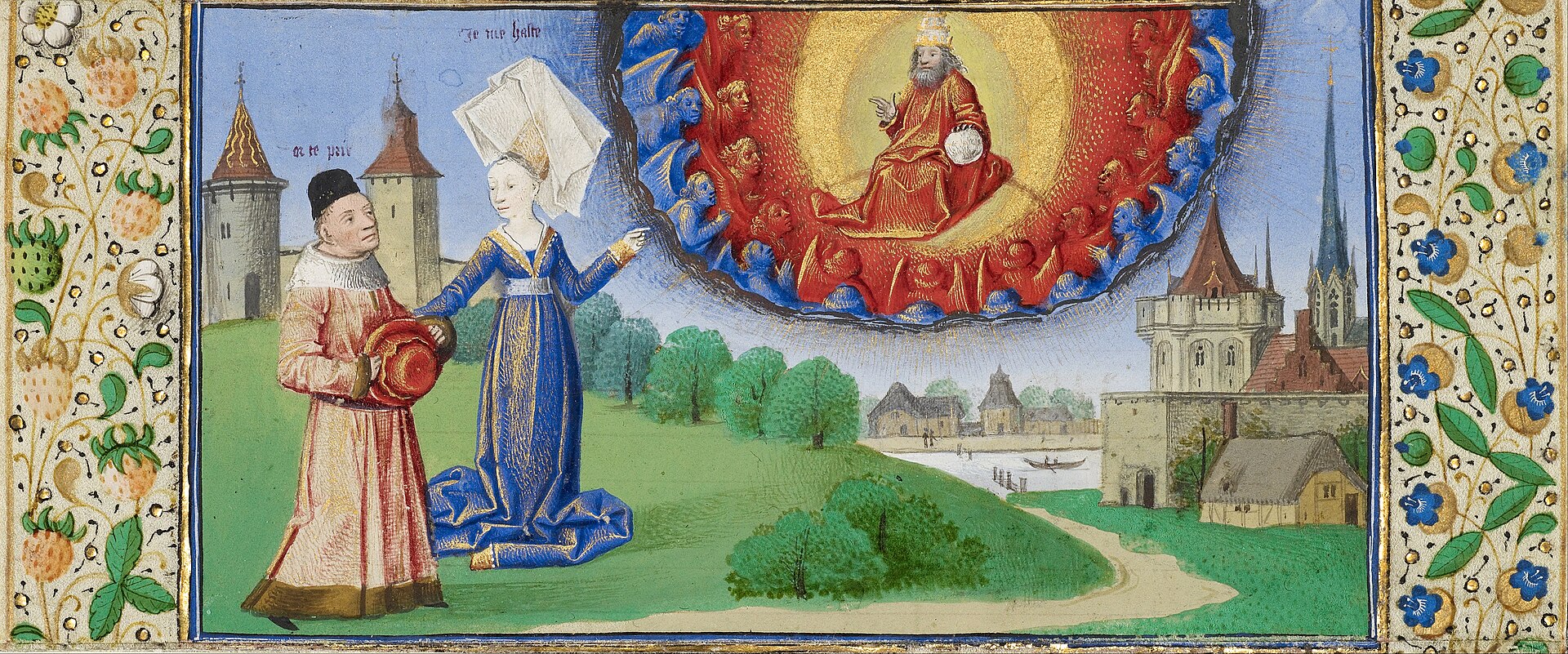 “Philosophy Instructing Boethius on the Role of God,” by Master Henri de Vulcop, circa 1460–1470. From “Consolation of Philosophy” by Boethius. (Public Domain)
Similarly, bodily pleasure cannot bring us lasting joy. “And what should I say about the pleasures of the body, when the appetite for them is full of anxiety and their fulfillment brings regret?” Lady Philosophy asks. “If bodily pleasures could make men become blessed, there is no reason why we shouldn’t call cattle blessed.” For Boethius, then, human beings are meant for a higher kind of joy and happiness than the merely physical pleasure pursued by animals.
Lasting Happiness
For Boethius—much like Aristotle before him—true happiness had to do with interior possessions, something grasped by the soul, which no misfortune had the power of tearing away from him. As Lady Philosophy says, “I’ll show you briefly the foundation of the greatest happiness. Is anything more precious to you than you are to yourself? … If you’re in control of yourself, you will possess what you would never wish to lose and what Fortune can’t take away from you.”
The echoes of Aristotle—whom Boethius had studied—are loud. For instance, Aristotle argued in Book I of “Nicomachean Ethics” that the activities of the soul—not the good or bad luck of one’s situation—give life its most fundamental character. “If activities are, as we said, what gives life its character, no happy man can become miserable; for he will never do the acts that are hateful and mean,” Aristotle said. The ability to continue acting virtuously, to rise above hard luck, remains with us no matter what circumstances we find ourselves in. Aristotle continued: “For the man who is truly good and wise, we think, bears all the chances [of] life becomingly and always makes the best of circumstances. … And if this is the case, the happy man can never become miserable.”
 A marble bust of Aristotle copied by a Roman after a Greek version by Lysippos in 330 B.C. (PD-US)
Think of the prisoner of war who still sacrifices for others, is courageous, holds on to his principles, and even loves his enemies despite the suffering and mistreatment. Interiorly, he remains free no matter what shackles are placed on him exteriorly. No one can take away his commitment to virtue.
A similar idea was expressed by a much more recent philosopher, the psychologist and WWII concentration camp survivor Viktor Frankl. He, too, wrote about the joy and meaning that lies in our freedom to choose a positive attitude regardless of our situation. In “The Unconscious God,” he wrote, “Caught in a hopeless situation as its helpless victim, facing a fate that cannot be changed, man still may turn his predicament into an achievement and accomplishment at the human level. He thus may bear witness to the human potential at its best, which is to turn tragedy into triumph.”
Good Wins in the End
It’s in this way that the good person, even in dire straits, retains a power that evil can’t quench. “The good are always powerful and the wicked always abject and helpless,” Boethius’s Lady Philosophy boldly claims. “Vices are never without punishment or virtues without reward, and … happiness always falls to good men and misfortune to evil ones.”
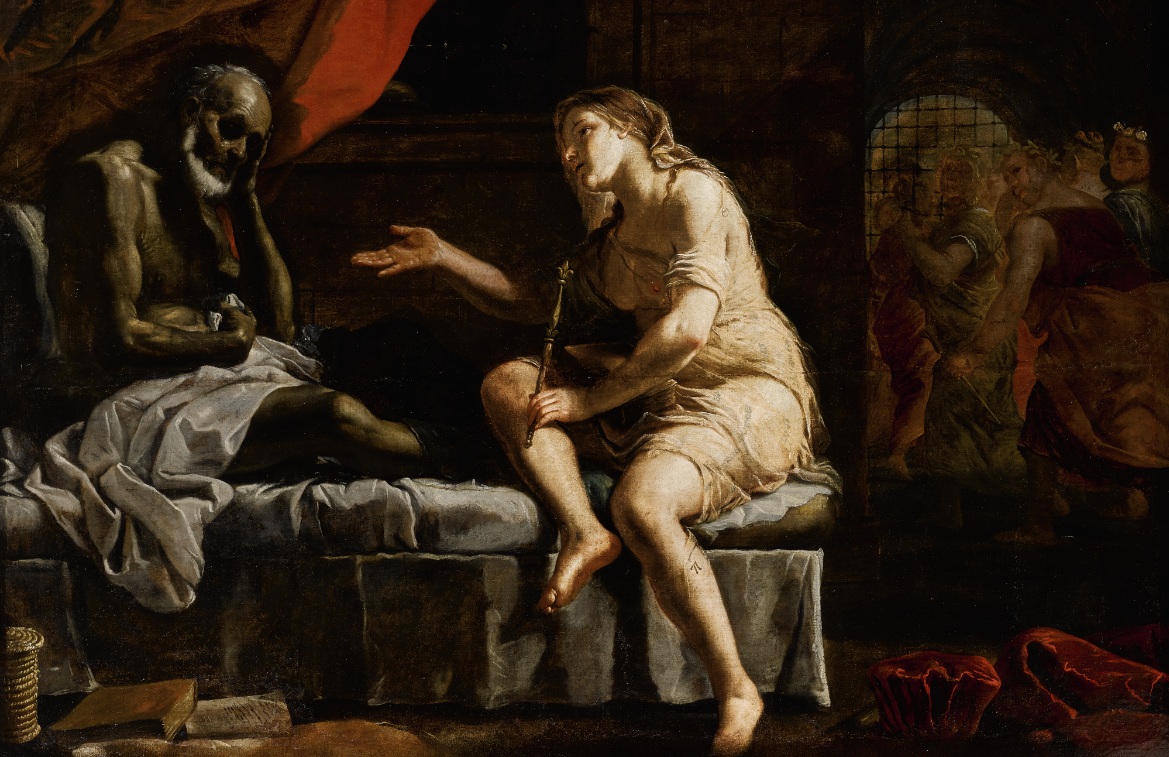 “Boethius and Philosophy,” 1680, by Mattia Preti. (Public Domain)
She then constructs an argument to prove this point. If someone is unable to achieve what they aim at, that’s weakness, whereas if they gain what they aim for, that’s power. Whatever one pursues, it is because one sees some goodness in it. But the wicked mistakenly think they can find it through selfish desires and evil actions. In reality, however, the wicked fail to achieve goodness because it can only be reached through truly good and virtuous actions. Lady Philosophy concludes: “Since both [the good and the evil] seek the Good, but good men acquire it and evil men don’t, we can hardly doubt that good men are powerful and evil ones are weak.”
True goodness is an interior possession, which people acquire through good desires and actions, and that interior goodness cannot be lost against our will, irrespective of how viciously the winds of chance or the malice of others tries to blow it away.
Boethius found profound consolation in this realization that through loving the Good, he was wealthy even when in poverty, and free even when in chains. Centuries of readers since his time have found consolation in his reflections. There’s no reason that consolation can’t also be ours.
What arts and culture topics would you like us to cover? Please email ideas or feedback to features@epochtimes.nyc