SEARCH


Can sound move stones?
To the modern mind, the question seems absurd. Sound may shatter glass; sufficiently powerful vibrations can affect physical objects; but nobody seriously expects a musician to pick up a lyre, strike a chord, and watch blocks of masonry obediently rise into walls. Yet our ancestors repeatedly imagined something very like this. Across myth, legend, and sacred history, sound possesses a strange authority over matter. Music moves stones. Words create worlds. Trumpets bring walls down. And, perhaps most intriguingly, some of the world’s most mysterious ancient monuments have remarkable acoustic properties.
What did our ancestors think they knew about sound?
One of the most striking examples comes from Greek mythology: Amphion, son of Zeus and Antiope, was the legendary builder of the walls of Thebes. His brother Zethus carried stones through physical strength; Amphion had another method. He played his lyre and the stones followed the music. As Amphion played, the great blocks moved into position of their own accord and formed the city’s fortifications.
It’s a beautiful image, but also a profound one. Civilization itself is being created through harmony. The musician does not force matter into shape; rather, matter responds to an ordering principle embodied in music.
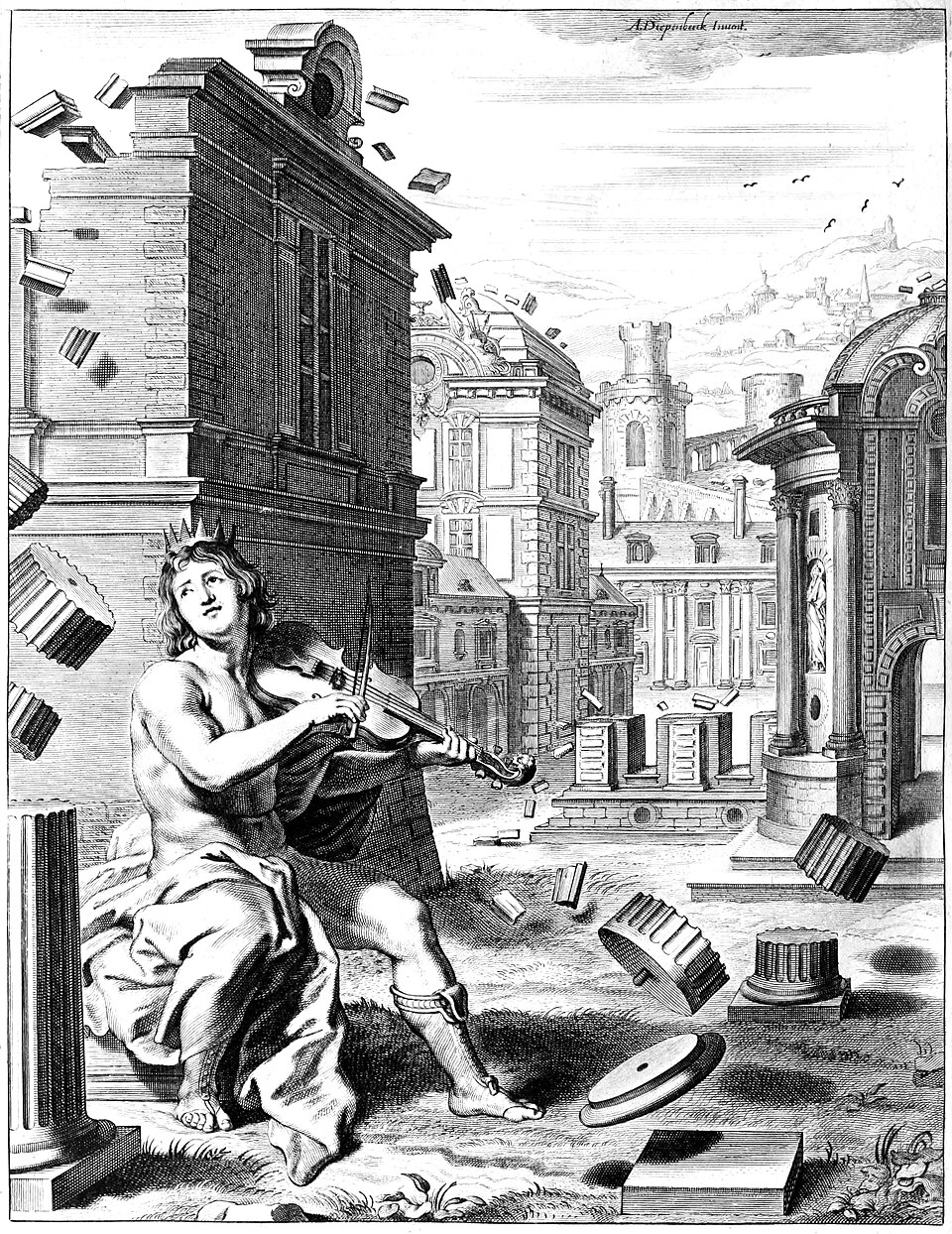 A 1665 illustration depicting of Amphion, whose music moves stones to build Thebes. (Public Domain)
We find a closely related tradition at Troy. Apollo and Poseidon were said to have served King Laomedon and to have been involved in the construction of Troy’s magnificent walls. Later traditions developed the story further, associating Apollo’s music with the miraculous raising of the stones. Once again, music and masonry mysteriously converge.
This ancient tradition inspired a poem of mine, “Apollo Builds Troy With His Lyre,” which was published by the Society of Classical Poets. I imagined the god playing while the city materializes before him: “The wall that rose visible each note he played:/ Coming into being that which was not –/ The whole of Troy… ”
But Apollo is not merely a god of music. He is also a god of prophecy. Thus the divine builder who sees Troy rising can also see beyond its completion toward its destruction. That paradox—sound building and sound destroying—takes us somewhere unexpected.
In the Old Testament Book of Joshua, the Israelites confront the apparently impregnable city of Jericho. Yet no conventional siege engine breaches its defenses. For six days the Israelites circle the city. On the seventh, priests blow their trumpets, the people shout, and the walls fall.
Whether one reads this primarily as sacred history, miracle, mythic narrative, or some combination of these, the imaginative pattern is extraordinary. At Thebes, music raises walls; at Jericho, sound brings them down. Sound appears to command stone.
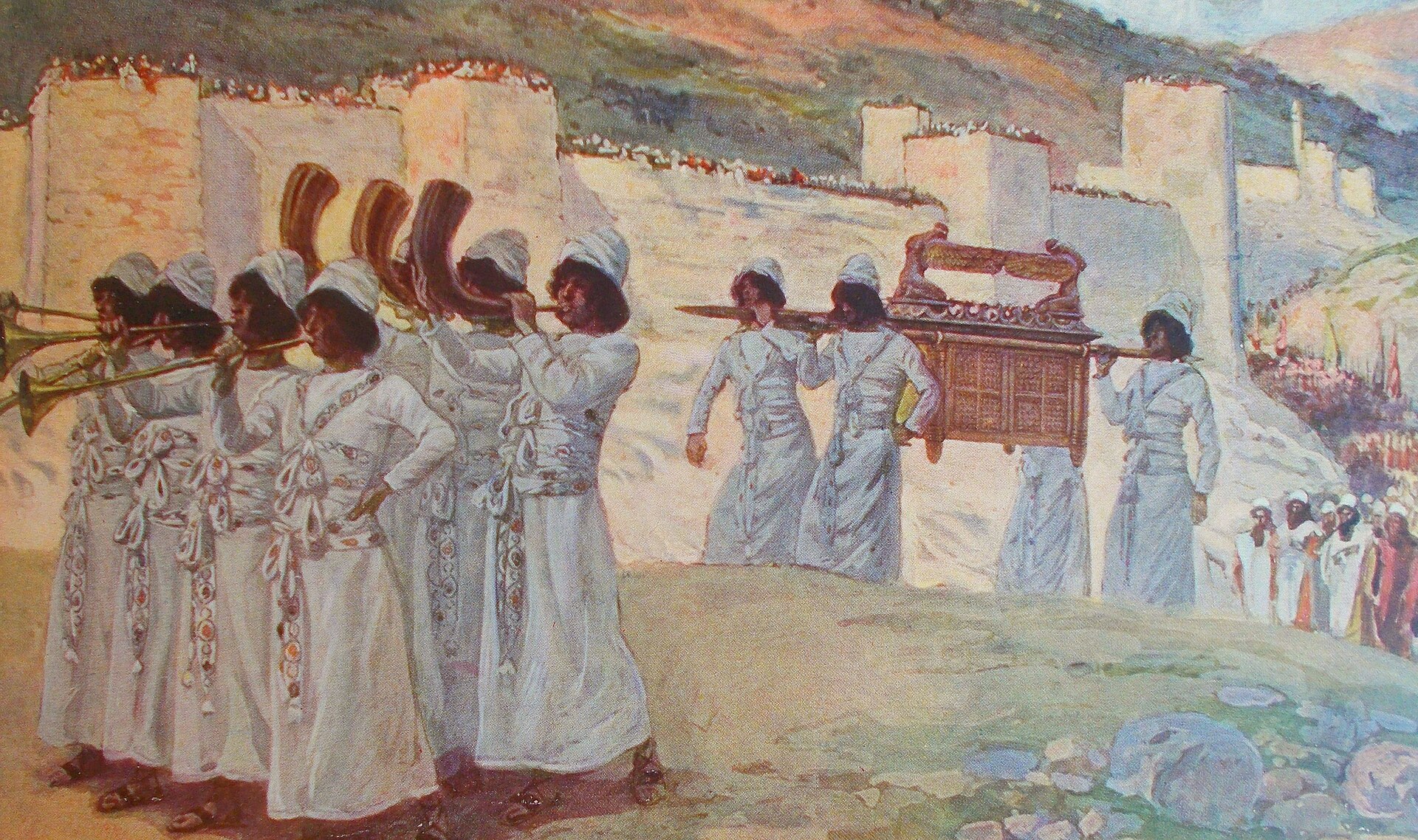 “The Trumpets of Jericho,” 1904, based on the sketches of James Tissot. (Philip Medhurst/CC BY-SA 4.0)
A Scientific Connection
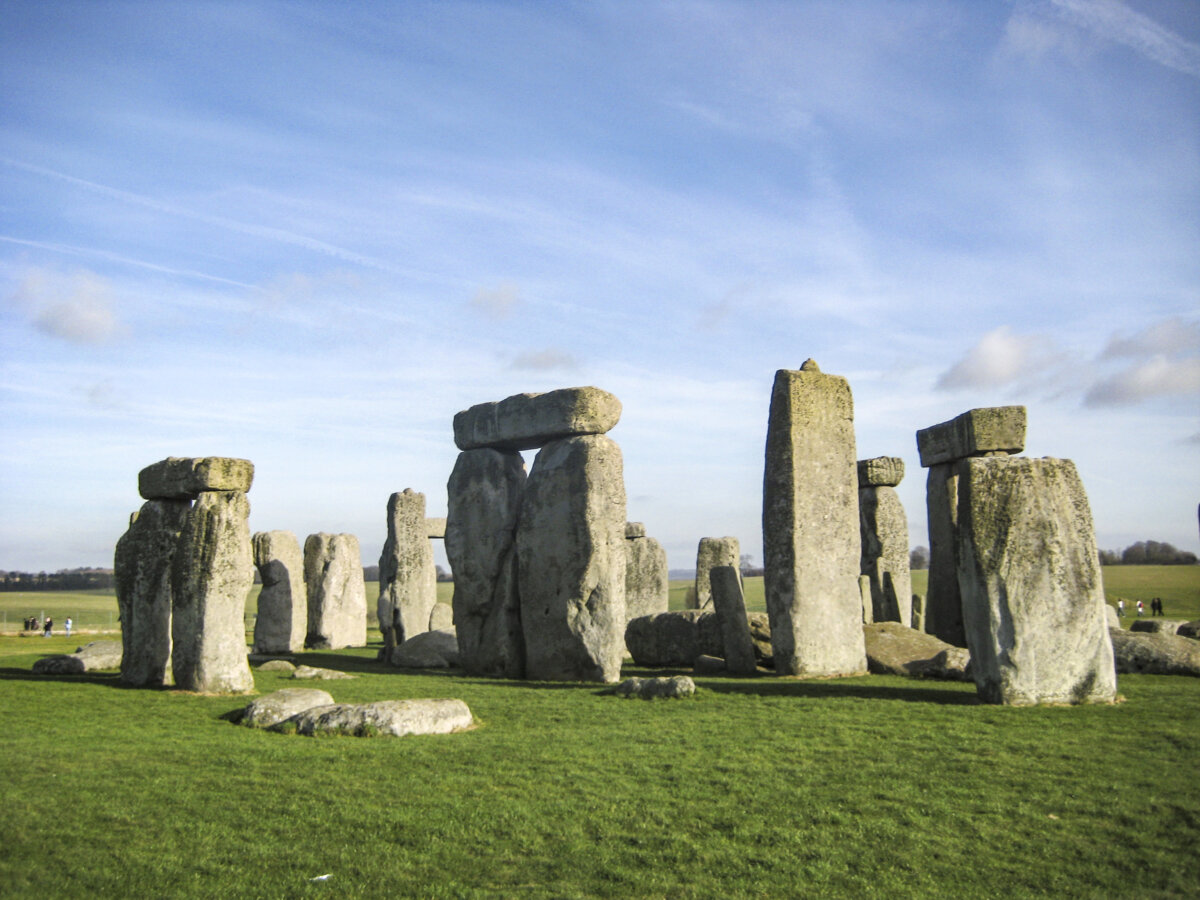
Perhaps these stories are merely products of the human imagination. But an intriguing modern field of research—archaeoacoustics, the study of sound within ancient sites—complicates the picture. Consider Stonehenge.
Modern acoustic investigations, including experiments with a 1:12 scale model of Stonehenge, suggest that the completed stone circle would have produced noticeable reverberation. Sounds generated within the monument acquired a resonance absent from the surrounding open landscape: the researchers measured a reverberation time of about 0.64 seconds and an amplification of speech of approximately 4.3 decibels. Speech, chanting, drumming or music performed inside the circle could therefore have created an unusually powerful auditory experience.
This does not prove that Stonehenge was designed as a gigantic musical amplifier, still less that sound somehow moved its stones into position. We should resist the temptation to convert suggestive evidence into sensational claims.
But imagine entering such a place four thousand years ago: There are no engines, loudspeakers, recorded music or electronic amplifiers. Most of your life is spent beneath an open sky, where sound rapidly dissipates. Then you enter an enormous circle of standing stones. A chant begins. A drum sounds. Voices rise together—and suddenly the stones themselves seem to return the sound.
Would you experience that merely as an interesting acoustic effect? Or would the stones seem alive?
The ancient imagination certainly did not draw our sharp distinction between animate and inanimate nature. Orpheus, perhaps the greatest musician in Greek mythology, could charm animals, trees and even rocks with his music. His song penetrated Hades itself and moved the rulers of the dead. Again, the symbolism is clear: True harmony reaches places brute force cannot.
Here we approach an idea still more fundamental than musical architecture. The ancient Greeks used the term “logos,” a word encompassing speech and reason; it’s the principle by which things become intelligible and ordered. Centuries after Amphion and Apollo, the opening of John’s Gospel made one of the most astonishing claims in Western thought: “In the beginning was the Word.”
But John is deliberately echoing an older beginning. The first chapter of Genesis does not depict God laboring like a human craftsman to manufacture the universe. Creation occurs through utterance: “And God said, Let there be light: and there was light.”
God speaks. Reality obeys. There’s is also something curious, almost counterintuitive, in the order: Before there is light to be seen, there is the Word to be heard. In a strange way, this reflects our own earliest human experience. In the darkness of the womb, before we see the world, we encounter it through sound—the rhythm of the mother’s heartbeat and the resonance of her voice.
So, we have moved beyond the lyre of Amphion. Sound does not merely move existing stones into walls; the divine Word calls into existence that which previously was not.
This ancient association between sound, order, and creation may also help explain why music has so often been regarded as more than entertainment. Pythagorean tradition imagined cosmic order itself in musical terms—the famous “music of the spheres.” Harmony was not simply something pleasing to the ear; it reflected the mathematical proportions underlying reality.
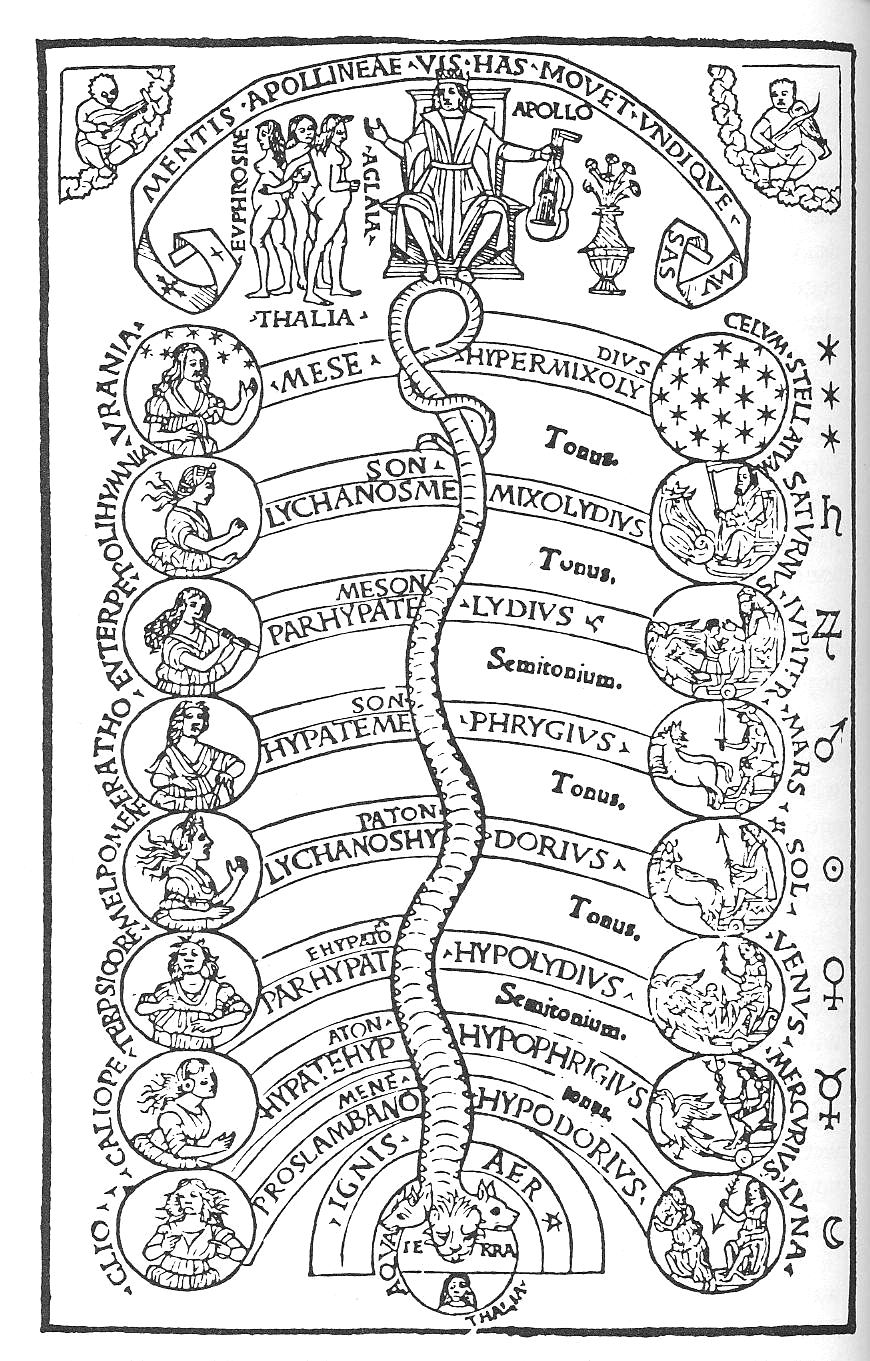 A Renaissance Italy engraving of the music of the spheres, by Guillaume Le Signerre (Public Domain)
To make music, then, was in some sense to imitate cosmic order. Nor is it irrelevant that, etymologically, a poet is a “maker”: the Greek “poietes” derives from “poiein,” “to make” or “create.” Poetry itself is thus linguistically rooted in the idea of making something that did not exist before.
That may be why the opposite possibility is so disturbing. If harmonious sound represents creation and order, dissonance may suggest dissolution and decay.
When I wrote “Apollo Builds Troy With His Lyre,” I introduced a deliberately modern shadow into the ancient story. Apollo watches towers rise almost instantaneously: “How long? 9, 11 minutes tops? Who’s sure?”
The allusion is to Sept. 11, 2001, and to towers that not only rose but ultimately fell. At the poem’s end Apollo’s prophetic vision momentarily overwhelms his satisfaction in creation, and a single tear falls. The god who can build knows built things can also be destroyed.
Perhaps that is why these ancient stories still speak to us. Civilization itself is a kind of building. It requires order, proportion, and harmony. It takes generations to build and sometimes astonishingly little time to destroy.
 The 9/11 Memorial Fountain. (Dreamstime/TNS)
Amphion plays, and the stones assemble; the trumpets sound at Jericho, and the stones fall.
Between those two images lies one of humanity’s oldest intuitions: The world is not shaped by matter and force alone. Words, music, meaning, and harmony have consequences.
Perhaps that is the ancient wisdom we have forgotten: Before the stones rise or fall, there is the word, the music, the idea—the invisible order that makes or unmakes the world we inhabit.
What arts and culture topics would you like us to cover? Please email ideas or feedback to features@epochtimes.nyc.