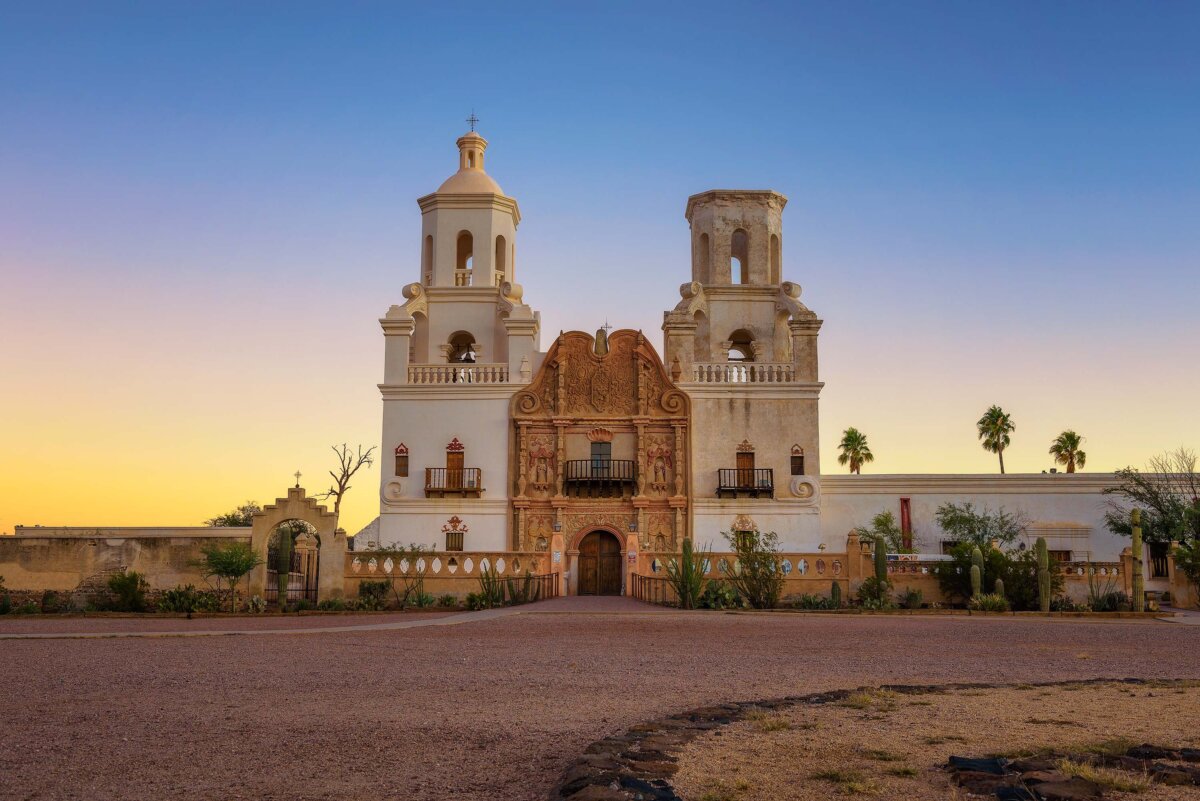
Construction of the San Xavier del Bac Mission by the Franciscans spanned 1783-1797. The church’s Spanish baroque style is dramatically on display in this approach view. It features two white stucco towers—one not completed, missing its tower roof and cross—and the heavily carved scrollwork retablo façade surrounding the main door. Retablo treatments are most often found around church sanctuary altars, as is the case inside the mission church as well. (Nick Fox/Shutterstock)
Gleaming white in the sun-baked Sonoran Desert of southern Arizona, the church has been an expansive Catholic mission for more than two centuries. Typical of western U.S. territories first inhabited by Spanish settlers and explorers, San Xavier del Bac Mission presents Spanish baroque architecture.
Spanish mission architecture is defined by factors such as arched windows and doorways, stucco or plaster facades, and lengthy arcades. Baroque style’s characteristics include grand scale, ostentatious ornamentation, curvaceous forms, obvious contrast between light and dark, and the use of domes and towers. All the elements mentioned are incorporated in the architectural design of San Xavier del Bac Mission.
While most mission churches in America’s southwestern and western states exhibit Spanish architecture, San Xavier del Bac Mission’s baroque qualities elevate it to a grander scale. It was made large and elaborately apportioned to communicate a statement in the 1700s that Arizona was part of New Spain.
Additionally, the structure is considered an inimitable representation of the Spanish mission because much of the design is asymmetrical. And, the interior of San Xavier del Bac Mission includes at least 183 angels.
Because of its unique and impressive architectural and design, San Xavier del Bac Mission attracts around 200,000 visitors annually. Besides its visual appeal, its historical significance is that it remains the oldest intact European structure in Arizona and, thus, achieved status as a National Historic Landmark in 1960 and was listed on the National Register of Historic Places in 1966.
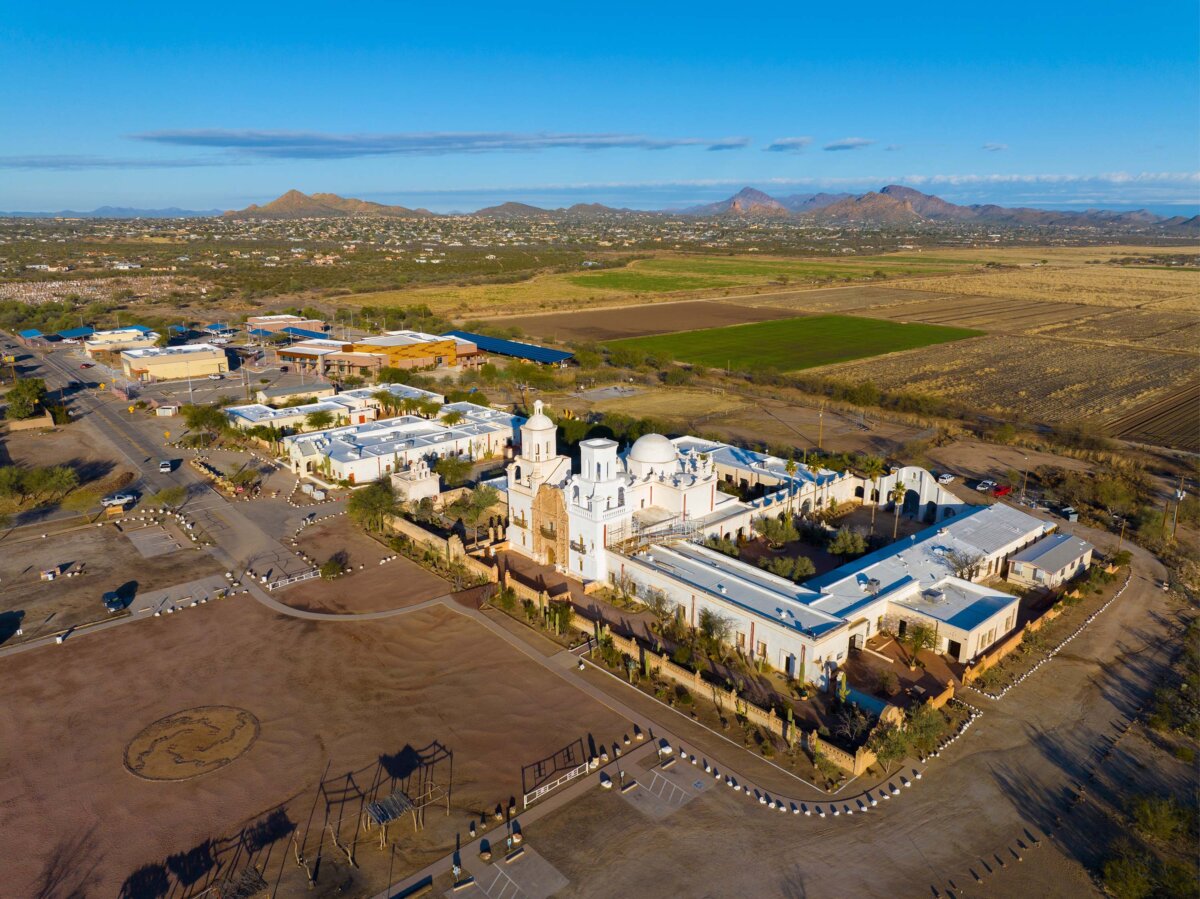
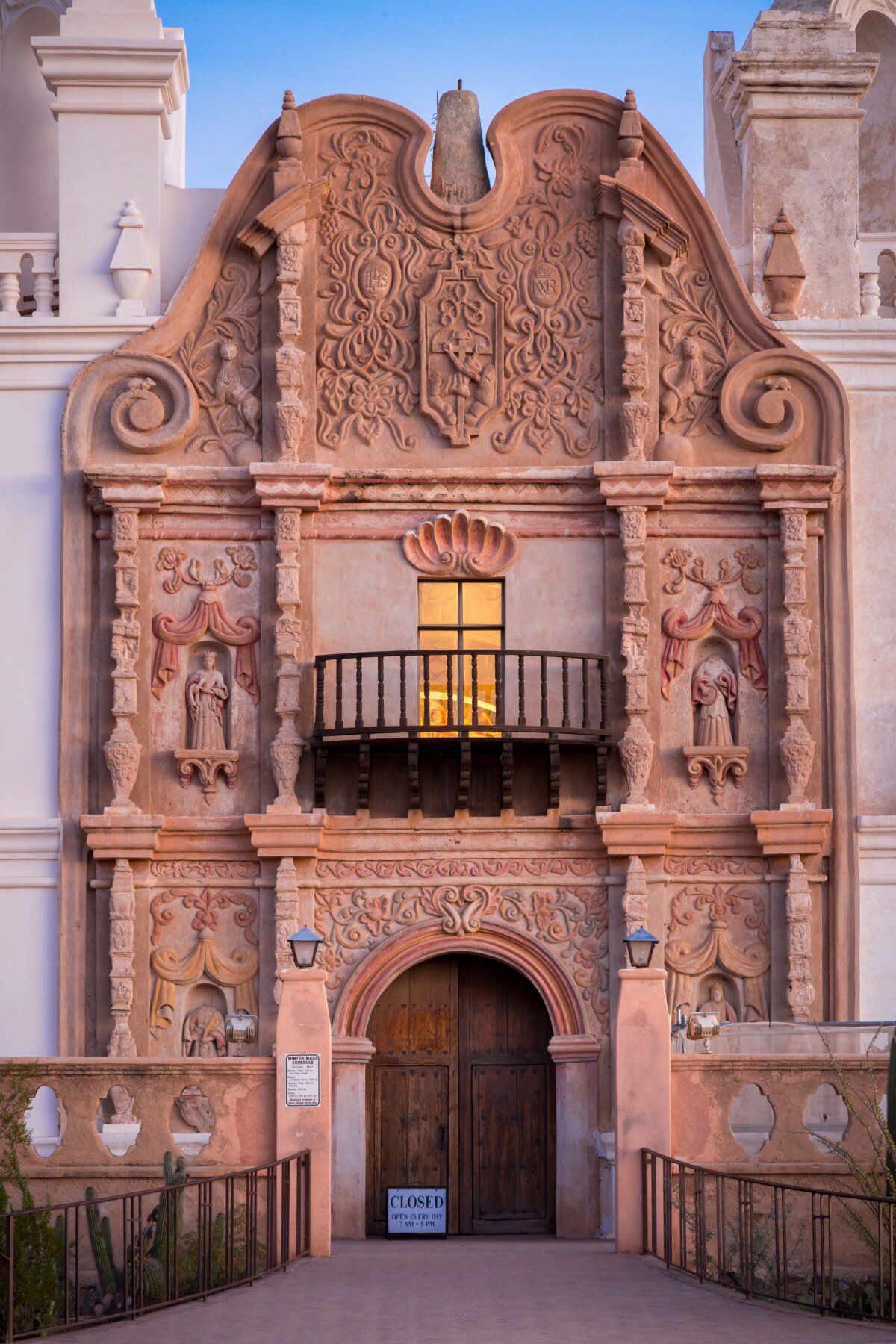
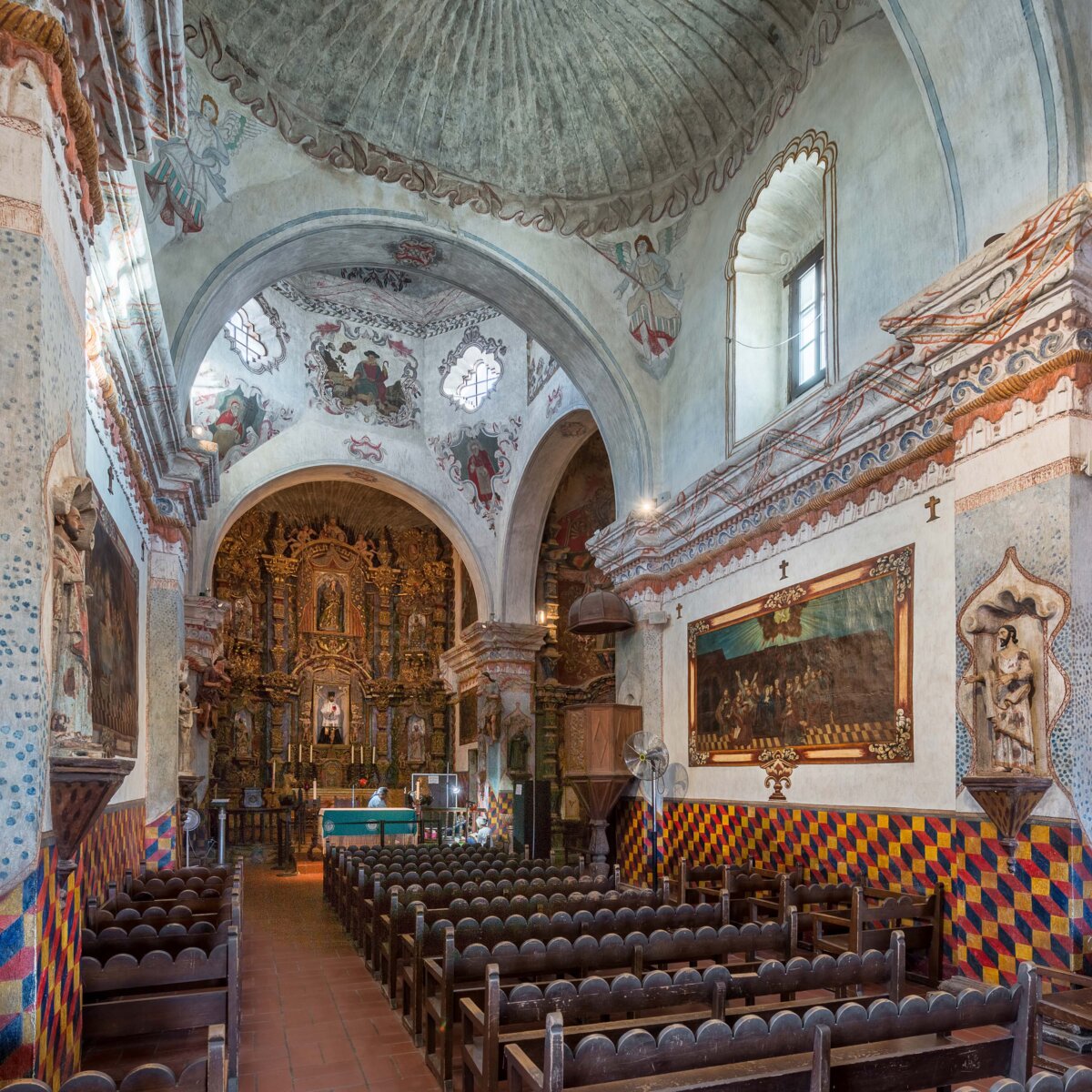
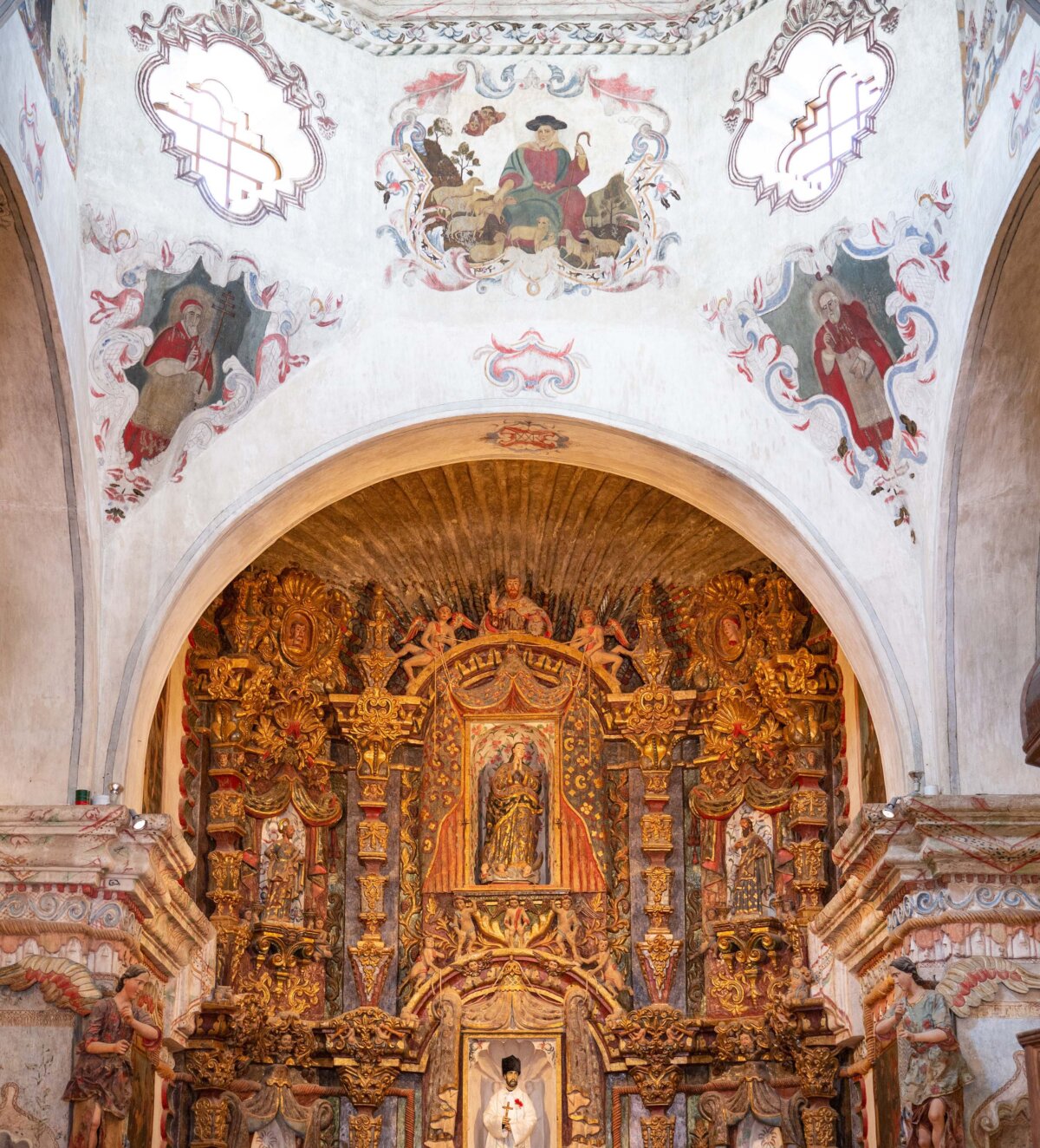
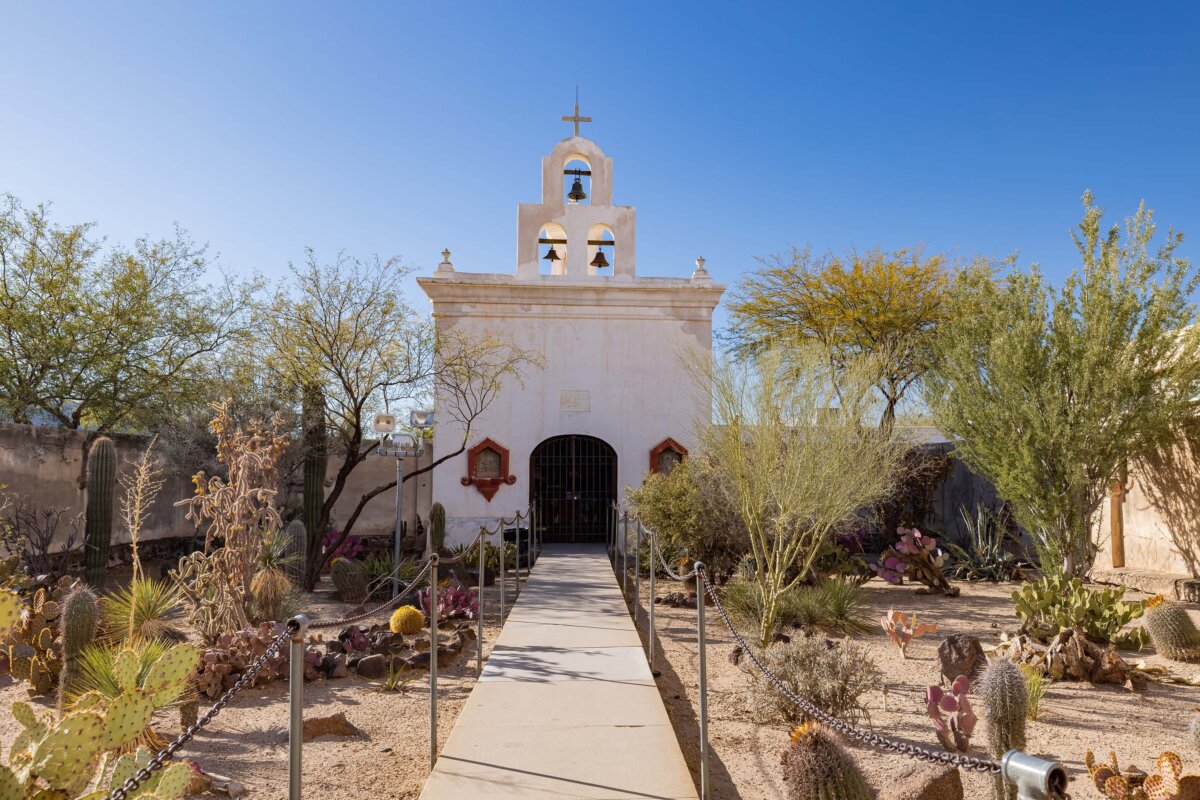
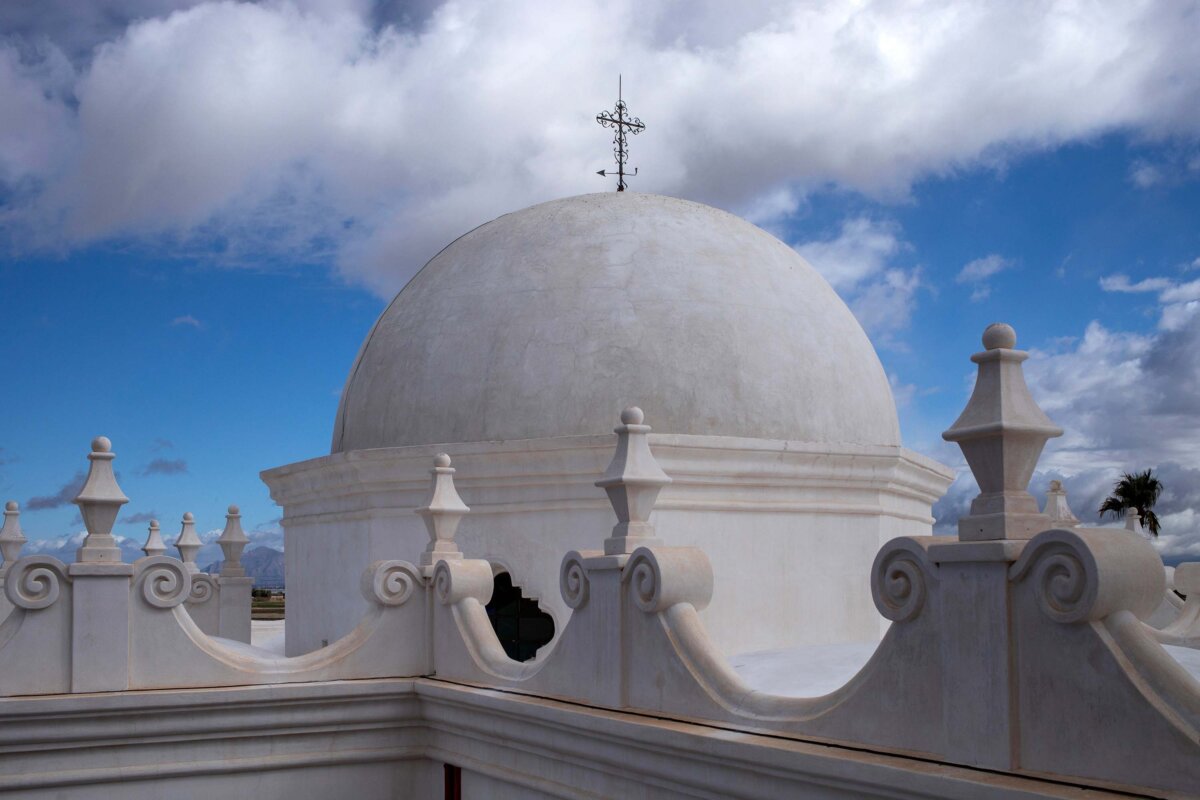
The expanse of white stucco buildings, contrasting the monochromatic desert, gives the historic San Xavier del Bac Mission compound a presence often described as “ethereal majesty.” In this aerial view, the church’s two main towers and dome are most prominent among the other structures. San Xavier del Bac Mission was constructed of low-fire clay brick, stone, and lime mortar. (Wangkun Jia/Shutterstock) Visitors entering through the massive, carved mesquite-wood doors, surrounded by an elaborate, carved stucco retablo façade, are understandably awed. Arching over the doorway and rising more than two stories, the art work showcases scrollwork, Moorish columns, a shell pediment over a window, swags, floral designs, and statuary. (Jonathan Manjeot/Shutterstock) The nave of the San Xavier del Bac Mission church is filled with rows of carved-wood, scalloped pews. On the walls below the wide stone arches are a colorful, geometric treatment called tessellation. (gnagel/Getty Images) The sanctuary and west transept altar are the main church stunners. Vaulted white ceilings are festooned with vibrant frescoes of saints. The multi-paneled retablo rises behind the altar and under the arch, supported by wide columns bedecked with layered capitals and protruding three-quarter relief, gold-leaf angel sculptures. The retablo is decorated with a multitude of ecclesiastical images and symbols. (Traveller70/Shutterstock) On the west side of the San Xavier del Bac Mission church is a chapel and garden. Topping the garden wall is a campanario, a Spanish mission feature displaying three bells within arches and a cross. It rests on the wall’s entablature. Visible on two corners atop the entablature are finials in the shape of crosses. Inside the sandy garden are cacti and plants native to the Arizona desert landscape. (Kit Leong/Shutterstock) A 52-foot white stucco dome is one of San Xavier del Bac Mission’s signature architectural elements. An ornate metal cross adorns the dome’s center. The pendentive base below the dome has a multilayered cornice. Embellishing the roofline of the church are repeating finials flanked by scrolls. (Cavan-Images/Shutterstock)
What arts and culture topics would you like us to cover? Please email ideas or feedback to features@epochtimes.nyc.
A 30-plus-year writer-journalist, Deena C. Bouknight works from her Western North Carolina mountain cottage and has contributed articles on food culture, travel, people, and more to local, regional, national, and international publications. She has written three novels, including the only historical fiction about the East Coast’s worst earthquake. Her website is DeenaBouknightWriting.com
 SEARCH