SEARCH


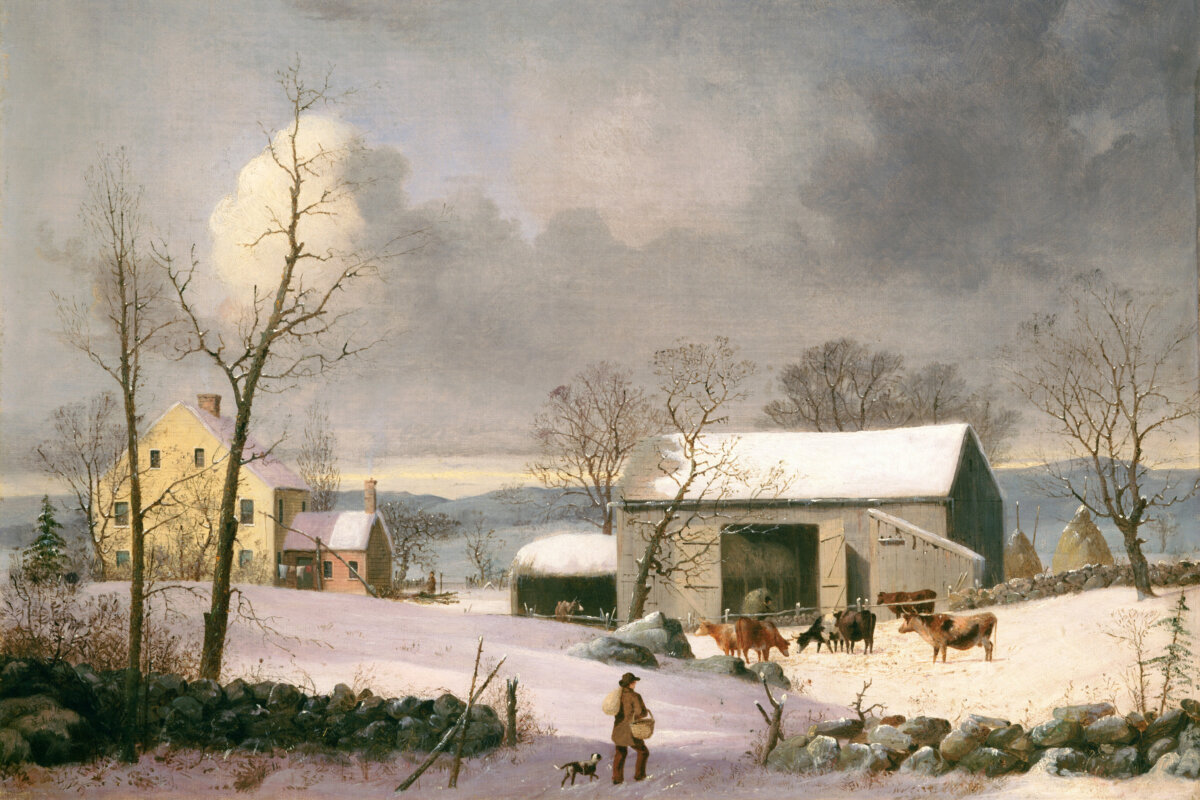
Families gathered close, warm against the cold, as winter light spilled over farmhouse walls and soft snow draped across the fields. George Henry Durrie (1820–1883) famously painted these scenes of daily life in rural New England.
Today, these paintings read as something else entirely, offering glimpses of a slower, more idyllic era.
Faith, Family, and the Portrait Trade
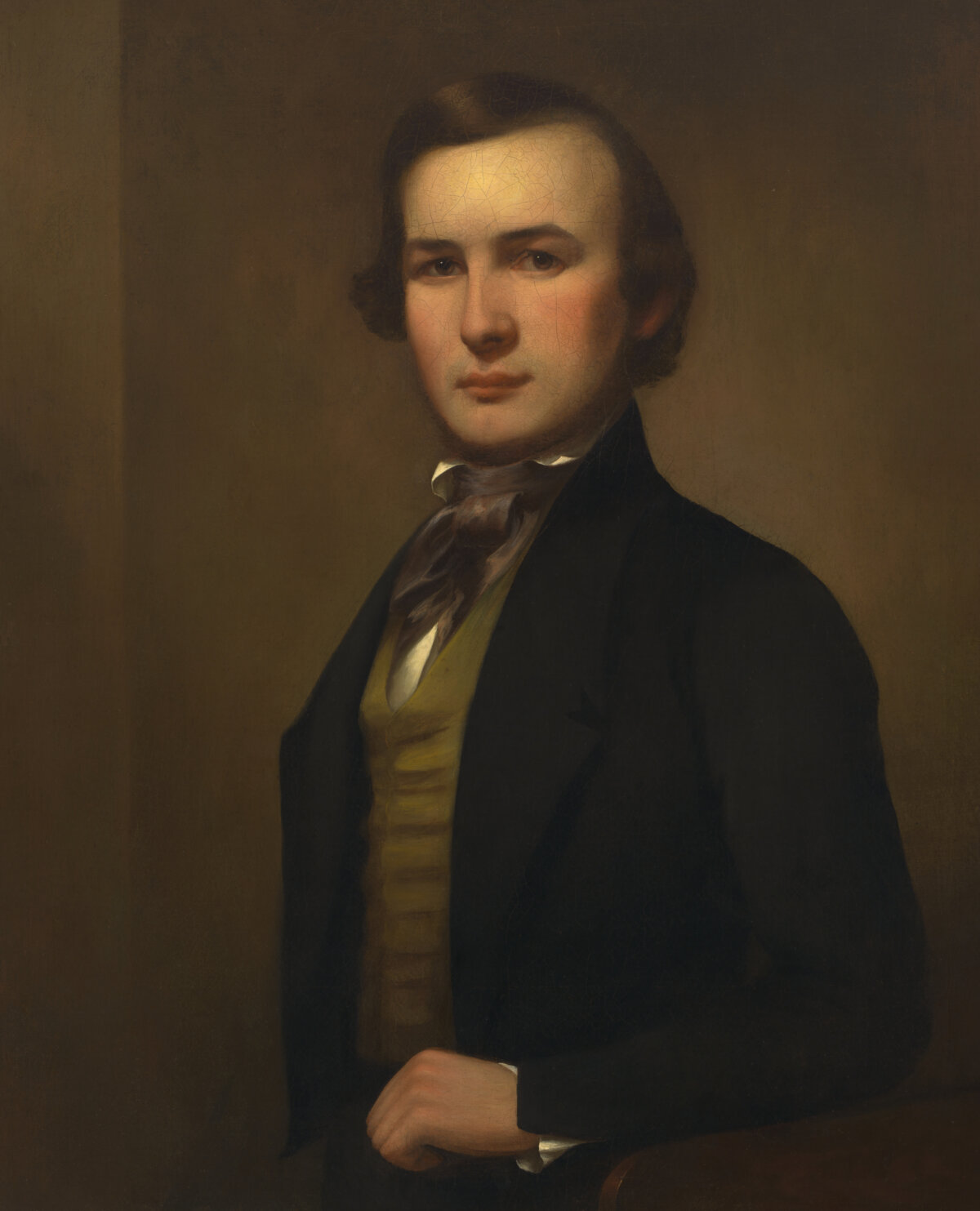
Born in New Haven, Connecticut, Durrie was the second of six children. Starting in 1839, he and his brother John Jr. trained on and off under local portrait painter Nathaniel Jocelyn, an experience that shaped Durrie’s early artistic development.
That artistic inclination extended beyond the canvas. Durrie played both violin and bass viol and sang regularly in church choirs. It was at choir rehearsals that he met Sarah A. Perkins, the daughter of the choir-master. The two married in 1841 and had three children: George, Benjamin, and Mary.
For much of his early career, Durrie earned his living primarily through portraiture, charging between $5 and $15 per painting. His clientele was largely local residents who commissioned portraits and purchased his early landscapes. These sales provided a moderate income, and to supplement his earnings, Durrie took on additional painting work such as retouching old portraits and decorating window shutters.
As a young portraitist seeking work, Durrie traveled regularly across the Connecticut countryside, and on these journeys he discovered an unexpected passion for landscape painting. He came to love the era’s new railroads and the scenery unspooling past their windows. Unlike his formal training in portraiture, this new pursuit would be almost entirely self-taught.
He filled his early sketchbooks with pencil studies of outdoor scenes, including numerous studies of solitary trees, which reflected a working method rooted in direct observation of nature.
The towns, hills, and farmland of Connecticut, particularly the area surrounding New Haven, became his primary subject matter. It was here that he developed the signature composition that would define much of his career: a farmhouse or schoolhouse seen from afar, set within a broad landscape and enlivened by a few small figures or animals.
Finding His Season
Where many of his Hudson River School contemporaries favored summer scenes, Durrie turned to winter, capturing landscapes defined by a peaceful atmosphere and unmistakably New England character.
Durrie’s account book shows he began selling landscapes to local patrons around 1843. An Oct. 14 entry that year records $20 from Mrs. Horace Daggett for three works: a portrait, a miniature, and a landscape. Nearly a year passed before he sold another landscape, again to the Daggett family, this time for $7. His early landscape subjects tended to be local scenes, likely because his existing portrait patrons were the most natural buyers for paintings of places they knew well.
Durrie exhibited his first landscape in 1844, when a now-lost work titled “Winter Scene” appeared at the New Haven State Fair alongside five of his portraits. The following year, he took second place at the same fair for two winter landscapes. Local newspapers soon began promoting his winterscapes, and in 1845, he exhibited “Sleighing Party,” also since lost, at the National Academy of Design. The show marked a turning point in his career, as Durrie moved decisively beyond portraiture toward the pastoral winter scenes.
By the 1850s, Durrie’s reputation around New Haven had grown to the point that he opened a permanent studio in the city. After 1851, he took on almost no portrait work, devoting himself instead to refining his landscape technique. In 1853, he built a house on Temple Street (then on the edge of downtown) where he lived with his family for the rest of his life.
The decade gave him no shortage of material. Winters in 1850s New Haven typically stretched from late November through March, and as the tail end of the Little Ice Age, the period brought prolonged freezes and heavy snowfalls. Although Durrie painted every season, winter dominated his work. Of his nearly 125 attributed paintings, 84 are snow scenes. His journal entries reveal why. He viewed winter not as a season of stillness but of activity, drawing inspiration from both the landscape and everyday experiences such as sleigh rides and gatherings among friends and neighbors.
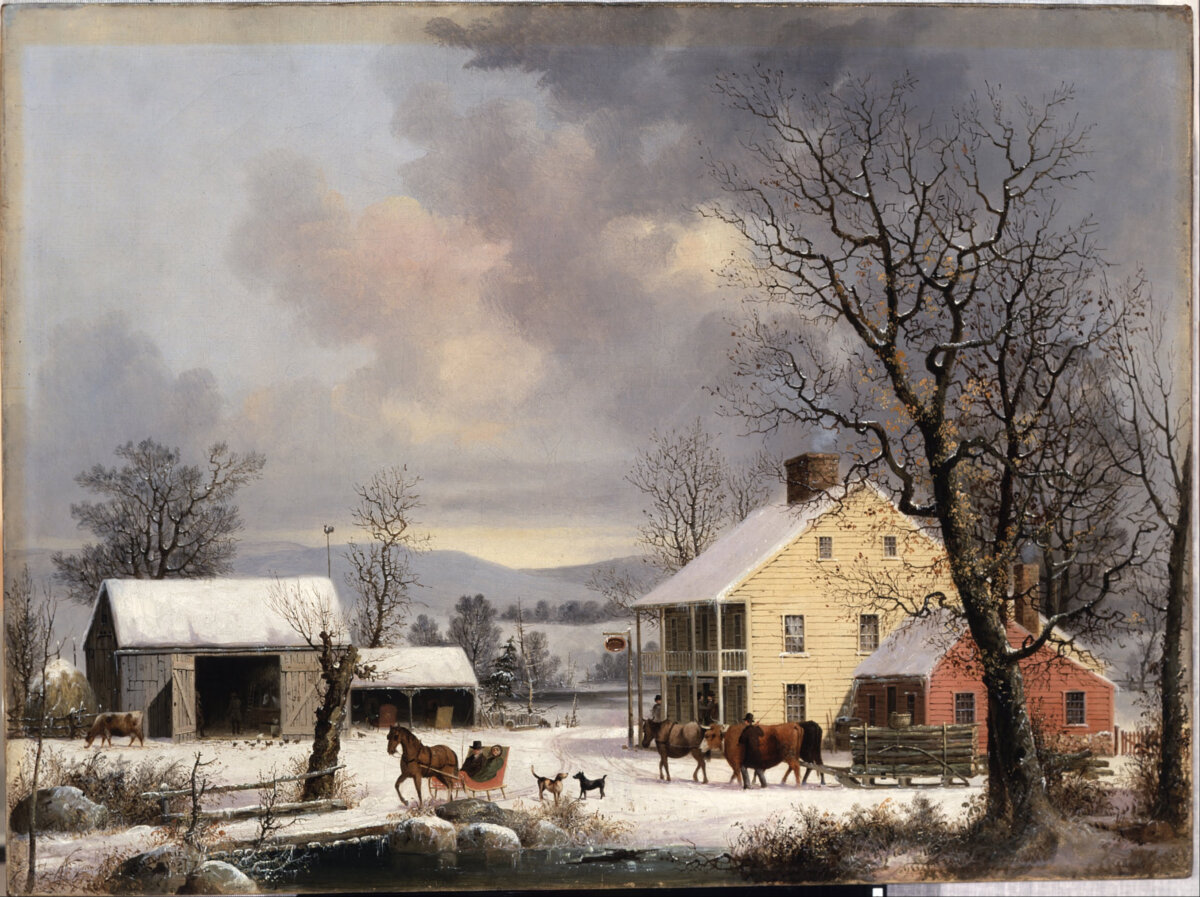
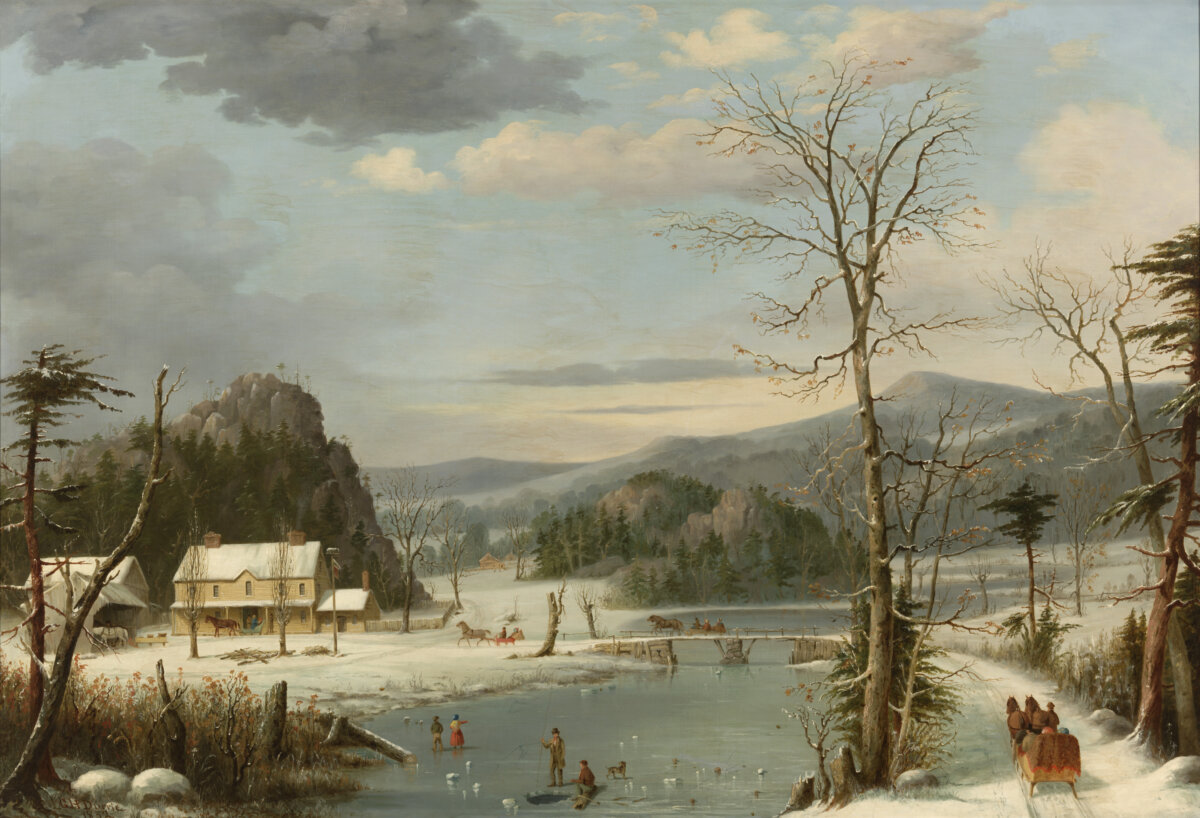
That inspiration comes through in his 1857 “Winter in the Country,” which captures New England’s winter conditions in detail. The painting portrays a provincial winter landscape, with a horse-drawn sleigh traveling along a snow-covered road framed by bare trees, split-rail fences, and distant rolling hills. A cool palette of whites, soft blues, and silvery grays envelops the snow and sky, while touches of warm color in the buildings, trees, and figures provide a welcoming contrast.
Durrie in Print
Durrie’s canvases entered the mainstream when they caught the attention of Currier and Ives, the most influential printmaking firm in 19th-century America. Self-styled as the “Publishers of Cheap and Popular Prints,” the firm built an empire on making images accessible to the American public. In the latter half of the 19th century, its artists churned out two to three new designs every week, ultimately producing more than a million hand-colored lithographs.
Each print began as a hand-drawn image, which was then transferred onto a lithographic limestone plate. Once ready, every impression was pulled and colored by hand. The resulting compositions made Currier and Ives prints instantly recognizable in homes across the country, and the firm sought out its artists accordingly, working with some of the era’s most prominent names, including James E. Buttersworth, George Inness, Thomas Nast, and Eastman Johnson. Between 1861 and 1863, Durrie earned a place among them, as Currier and Ives published four lithographs based on his paintings.
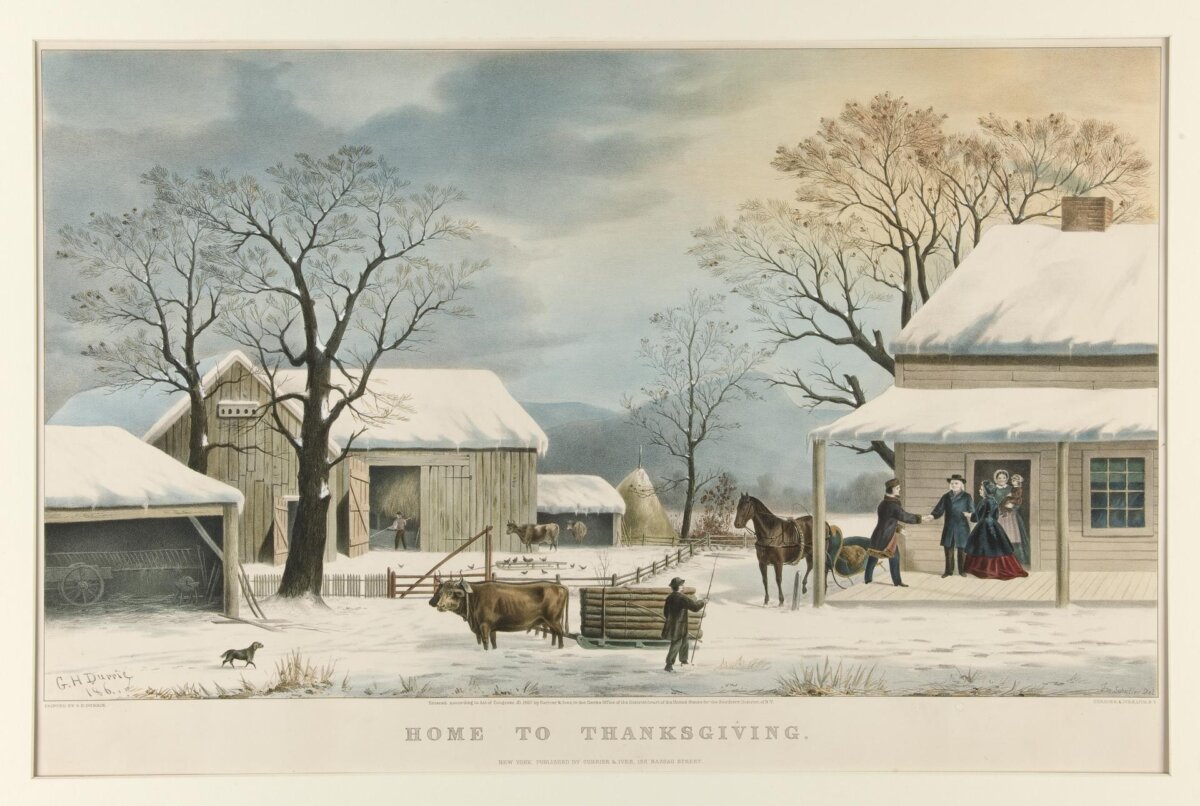
The partnership didn’t end with Durrie’s death. After he passed away in 1863, Currier and Ives published six more of his works. The last of these, “Home to Thanksgiving,” was published in 1867. The print is characterized by a cool palette accented with warmer tones, a hallmark of the artist’s style. It depicts a charming early-winter scene where a young man returns to his family’s farm for Thanksgiving. Durrie’s paintings offer an idealized vision of the countryside, one shaped by his own life in the Connecticut hills he knew so well.
His familiarity with the region shows in the local details he included, like nearby farms and rural landmarks, giving his works a sense of authenticity that resonated deeply with his audience. Historian Kathryn Elizabeth Sackett notes: “When purchasing a work by Durrie, patrons were not necessarily looking to buy an original work by a particular artist; instead, they bought a connection to their childhood, to earlier days, or to a simpler way of life.”
This article was originally published in American Essence magazine.
What arts and culture topics would you like us to cover? Please email ideas or feedback to features@epochtimes.nyc.