SEARCH


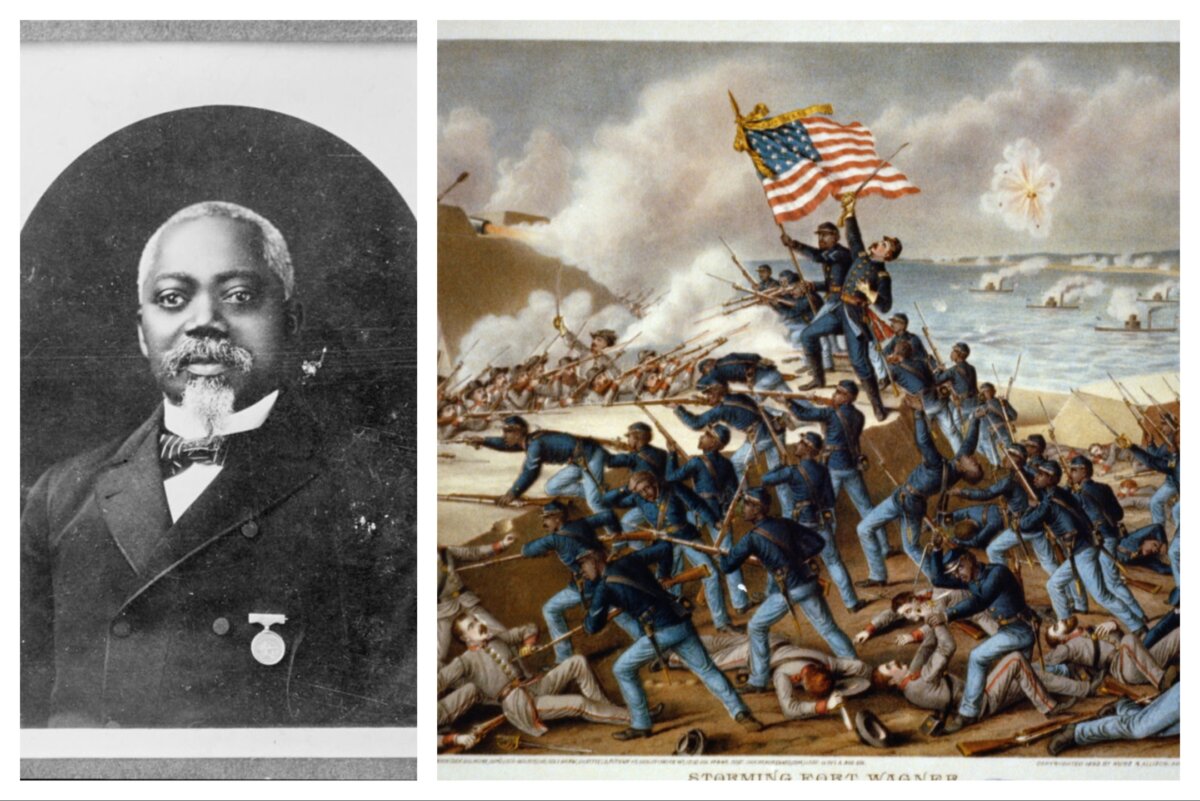
After growing up a slave, William Harvey Carney (1840–1908) eventually received his freedom before the onset of the Civil War. On Jan. 1, 1863, the Emancipation Proclamation was heralded, and young Carney, who had planned a career in the ministry, took an opportunity to join the fight. His love of freedom and the American flag were on display during a bloody battle in Charleston, South Carolina and resulted in his earning the nation’s highest military honor.
Carney was born in the port city of Norfolk, Virginia, where his father and mother, William Carney Sr. and Ann Dean, were slaves promised their freedom when their owners died. When Ann Dean’s owner, Maj. Carney, died, she and the rest of his slaves were freed. About 1857, Carney Sr., however, pursued his freedom via the Underground Railroad. He first arrived in Philadelphia and then New York City, but he didn’t settle down until he felt at home. That home was in New Bedford, Massachusetts.
During this time, Carney Sr. worked tirelessly to earn enough money to pay for the freedom of his entire family. While Carney Sr. was working to raise those funds, Carney attended a private and secret school managed by a local minister. It was here that he learned to read and write. Carney Sr. soon sent for his family, having earned enough money to purchase their freedom.
Joining the 54th
Carney worked with his father in the shipping trade, but soon turned his eyes to the ministry. Not long after his arrival in New Bedford, though, the Civil War erupted. While he obviously wished for a Union victory, he could do little to contribute until President Abraham Lincoln issued the Emancipation Proclamation. It not only declared all slaves in the Confederate territories free, but also allowed blacks to enlist in the Union Army.
“When the country called for all persons, I could best serve my God by serving my country and my oppressed brothers,” Carney recalled. “The sequel is short—I enlisted for the war.”
Carney joined the 54th Massachusetts Colored Infantry Regiment by March 1863 and was assigned to Company C. By May, Carney and the 54th under the command of Col. Robert Gould Shaw had completed their training. They now set off to war.
Looking to Fight
Their first deployment was to Darien, Georgia. It was not a battle but a raid, which left the town pillaged and on fire. Shaw criticized the fact that his regiment was being used merely to pillage. He believed they should fight. His criticisms apparently reached the right people and the 54th were given orders to pursue Charleston, the capital city of South Carolina and one of the Confederates’ strongholds.
Charleston was a strategic objective for the commanding general of the U.S. Army, Winfield Scott, whose Anaconda Plan included a naval blockade of Confederate ports. The first objective for the 54th to secure Charleston was to land at James Island. Landing there would hopefully divert Confederate troops from the stronger Fort Wagner, therefore weakening its defenses. Union troops landed on the island on July 8, 1863. Confederate troops took the bait and sent 3,000 troops to take the island, resulting in the July 16 Battle of Grimball’s Landing. With a successful strategic maneuver, the Union troops retreated from James Island the following day, with plans to attack Fort Wagner on July 18.
On the morning of July 18, Brig. Gen. George C. Strong visited Shaw and his 54th. He pointed to Fort Wagner, which was currently being bombarded by Union ships and siege guns, and asked the soldiers, “Is there a man here who thinks himself unable to sleep in that fort tonight?” The soldiers yelled back, “No!”
Strong followed with another question and one that had historic consequences for Carney. “If this man should fall,” Strong said pointing to the color bearer, “who will lift the flag and carry it on?”
Shaw immediately stated that he would. The 54th erupted in a cheer. The responsibility, however, soon fell to Carney.
‘The Dear Old Flag’
Inside Fort Wagner awaited approximately 1,800 Confederate soldiers. Suddenly, 5,000 Union troops, led by the 54th, charged the fort.
“When about 100 yards from the fort, the rebel musketry opened with such terrible effect that for an instant the first battalion hesitated,” reported the Liberator newspaper.
“But only for an instant, for Col. Shaw, springing to the front and waving his sword, shouted, ‘Forward, my brave boys!’ and with another cheer and a shout they rushed through the ditch, gained the parapet on the right, and were soon engaged in a hand-to-hand conflict with the enemy. Col. Shaw was one of the first to scale the walls. He stood erect to urge forward his men, and while shouting for them to press on, he was shot dead, and fell into the fort. His body was found, with twenty of his men lying dead around him, two lying on his own body.”
The casualty numbers for the 54th were high, and among those casualties was the color bearer. Carney noticed the wounded soldier. He tossed his rifle and ran to grab the flag. Carney then rushed toward the ramparts of the fort. He noticed that his regiment was not with him. He decided to await them, despite musket balls whizzing by him.
The troops began another charge. As he waited for them to move ahead of him, he noticed they were Confederates. He quickly wrapped the flag and rushed from the fort toward the Union soldiers. While running, flagstaff in hand, he was shot in the chest, but kept running. He was soon hit by a second bullet. When he encountered a member of the 100th Infantry Regiment of New York, the soldier offered to carry the flag for him. Carney was adamant that the colors stay with him until he could pass them to another member of the 54th. As the two pursued the rear of the Union troops, Carney was struck again, this time in the head. Despite three wounds, he held the flag.
“As he saw the men falling back, himself severely wounded in the breast, he brought the colors off, creeping on his knees, pressing his wound with one hand and with the other holding up the emblem of freedom,” reported the Liberator.
“The moment he was seen crawling into the hospital with the flag still in his possession, his wounded companions, both black and white, rose from the straw upon which they were lying, and cheered him until exhausted they could shout no longer. In response to this reception, the brave and wounded standard-bearer said: ‘Boys, I but did my duty; the dear old flag never touched the ground.’”
The Medal of Honor
Shortly after the battle, Carney was awarded the Quincy A. Gillmore Medal of Gallant and Meritorious Award. His wounds had left him incapable of continuing with the 54th, and he was discharged. But his moment lived on in the memory of his fellow soldiers.
Decades later, Christian Fleetwood, who had fought for the 4th Regiment United States Colored Infantry, asked Carney if he could borrow his Medal of Honor to exhibit at the 1900 Paris Exhibition. Fleetwood had been awarded the Medal of Honor on April 6, 1865, for actions practically identical to Carney’s. Fleetwood’s commendation reads: “Seized the colors, after two color bearers had been shot down, and bore them nobly through the fight.” Fleetwood discovered, however, that Carney had not received one.
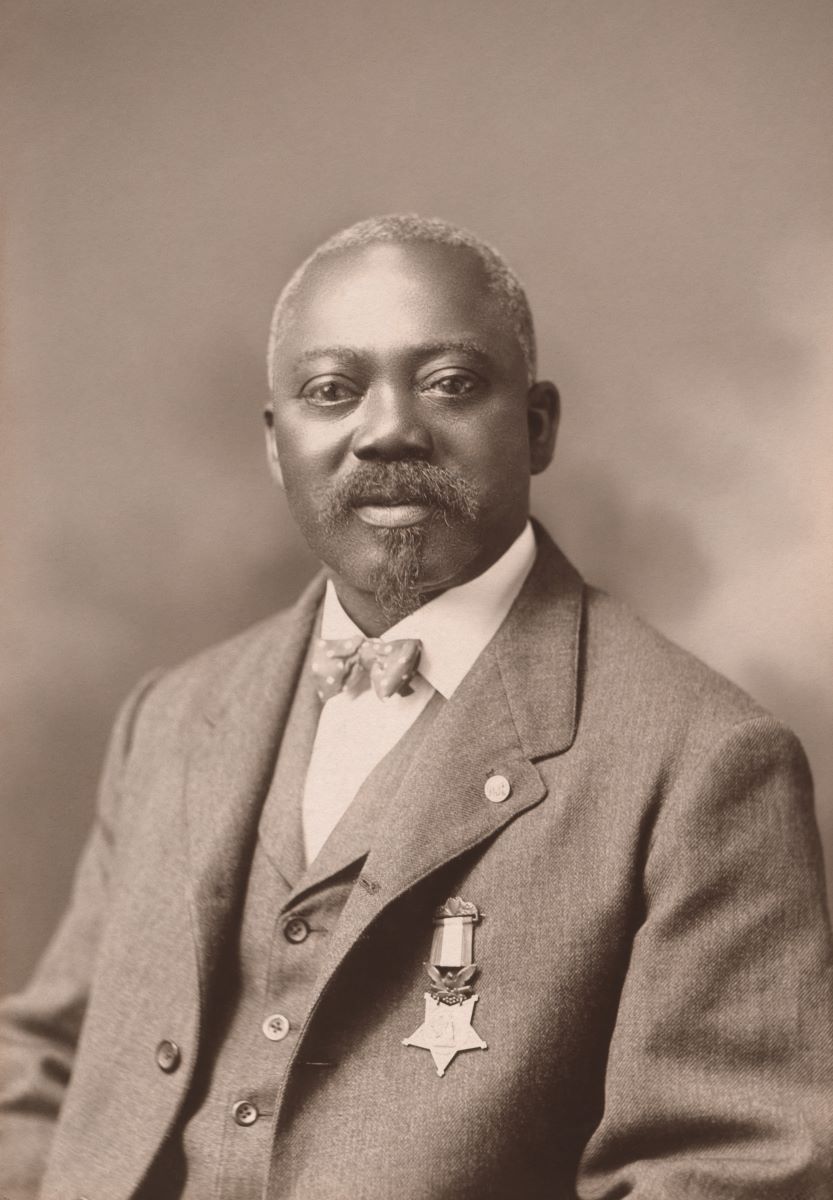
Fleetwood, along with Luis Fenollosa Emilio, who had been a captain in the 54th Regiment, petitioned the War Department that Carney receive the Medal of Honor. On May 23, 1900, Carney was presented with the Medal of Honor for “when the color sergeant was shot down, this soldier grasped the flag, led the way to the parapet, and planted the colors thereon. When the troops fell back he brought off the flag, under a fierce fire in which he was twice severely wounded.”
Although Carney was not the first of the 25 black Civil War soldiers to receive the American military’s highest honor, the date made his actions the first worthy of the Medal of Honor.
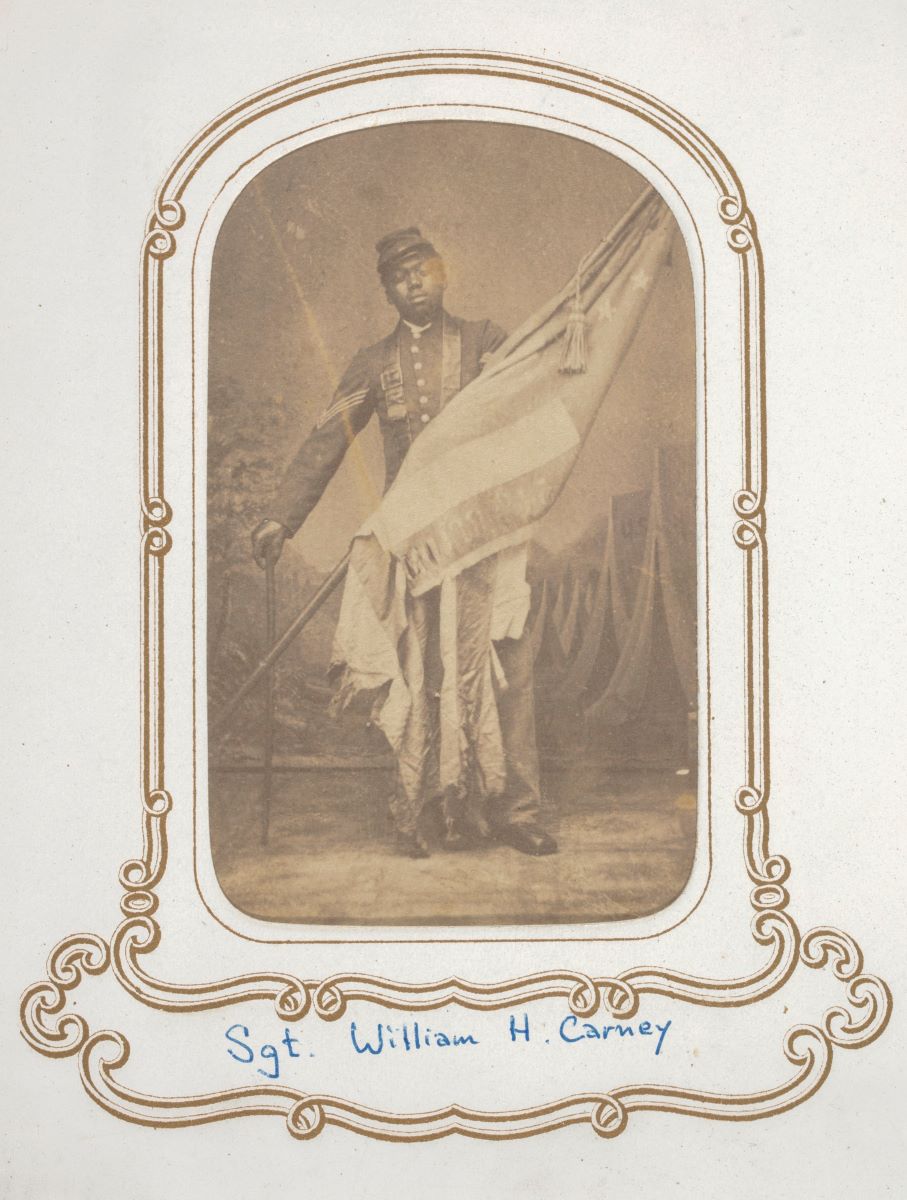
Carney returned to New Bedford after the war where he married Susannah Williams, had a daughter, and became a U.S. postal carrier—the nation’s first black mail carrier. Along with his Quincy A. Gillmore Medal of Gallant and Meritorious Award (which was replaced in 1905 as with the Civil War Campaign Medal) and the Medal of Honor, Carney’s 54th was memorialized in the Boston Common by sculptor Augustus Saint-Gaudens; his rescued flag is on display in Boston’s Memorial Hall; and, in New Bedford, the elementary school Sgt. William Carney Memorial Academy is named in his honor. Additionally, there is a famous photo, taken in 1864, of Carney with “the dear old flag” which “never touched the ground.”

What arts and culture topics would you like us to cover? Please email ideas or feedback to features@epochtimes.nyc