SEARCH


“What George Washington was to American politics, John Marshall was to American justice.” Taken from the first paragraph of Joel Richard Paul’s book “Without Precedent: Chief Justice John Marshall and His Times,” that assertion won two thumbs up from most American legal scholars.
For 34 years, Marshall guided the Supreme Court and, consequently, the Constitution through the roiling waters of political controversies and fierce antagonisms. Although the Marshall court ruled on several cases profoundly impacting American law and history, today most of us remember him for “Marbury v. Madison,” arguably the most important case in U.S. history as it established the Supreme Court as the vehicle for judicial review and constitutional interpretation, which was and remains its paramount function.
If we dig a bit into Marshall’s life and personality away from a judge’s bench, we discover the man whose character and qualities, still worthy of our admiration today, helped steer the new republic through some dangerous storms.
Education in Peace and in War
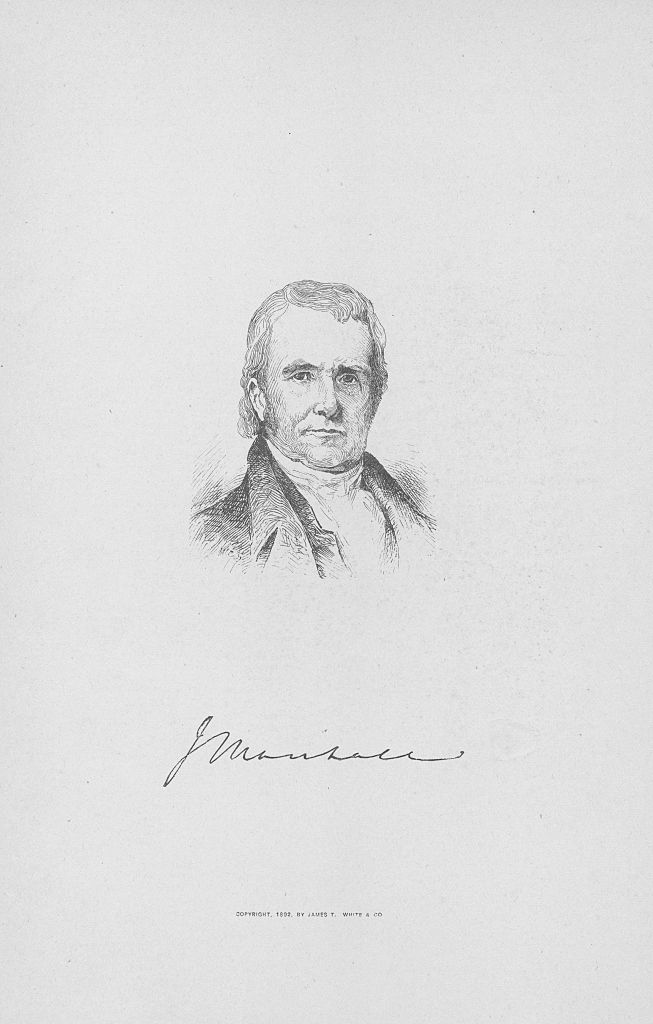
Unlike some other Virginians like George Washington and Thomas Jefferson, John Marshall (1755–1835) was born on the Virginia frontier into a family that sometimes struggled to make ends meet. He was the oldest of 15 children. His mother was related to Jefferson, and his father counted Washington as a friend from the surveying they’d done together for Lord Fairfax.
As an adult, Marshall himself became Washington’s close friend and would later write a five-volume biography of the recently deceased general and president. He also knew Jefferson—he administered the presidential oath of office to him in 1801—but that relationship was marked by mutual ill will and disdain.
During his adolescence and teen years, Marshall received only one year of formal schooling, where he befriended future president James Monroe. Instead, he took his learning from his father’s small but excellent library, gaining a lifelong love for English literature, history, and poetry.
When war with Britain broke out, Marshall, inspired by Washington, left behind his reading of the law and joined the newly formed Continental Army. He first served as a lieutenant in Virginia, then joined Washington’s force in the north, where he fought in the battles of Brandywine, Germantown, and Monmouth, and endured the bitter winter at Valley Forge. Sent back to Virginia to train recruits, he found little to do since they were not forthcoming, and so in the spring of 1780 he continued his study of law at the College of William and Mary, in Williamsburg, Virginia.
All of these experiences—his frontier-tough upbringing, his pursuit of knowledge, his wartime service—exposed Marshall to a wide variety of ideas and people, which later served him well on the highest court of the land.
The Romantic
It wasn’t just his legal studies that drew Marshall to Williamsburg. In his article “Speaking With One Voice,” Marshall biographer Paul wrote:
“If it were not for Mary Ambler, the pale 13-year-old daughter of Virginia Treasurer Jaquelin Ambler, we might not have the Constitution we have today. The young teenager—who was called Polly—was the lovely object of John Marshall’s affection. In 1780, the 24-year-old Marshall, then an army captain, pursued her to Williamsburg, where her father was then serving. Eventually with no troops to command and nothing to do but wait until Polly was old enough to marry, Marshall enrolled in George Wythe’s famous law lectures at the College of William & Mary.”
Paul further notes that in his class notebook Marshall “scribbled Polly’s name over and over.”
Six weeks after Marshall had started school at William and Mary, the Ambler family moved to Richmond. Marshall immediately abandoned his studies and followed Polly to that city. Despite her father’s early objections to Marshall’s frontier background, his warm personality and smile, and his clear affection for her, won Polly over. At the age of 16, she married the 27-year-old suitor who had so ardently courted her.
The depths of their love for each other can be told in the story of a locket. Depending on the account we read, it contained either a single hair from each of them or a lock Polly had cut from her own head as a guarantee of her affection after she’d initially rejected his marriage proposal. For the nearly 49 years of their marriage, Polly wore that locket. Just before dying on Christmas Day, in 1831, she feebly attempted to remove the locket, but could do so only with the help of her husband. He then put it around his own neck and wore it until his own death four years later.
Behind the sharp legal mind of Marshall was a lover’s heart.
Under One Roof
This same combination of head and heart, of legal acumen coupled with warmth and laughter, quite often moved his fellow judges to align themselves with his rulings and counsel.
When Marshall became chief justice in 1801, the rancor between the Federalists of John Adams and the Republicans of Thomas Jefferson had reached a fever pitch. Marshall, who stood with the Federalists and a strong federal government, rightly feared that extremism and infighting might wreck the new Constitution and the republic itself; he worked to achieve consensus among the judges.
In an attempt to draw the Supreme Court justices together to face these political storms, Marshall devised a brilliant strategy. He arranged for the justices to take up lodgings together in a Washington boardinghouse during their annual two-month term in that city.
They resided first at Conrad and McMunn’s boardinghouse on Capitol Hill. In the evenings, they would gather in the parlor, discussing the business of the court as well as politics and news from their homes. Though they rented rooms in several boardinghouses over the years, this practice of shared quarters continued for three decades.
As time passed, Federalist Supreme Court appointees were replaced by others with different views of the law, yet for most of Marshall’s tenure, the court retained its unity and a strong Federalist flavor. In the American Heritage magazine article “The Great Chief Justice,” law professor Fred Rodell credits Marshall’s living quarters inspiration with a harmonious court, noting:
“For Marshall made of his Court a sort of close-knit men’s club, whose members lived and dined and wined with each other in the same Washington boardinghouse, wifeless while the Court was in session; and trudged together, through muddy or dusty streets, to and from their little courtroom in the Capitol basement; and did their most decisive work away from their official site of business, as legal discussion blended into political commentary or sheer social gossip and then drifted back to the cases, around the congenial board. In such close and common quarters, even more than in the stiffness of the formal consultation chamber, Marshall’s easy eloquence was at its best. Republicans might come and Federalists go, but Marshall stayed king of the cloister.”
Rodell then calls to our attention the special Marshall touch that so often won others to his arguments.
“He did not stay king by throwing his weight around, by parading his Chiefship to his officially slightly interiors, nor by sternness and severity of manner. By contrast to the oft-imagined picture of Marshall as austere, coldly impressive … the man was a thoroughly likable, approachable, outgoing and easygoing figure in his relationships with people, blessed with a gangling, rough-cut charm that made personal friends out of political enemies.”
Lessons for Today From John Marshall

The first quarter of the 21st century has brought about the politicization of the court, a situation feared by Marshall more than 200 years ago. Media commentators and the public at large often refer to a particular justice as a conservative or a liberal. The Congress that appoints these justices typically makes these choices based not on the nominees’ record and knowledge of the law, but on their politics and their opinions on issues like abortion. Consequently, and in contrast to the Marshall court, decisions today are rarely unanimous and do indeed sometimes seem to reflect the justices’ beliefs rather than the facts of a particular case or a reliance on the Constitution.
At the end of “Without Precedent,” Paul wrote:
“Chief Justice Marshall lived in a revolutionary age in which the country was deeply polarized by competing ideologies. The politics of his day were every bit as negative and ruthless as the politics of our own time. … Though the Revolutionary generation was governed by certain rules of civility—rules that have since been forgotten—men were no less mean-spirited, petty, jealous, avaricious, or corruptible than in our own time.”
Thanks to John Marshall, the court usually managed to stay above these storms and acted as ballast for an endangered ship of state.
What arts and culture topics would you like us to cover? Please email ideas or feedback to features@epochtimes.nyc