SEARCH


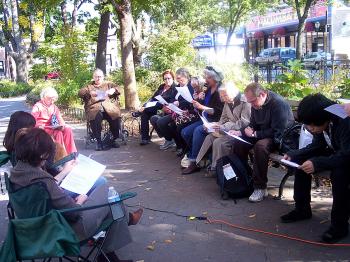
According to their website, Staten Island OutLOUD is a “community dialogue and performance project” where neighbors gather together to read aloud and sometimes stage readings of literature by writers of all cultures from the past to the present, ranging from the Declaration of Independence to Zen poetry. Oftentimes, their choices of venue are scenic locations around the island. For a reading of Moby Dick, for example, they congregated at Fort Wadsworth, a favorite spot of Herman Melville.
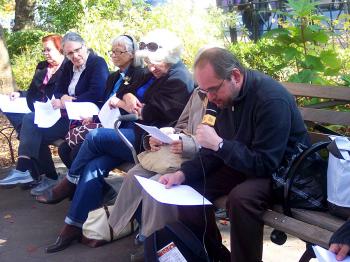
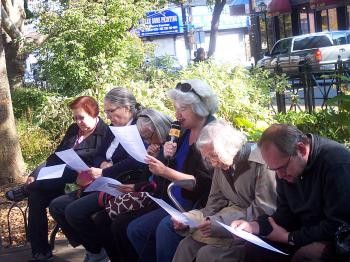
On a late Saturday afternoon, a dozen or so Staten Islanders gathered at Tappen Park in Stapleton for an intimate reading and discussion of Chinese poetry. The event was inspired by two local neighbors Isla Ng and Anna Lung, one a young high school student who recently visited China for a model United Nations trip, and the other a Chinese poet herself. Lung publishes her poems on her blog, which is accessible to netizens in mainland China.
Misty and Mysterious

The Misty Poets were formed as part of a reaction to the suppression of artistic expression under Mao’s regime. The oblique nature of the Misty school can be observed in Yang’s “Storkwinkel, Berlin,” which artfully captured the grim and somber in the first two lines: “death’s play has twisted your features no longer people / remember one cry of a frail child’s laughter and dread.”
The Staten Island literary enthusiasts speculated that the bleak, dark imagery in Bei’s and Yang’s poems was perhaps a reflection of their traumatic memories of the June 4 massacre. Others said Bei’s style reminded them of the American Beat poets of the 1940s and 50s. Many also noted that the nuances, complexities, and ambiguities intrinsic to the Chinese idiom must have been lost in translation. Thus, they believed, they were not able to fully appreciate the artistry in Chinese poetry.
Classical Elegance

In classical Chinese poetry, there exist rules that poets must strictly adhere to. Much like sonnets in the English tradition, both shi and ci poetry have specific requirements for the structure of the poem, including the number of characters within each line, the number of lines and stanzas in the poem, and a specific rhyme scheme.
The most common form was the five- and seven-character poem, both of which were required to end in four or eight lines. The four-lined poem is called a jue shi, while the eight-lined poem is a lu shi. Rhyme schemes also varied. In the lu shi, the last character in all the even- and odd-numbered lines of the poem must rhyme with each other (that is, ABAB).
Like the English meter, some types of shi poems specified a pattern of flat and uneven tones for each line (Mandarin Chinese consists of four tones, the first classified as flat, the second to fourth as uneven) and which tone was rhymed throughout the poem. Some shi poems required the characters in each line to correspond to each other in syntax. For example, if the third character in the first line is a verb, the third character in each subsequent line must also be a verb.
Ci poems have even more distinctions. A combination of a specific number of characters in each line and a pattern of flat and uneven tones constituted a ci pai, of which there were up to 800 different permutations. Ci poems were also classified by the length of the poem and the number of stanzas. For instance, a poem with 58 characters or fewer was a xiao ling, and if it was separated into two stanzas, it was called a shuang diao.
There was also a classification of musical style for the tune that the ci poem was sung to with a total of nine different categories. In addition, the tunes were also classified into four different tempo speeds, the ling being the fastest and the man the slowest. Finally, there was a distinction between poem styles, one called the wan yue (graceful and restrained) and the other hao fang (bold and unconstrained).
Many at the reading commented on the vivid imagery in the classical Chinese poems, which resembled paintings in its graphic descriptions of nature. They also noted that the classical poems were easier to understand, whereas the modern Chinese poets played with the language in ways that revealed their individualistic sensibilities. Classical or modern, the readers left with new insight into Chinese poetry, touched by the poets’ powerful words and provoking images.
Staten Island OutLOUD will be holding a staged reading of Chaucer’s Canterbury Tales on Saturday, Nov. 6 at the Killmeyer’s Old Bavaria Inn on Staten Island. For more information on Staten Island OutLOUD’s activities, please visit www.statenislandoutloud.org .