SEARCH


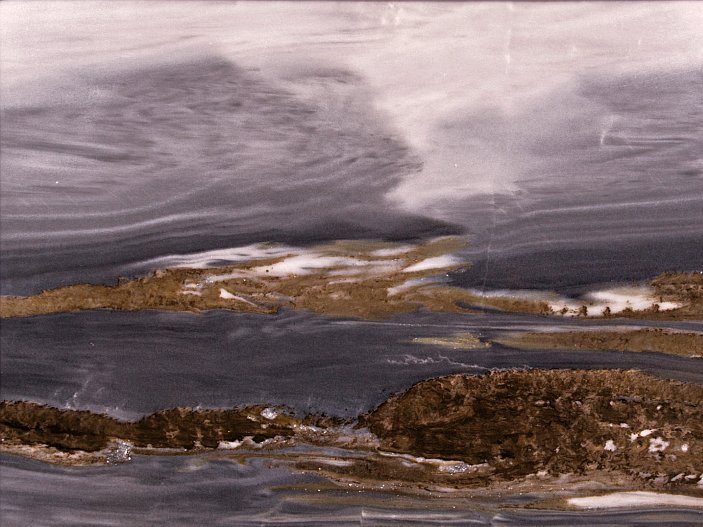
NEW YORK—For the people of Dali prefecture in southwest China, the idea that mountains can paint is not new. For millennia, they have quarried marble, and the experts among them slice through the rock to reveal images crafted by billions of years of geological activity.
Polished and framed, the dreamstone’s striations of mineral deposits depict scenes that look like landscapes, seascapes, forests, humans, and animals—and the artistic styles they resemble range from that of Song Dynasty brushwork to abstract.
The source for these extraordinary marbles is the towering Cangshan Mountains, surrounding the ancient city of Dali in Yunnan Province.
It was during a trip to Dali 15 years ago, looking for bronzes, that antiquities dealer and researcher Michael Teller stumbled upon dreamstones. Despite dealing in antiquities for decades, Teller had never heard of dreamstones until he noticed one in the home of an older Chinese gentleman.
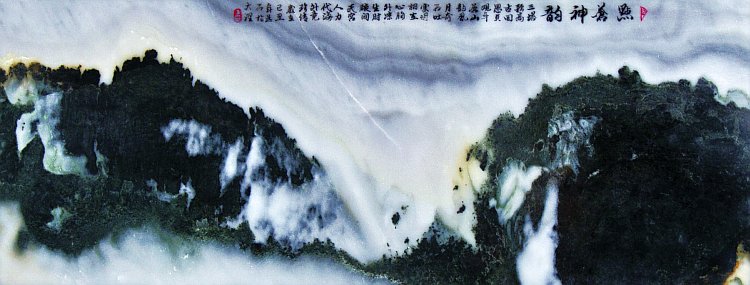
“It was leaning against a wall in this ‘hoarder’s room of art,'” Teller recalled. “I thought it was a painting, and I said to him, ‘That’s a beautiful painting!’ Well, he got really upset and started telling me that it was a dreamstone.”
As Teller would learn, dreamstones were revered and sought after among Chinese royalty, aristocracy, and literati since the Tang Dynasty. According to records from the Song Dynasty, emperors valued them over gemstones and gold, even demanding them as tribute. In fact, the Dali marble was so revered in early China that the word for marble in Chinese is ‘dali.’
After viewing a dreamstone, prominent Ming geographer and scholar Xu Xiake famously said that all art galleries not showing dreamstones should be shut down because no other art form could compare in displaying the essence of nature.
Despite their high status in history, they have been little-known since the 20th century due to the systematic destruction of traditional arts under Mao and the communist regime.
“This art form has been lost to the last couple of generations,” Teller said. “But they didn’t feel the loss of the art since they didn’t even know it existed.”
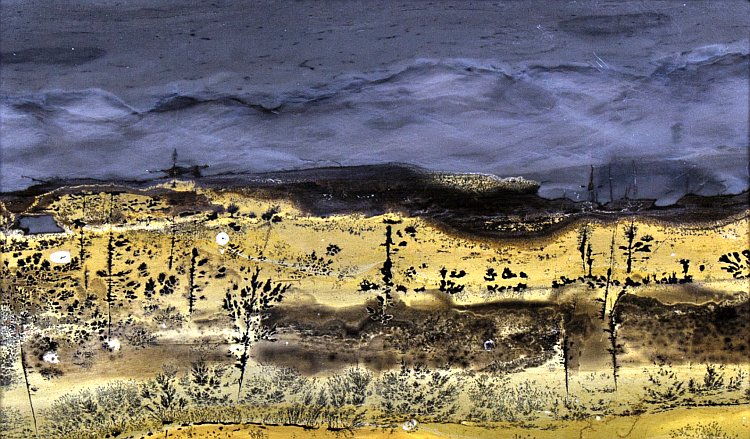
Persisting through the Chinese Communist Party’s attempt to erase China’s traditional arts, the practices of quarrying, revealing, collecting, and appreciating dreamstones has been kept alive by 150 families of the Bai ethnic minority in and around the old city of Dali.
Now, a small number of collectors both in China and in the West have begun to rediscover and appreciate the artistic significance of dreamstones and the rare talent required to reveal a scene hidden in stone.
Mysterious Connections
Marble is everywhere. In Dali, small marble accessories are some of the most common tourist trinkets. But rocks that can become dreamstone masterpieces are hard to come by and even harder to reveal.
According to Teller’s estimate, there are only 12 established masters living today who have the ability to intuit where and what to quarry, and how to cut a stone to reveal the art inside.
“You can’t go to the other side of the mountain or even 50 yards away and find the same color scheme and pattern,” Teller said.

The stones have an innate connection to the places were they are found. Often, a rock taken from a forested area will reveal a bamboo grove; a rock from a mountain will reveal that mountaintop shrouded in mist. No one knows why this might be, and that mystery is part of dreamstones’ appeal.
The intuition, or sixth sense, or expertise—whatever it may be—to know how to cut a drab, featureless rock in just the right angle and location, down to 1/16 of an inch in order to unveil a scene of artistic value, belongs only to a master revealer.
In Teller’s midtown Manhattan gallery is a small boulder that reveals mountaintops in shades of rust, but remains uncut and unpolished. Viewing it from the side, one can imagine that if the master had cut a fraction of an inch further back, the image attained may have been quite different, or not impressive at all.
“He could have gotten a nice floor tile,” said Teller.
Appraising and Collecting
The body of dreamstone collectors is growing, says Teller, who once held an exhibition of 175 dreamstones in which 150 were sold. Almost none of the buyers had heard of dreamstones before but were captivated by their beauty and visceral appeal.
“There doesn’t seem to be any specific demographic for dreamstone collectors,” Teller said. Of the buyers he has spoken to, there were people of all ages, cultural backgrounds, levels of education, and financial circumstances. “There was one young couple who had to pay installments for one small piece, and a millionaire who bought 40 pieces at a time.”
The prices at that sale ranged from $950 to $50,000.
The growth in interest in the art form has made pressing the need for an oversight body that acts as an advocate for collectors. There are stone craftsmen in China who work with marble but are not dreamstone revealers.
To the uninitiated, it is easy to fall into the trap of paying exorbitant prices for a stone that has been manipulated. Even if it had been given an “award” from a local association, it could be at best an unimportant piece, or at worst, a fake.
To preserve and promote the integrity and continuation of this rare art form, Teller and several dreamstone experts have founded the International Dali Dreamstone Association (I.D.D.A.). The consulting members include scholars, collectors, and masters both from the United States and China.
While several stone collecting societies exist locally in China, prior to the I.D.D.A.’s establishment, there has not been an international body for the protection of dreamstone revealers and collectors. With one dreamstone selling for US$250,000 in China recently, according to the I.D.D.A., the association seems quite necessary.
By votes, members categorize, grade, appraise, and certify dreamstones based on the stone’s rarity in the natural world, the revealed scene’s adherence to artistic tenets, and integrity of workmanship.
Even with this attempt at standardization, the tastes in dreamstones remain highly personal.
“Several people could be looking at a dreamstone and all have the same visceral reaction, but each one will see something different in it,” said Teller.
To view the largest collection of dreamstones in the West, visit Teller’s gallery, TK Asian Antiquities at the Fuller Building, 41 E. 57th St. The exhibit is part of New York Asia Week and runs Sept. 8–30, 11 a.m.–6 p.m.
TK Asian Antiquities is an advertising partner with The Epoch Times.
The Epoch Times publishes in 35 countries and in 19 languages. Subscribe to our e-newsletter.