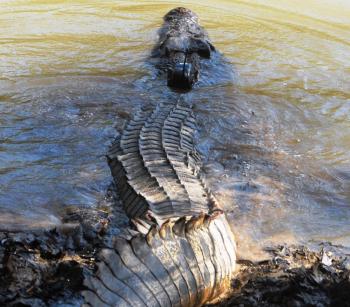


Although poor swimmers, estuarine crocodiles (Crocodylus porosus) have occupied many South Pacific islands, which are separated by huge stretches of ocean water.
Their migration has puzzled many until Dr. Hamish Campbell of the University of Queensland and colleagues from the Queensland Parks and Wildlife Service and the Australia Zoo solved the mystery.
“Of all the amazing things animals can do, the ability of certain species to migrate significant distances across formidable geographical barriers is one of the most remarkable,” the ecologists wrote in their research paper, which is published in the British Ecological Society’s Journal of Animal Ecology.
The ecologists tagged 27 adult estuarine crocodiles with sonar transmitters and used underwater receivers to track their movement throughout an entire year. Over time, they found that the crocodiles—like surfers catching waves—ride surface currents for long-distance travel, which could enable them to travel from one oceanic island to another.
“The estuarine crocodile occurs as island populations throughout the Indian and Pacific Ocean, and because they are the only species of saltwater-living crocodile to exist across this vast area, regular mixing between the island populations probably occurs,” Campbell said in a news release.
"Because these crocodiles are poor swimmers, it is unlikely that they swim across vast tracts of ocean. But they can survive for long periods in salt water without eating or drinking, so by only traveling when surface currents are favorable, they would be able to move long distances by sea.”
The estuarine crocodile, a semi-aquatic reptile, is the largest living reptile on Earth. They live mainly in rivers, mangroves, and estuaries, covering over 10,000 square km (3,861 square miles) of the South-East Pacific, from East India to Fiji and from Southern China to North Australia. Although they spend most of their lives in salt water, they are not marine reptiles as they rely on land for food and water.
During their experiment, the ecologists recorded 1.2 million data packets and found that both male and female crocodiles went for long-distance travels. They usually traveled for more than 50 km (31 miles).
The data revealed that crocodiles always begin their voyages within an hour of the tide change, allowing them to go with the flow. They stop their journeys by moving out onto the riverbank when the tide turns against them.
Over 25 days, a 3.84-meter-long male crocodile left the Kennedy River and traveled 590 km (367 miles) down the west coast of Cape York Peninsula. The timing of his journey coincided with a seasonal current system that developed in the Gulf of Carpentaria.
Another 4.84-meter-long male crocodile moved more than 411 km (255 miles) within 20 days from the east coast of Cape York Peninsula through the Torres Strait to the Wenlock River on the west coast of Cape York. As the Torres Strait’s strong water current was against the crocodile’s direction of travel, he waited in a sheltered bay for four days and continued his journey when the current was favorable.
“This study has shown that adult estuarine crocodiles dramatically increase their travel potential by riding surface currents,” read the research paper. “This observation has profound management applications because a problem crocodile translocated to an area where residual surface currents flow in the direction of the home-area will rapidly travel back home.”
Read the research paper at http://tiny.cc/zbmyk