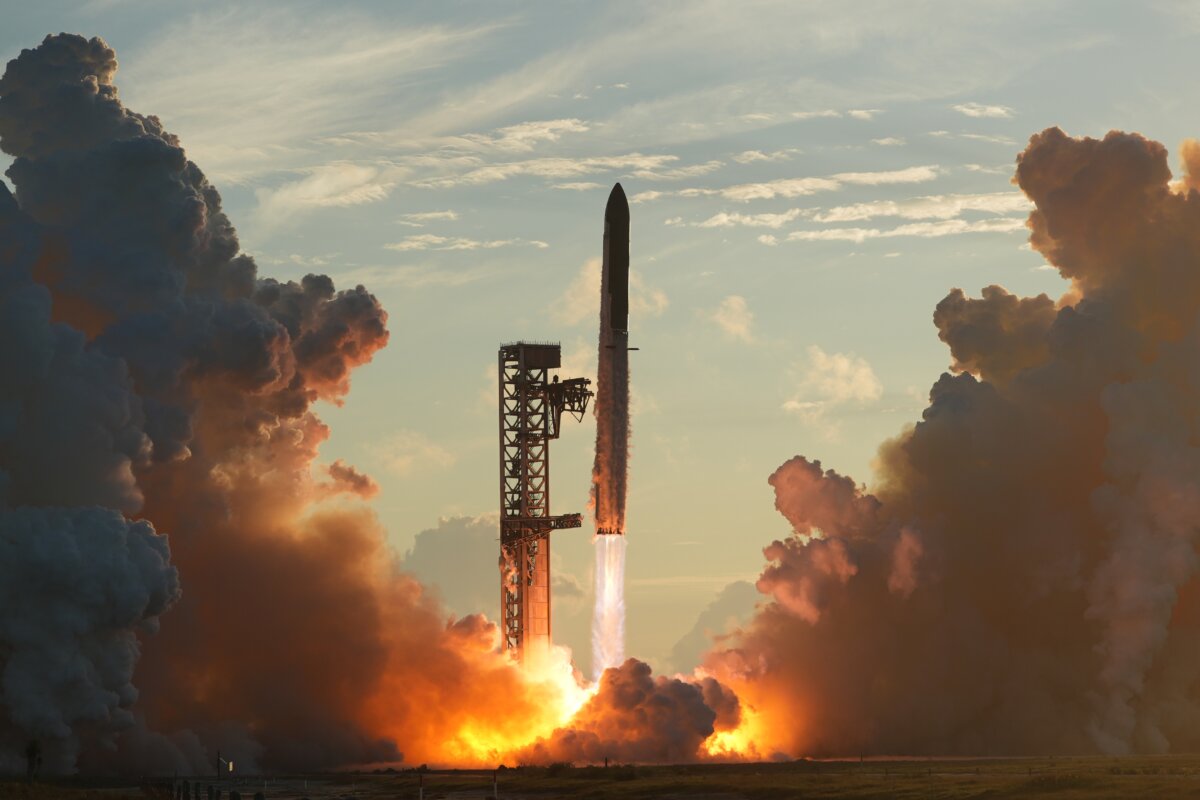

SpaceX successfully sent its Starship on its most ambitious mission yet: a roughly 22-hour-long mission that will set a new personal record time in orbit, with the goal of the upper stage making its first return to the launchpad.
Liftoff came around 5:45 p.m. ET on Nov. 13 from Starbase, Texas. The largest rocket in operation roared over the Gulf of America with every engine on the booster operating nominally. Hot staging came a little more than two minutes into flight with all six engines firing.
The super-heavy booster was supposed to make a controlled return to the launch pad, touching down back at the tower with help from two arms catching it. However, mission leaders aborted the return attempt as the booster fell back toward Starbase. It then made a controlled water landing just off the coast. SpaceX has not caught the Starship booster back at the launchpad since March 2025.
Meanwhile, Starship successfully reached a suborbital staging area where it waited for mission control to give it the go-ahead for orbital insertion. After nearly 20 minutes of suspense, Mission Control gave it the Go, and one Raptor engine was briefly reignited to give the spacecraft the right speed and altitude to stay in orbit.
Applause from SpaceX team members could be heard in the background of the livestream as focus turned to what was to come. Starship got to work deploying another 26 Starlink V3 satellites, and then continued to remain in orbit for several hours.
SpaceX is targeting 14 orbits with three early return checkpoints built into the flight path. If all goes well, Starship will be the first to be caught on the launch pad.
Starship is expected to be the first fully reusable rocket ever built, and a controlled return of both the booster and upper stage to the launchpad is part of that reusability and, ultimately, the fast-turnaround capability SpaceX founder Elon Musk hopes to achieve.
The previous Starship flight was the first to successfully reach low Earth orbit. The original flight plan called for six orbits, but the mission was called off after just one complete trip around the world. That mission also demonstrated the deployment of Starlink satellites.
This second mission demonstrates continued progress in developing the necessary capabilities to return human beings to the lunar surface in 2028. NASA has selected a Starship variant called the Human Landing System as one of the two crew landers vying for the Artemis IV mission to put Americans back on the moon for the first time since 1972.
A Starship variant featuring only the intended nose cone docking port is scheduled to fly and dock with an Orion crew capsule in Earth orbit as part of the Artemis III mission in 2027.