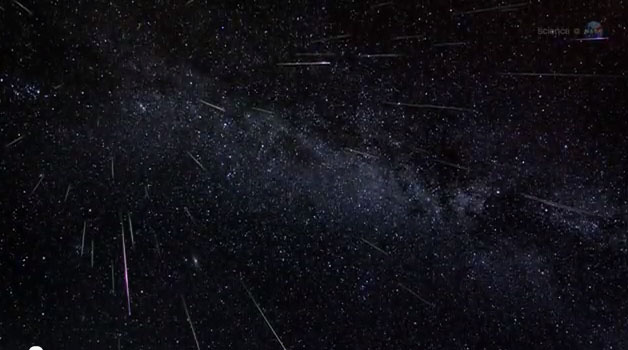

The Draconids Meteor Shower is underway until about October 10.
The meteor show is debris from the dusty tail of Comet 21P/Giacobini-Zinner.
The peak date is actually the night of October 8 and the morning of October 9.
“The Draconids seem to originate, or radiate, from the head of the constellation Draconis, the Dragon. In the USA, this radiant point will be high overhead in the early evening, making this a meteor shower best observed in the evening instead of the early morning,” NASA’s Night Sky Network said.
The Draconis is typically right above the Little Dipper.
“As with observing any meteor shower, get to a dark spot, get comfortable, bring blankets to stay warm, and let your eyes adjust to the dark sky. A cozy lounge chair makes for a great seat, as does simply lying on your back on a blanket, eyes scanning the whole sky,” the network added.
The shower is visible from parts of the United States, Europe, and Asia.
“The time of the eclipse is before sunrise October 8 in North America, and after sunset October 8 for New Zealand, Australia and eastern Asia,” according to EarthSky.
“So clearly after sunset is the best time to hope for seeing Draconid meteors during the lunar eclipse. But – if you’re in New Zealand or Australia – you need to know that this shower is best seen from the Northern Hemisphere.”
The shower is relatively weak and usually offers no more than handful of meteors per hour. Then again, every once in a while it offers bursts of hundreds of even thousands of meteors in an hour.
The meteors in the shower are caused when Earth collides with bits of debris shed by periodic comet 21P/Giacobini-Zinner (and that’s why this shower used to be called the Giacobinids), according to NASA.
“The comet has a 6½-year-long orbit that periodically carries it near Jupiter. Ordinarily, celestial dynamicists would expect the planet’s powerful gravity to scatter anything in its vicinity into varying and unpredictable orbits. But they believe that a stream of particles, ejected in 1900, is still largely intact. The meteors appear to travel from a point near the head of Draco the Dragon, a constellation visible all year for most people with a view of the northern sky.”