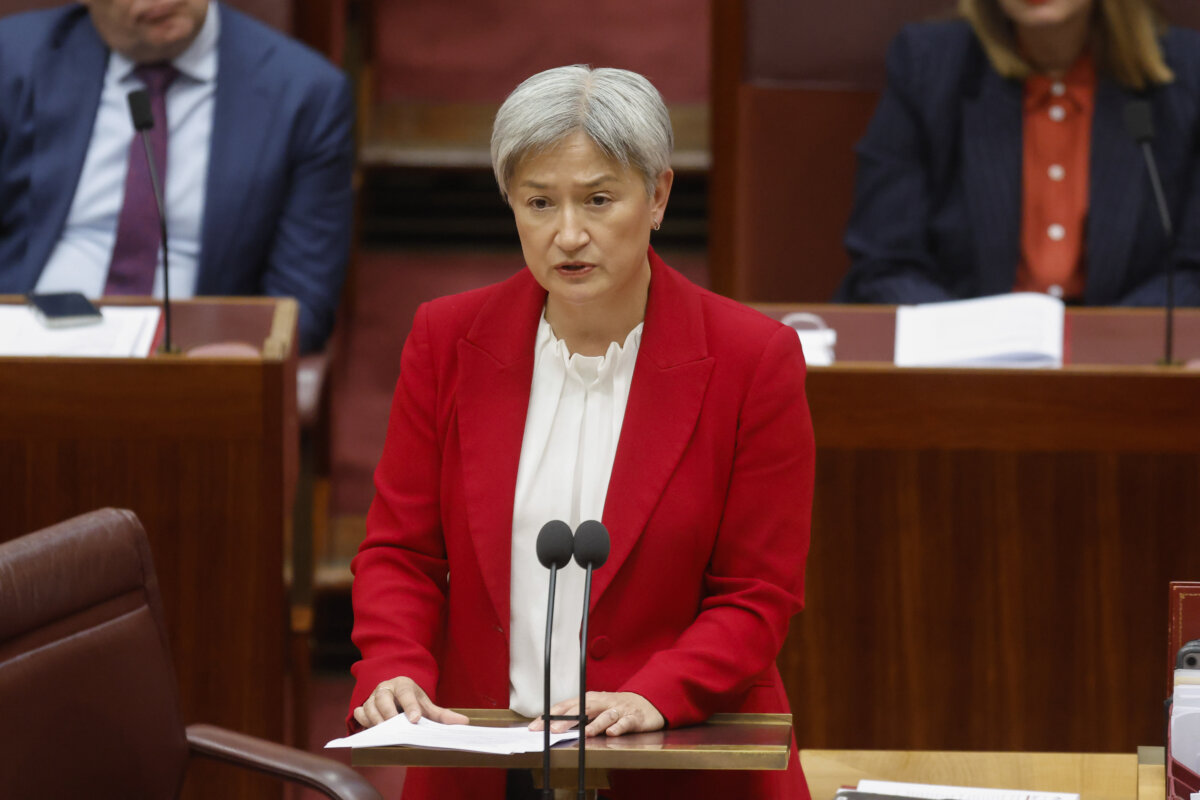

Foreign Affairs Minister Penny Wong has rejected calls to reconsider Australia’s alliance with the United States amid concerns over policy uncertainty under the Trump administration.
In a speech to the Senate on Nov. 24, Wong outlined the Albanese Labor government’s approach to navigating an increasingly complex geopolitical landscape amid ongoing competition between the democratic allies and the Chinese Communist Party (CCP).
“Today, the [U.S.-Australia] alliance enhances Australian security, gives us access to advanced technology and intelligence we could not acquire on our own, and bolsters our capacity to deter aggression through AUKUS force posture initiatives and our wider defense cooperation,” she said.
“Our alliance lifts the capability we bring to our own defense, and in turn to regional stability.
“Our economic relationship is equally important. The United States is Australia’s largest source of foreign investment, and the relationship supports hundreds of thousands of Australian jobs.”
The United States is Australia’s biggest investment partner, a more sophisticated relationship compared to trade ties, which involves buying and selling goods only.
Wong acknowledged the differing approach the Trump administration took towards globalisation.
“Those who say uncertainty about American policy means Australia should abandon America … ignore the vibrancy of American democracy, the dynamism of its economy and its contribution to the prosperity of our region,” she said.
“What they would do is give us fewer choices and leave us more vulnerable, reducing our capacity to contribute to a regional balance in which sovereignty can be protected.”
Since the start of his second term, President Donald Trump has emphasised the “America First” doctrine, which prioritises rebuilding U.S. manufacturing capacity over facilitating trade growth for other nations.
It has also seen a reorganisation of U.S. relations with its allies and other countries, including imposing tariffs and compelling governments to increase defence spending.
However, Wong pointed out that U.S. politics is not static and can change, as demonstrated by the midterm elections in which the Democrats won control of both chambers of Congress.
“As we have seen in recent weeks, the United States is a vigorous democracy with the ability to remake and re-imagine itself,” she said.
“The direction of its foreign policy is still being contested at home in ways that will affect the entire world.”
A Multipronged Approach to Foreign Policy
Despite the importance of the Australia-United States alliance, Wong said the Albanese government had never relied on it alone to “secure our future.”
“Instead, we have shaped it while building greater Australian capability and a wider network of effective partnerships,” she said.
This can be seen in Australia’s efforts to improve relationship with “mid-sized powers” in the region such as Japan, India, Korea and Indonesia through economic and defence cooperation.
“And together with the United States, Japan, and India, we are also working through the Quad [Quadrilateral Security Dialogue] on practical cooperation that supports an open and stable Indo-Pacific,” Wong said.
Bid to Maintain US Ties Comes Amid CCP Aggression
Since coming to power, the Albanese government has sought to “normalise” diplomatic ties with the CCP.
While China is Australia’s largest trading partner and the two countries cooperate in many areas, the government has been forced to grapple with ongoing national security issues.
In February 2025, three CCP warships conducted a series of military exercises in the waters between Australia and New Zealand before circumnavigating the Australian coastline.
According to observers, the deployment sent a clear message about the presence of the CCP’s navy in the Indo-Pacific.
In July 2026, the CCP test-fired a nuclear-capable intercontinental ballistic missile from south-eastern China, sending it on a 6,300-kilometre journey over several countries before landing south-east of the Pacific island nation of Nauru.
The incident drew strong condemnation from the United States, Japan, Australia and other countries.
“We will clearly state our views on issues that matter to Australians,” Wong said.
“We recognize that frank dialog doesn’t eliminate differences, but it does help us manage them, cooperating where we can, disagreeing where we must, and reducing the risk of mistakes and missteps.
“We believe a stable relationship, in which differences can be managed, is better for Australia, better for China, and better for our region.”