
Australia and Pacific nation, the Solomon Islands, have signed a new “historic” bilateral security treaty that effectively sidelines the Chinese Communist Party’s (CCP) previous attempts at establishing a security presence locally.
Days prior to the official announcement on Nov. 25, media reports suggested the 2022 Beijing-Honiara defence pact would not be renewed—the previous deal was due to expire in 2027 and allowed the CCP to station soldiers, police, weapons, and naval vessels in the country.
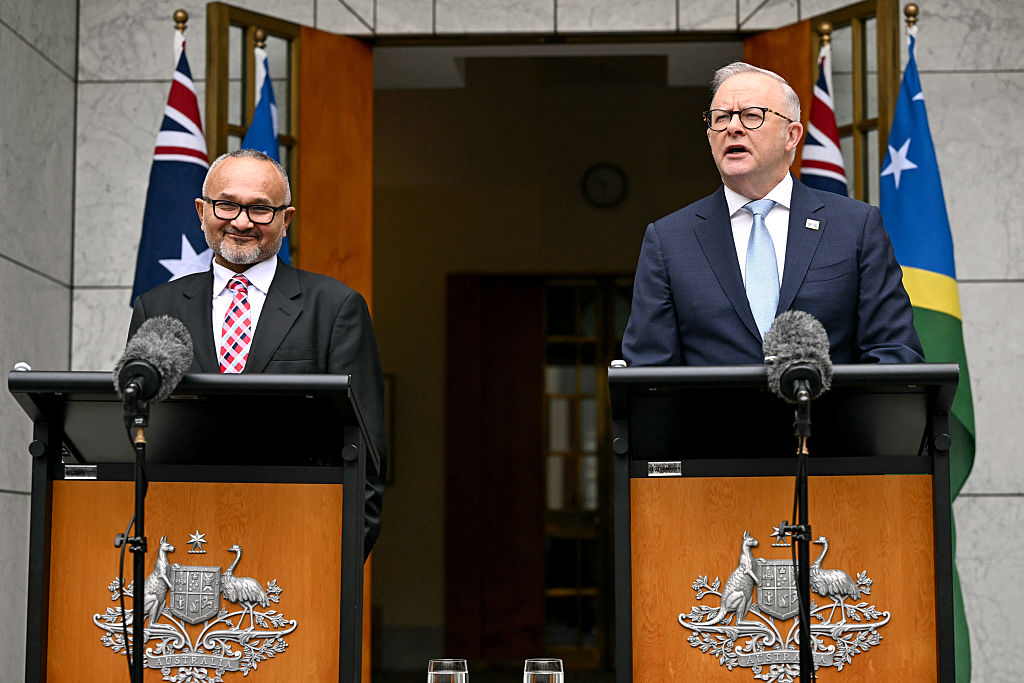
After the signing of the Australia-Solomon Islands Treaty, Australian Prime Minister Anthony Albanese said it marked “a new chapter” in the partnership between the two nations, which aims to strengthen their shared prosperity and security.
“Today, we are delivering on a shared ambition as we sign the historic Australia Solomon Islands Treaty,” he told reporters in Canberra on Nov. 25.
“Two sovereign nations coming together to advance the interests of both of our nations, but also the interests of our region.
“Australia’s future is directly tied to the future of our neighbors, and when our neighbors are stronger, our region is stronger. Backing our Pacific neighbors is an investment in Australia’s own security and our own prosperity.”
Under the Treaty, Australia is recognised as Solomon Islands’ primary security partner, with commitments to support community safety, strengthen its police force, and improve border security.
Meanwhile, the Solomon Islands commits not to allow foreign military or security bases on its territory. Further, sensitive infrastructure, including airports, ports and telecommunications facilities, must remain free from militarisation.
Solomon Islands also commits to seeking security cooperation from members of the Pacific Islands Forum, while consultations on security and infrastructure arrangements with other countries must involve Australia.
Australia is expected to provide substantial economic support to Solomon Islands, including investment in the local economy, infrastructure development, and affordable renewable energy.
Specifically, Australia will spend $740 million (US$489 million) on a range of initiatives in Solomon Islands over the next decade. Of this amount, $670 million will be provided in grants, while the remaining $70 million will be in loans.
The Treaty also covers cooperation in free education, employment and migration opportunities, as well as culture, sports and the arts.
Solomon Islands PM Says Treaty Elevates Bilateral Ties
Solomon Islands Prime Minister Matthew Wale, who visited Canberra with his cabinet, said the Treaty not only reset his country’s relationship with Australia but also elevated it to an enduring partnership.
“Solomon Islands has been for a number of years a source of uncertainty and doubt in the region,” he told reporters.
“Those days are gone. We don’t want to be there again, and that comes by being trusted by our neighbors, and it is important to not only Australia, and New Zealand [but also] the entire Pacific Islands region.”
Wale also thanked the Albanese government for the effort put into the agreement and the speed with which it was finalised, allowing the Treaty to be signed before December.
When asked whether he had spoken to Beijing about ending the security deal with the CCP, Wale said he could not discuss the issue because of a non-disclosure clause.
Meanwhile, Albanese praised Wale’s courageous leadership, saying it had taken the relationship between the two nations to “the next level.”
Wale’s election to the prime ministership signaled a shift away from Beijing, which had been the primary partner of the Solomons under the former Manasseh Sogavare government
Sogavare oversaw the ramping up of Chinese investment locally and also the 2019 decision to abort official diplomatic ties with Taiwan in favour of Beijing.