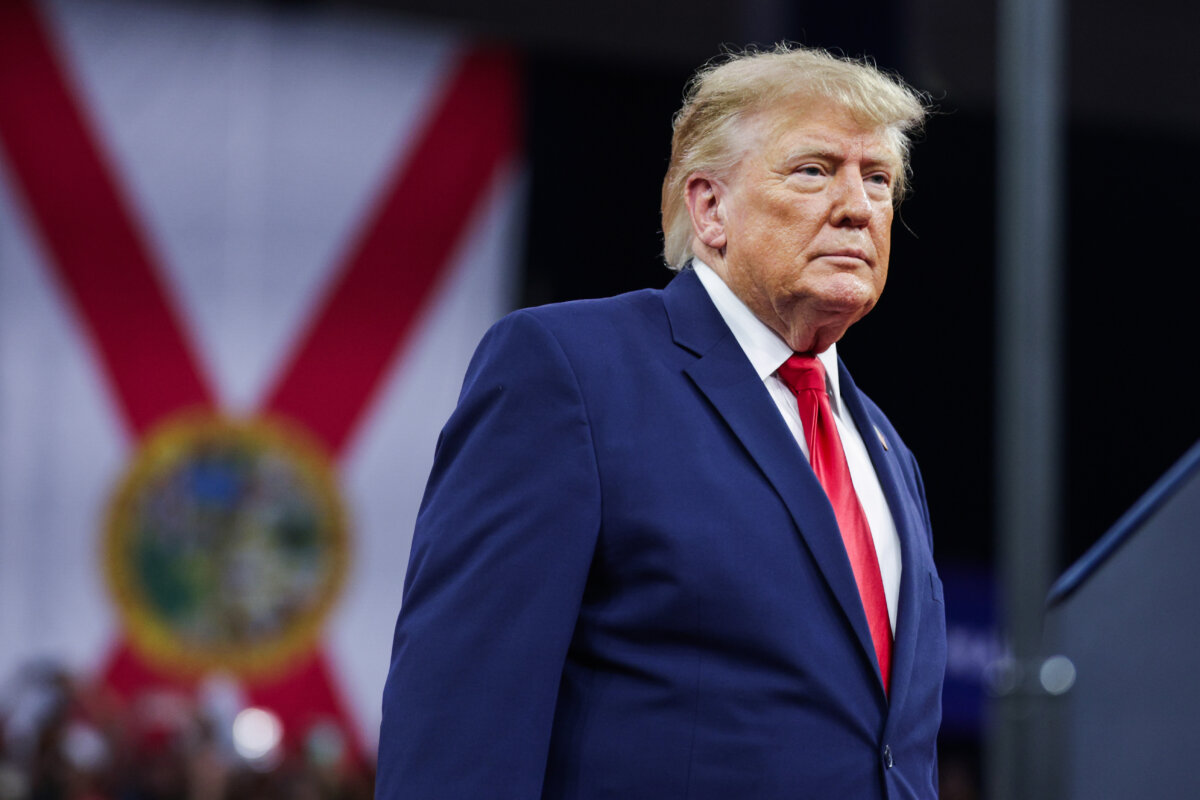

The president said the United States has no immediate plans to launch further military strikes against Iran, despite warnings from Israeli officials that fighting could intensify after the midterm elections.
Speaking in a telephone interview with the Financial Times published on Tuesday, President Donald Trump said Washington was satisfied with the current state of its confrontation with Tehran while remaining prepared for further military action if necessary.
“We seem to be getting everything we want,” Trump told the newspaper.
Senior Israeli officials told Epoch Magazine Israel that Israel was preparing for a prolonged conflict with Iran after the U.S. midterm elections.
Asked about suggestions that military action could resume later this week, Trump said: “I’m ready, we’re ready. We’re locked and loaded if we need to go, but there may be no reason for it.”
The remarks came hours before polls closed in the U.S. congressional midterm elections, which were dominated by voter concerns over inflation and higher energy prices following the conflict with Iran.
Ahead of the midterm elections, the U.S. military struck an Iranian anti-aircraft facility on Monday night. Trump has confirmed to Fox News’ “Fox & Friends” that the operation targeted the site shortly after it was completed.
According to Iran’s state-run IRNA news agency, on Monday, several explosions were heard on Qeshm Island, the largest island in the Persian Gulf and home to radar and drone command-and-control sites.
Despite military escalation warnings on both sides and the latest attack on an Iranian facility, diplomatic negotiations between the United States and Iran are ongoing.
Indirect talks were held in Qatar over the weekend between U.S. and Iranian officials, while Qatari officials confirmed Tuesday that negotiations were continuing.
Conflict Outlook
Iran has warned that any new U.S. or Israeli military action would trigger a broad response.
In a statement reported on Tuesday by Iranian state media, the Iranian military said it had expanded its list of potential targets to include the “enemy’s tangible and intangible assets within range” and vowed “an immediate, effective response without geographical limitations” to any future attack.
In the Financial Times interview, Trump said that Washington was not engaged in a broader war with Iran.
“We’re not really in a war, because we hit them with the B2 bombers and wiped out their nuclear potential incapacity. We then hit them again, Epic Fury. … But if you think about it, we haven’t really had a war with them in a long time, six months, maybe more,” he said.
Trump added that he didn’t regard the conflict with Iran as a war comparable to the war in Ukraine or World War I and World War II.
The Trump administration has repeatedly said that its aim is to prevent Iran from rebuilding its nuclear program. The U.S. president said indirect negotiations with Iran over its roughly 1,000 lb stockpile of highly enriched uranium were continuing.
The IAEA said in a February report that Iran had almost 22,000 lbs of enriched uranium in June 2025. Included in that amount is about 1000 lbs enriched to 60 percent, about 400 lbs enriched to 20 percent, and about 13,000 lbs enriched to 5 percent.
“Even though it’s under hundreds of tons of rock, I would say that I’m not happy that it will be there,” Trump said, referring to the stockpile of highly enriched uranium. “We’re having discussions, and we’ll see how that all works out.”
Oil Markets
The conflict has continued to drive volatility in global energy markets because of concerns over shipping through the Strait of Hormuz, one of the world’s most important transit routes for crude oil and liquefied natural gas.
The security situation has also been complicated by attacks by the Iran-backed Houthis on Saudi Arabia and continued fighting around Yemen, increasing risks to shipping through the Bab el-Mandeb Strait, another critical maritime route connecting to the Red Sea and the Suez Canal.
Oil prices fell on Wednesday, with Brent crude futures down 1.8 percent to $101.68 a barrel by 8:35 a.m. ET, while U.S. West Texas Intermediate crude fell 1.63 percent, to $94.69.
Reuters contributed to this report.







