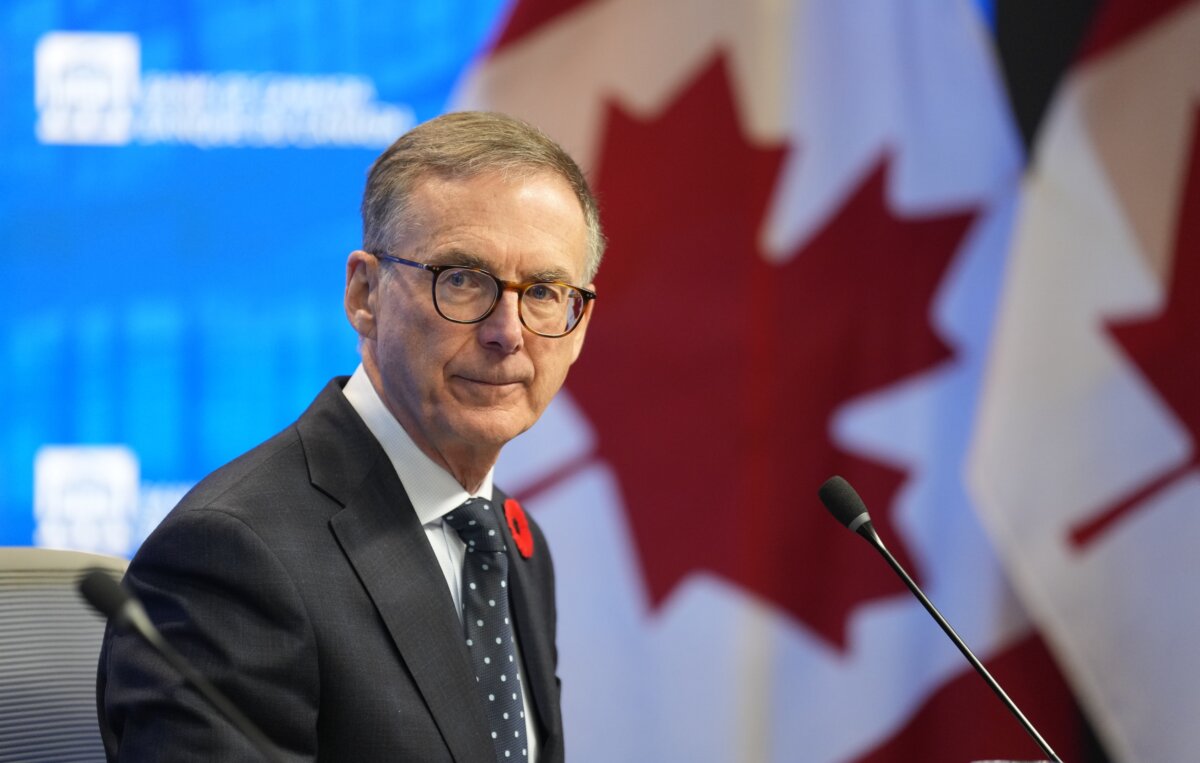

Bank of Canada Governor Tiff Macklem will not seek a second term and will step down next June when his seven-year term expires, the central bank has announced.
The central bank’s board of directors said in a statement that it has begun searching for a successor to take over when Macklem’s term ends on June 2, 2027.
“My time as Governor has seen Canada navigate a more fragmented, shock-prone world. The Bank has faced these challenges by acting decisively, by using sound judgment in the face of uncertainty, and by serving Canadians with humility and a steadfast commitment to its mandate,” Macklem said in the Nov. 16 announcement. “It is a privilege to serve as Governor, and I remain fully committed to fulfilling my responsibilities and delivering for Canadians through the remainder of my term.”
The Bank of Canada said it expects to complete the recruitment process by spring 2027. The board’s independent directors will select the next governor, subject to approval by the finance minister and federal cabinet. The successor will begin a seven-year term on June 3, 2027.
Finance Minister François-Philippe Champagne told reporters on Nov. 16 that Canadians should thank Macklem for “doing a good service for Canadians and serving for a long, long time.”
A reporter asked him if the federal government would look into hiring a candidate with more “diversity traits,” and Champagne replied that Ottawa wants the “best possible candidate to lead one of the most important institutions in our country.”
“The Bank of Canada is serving the interest of all Canadians, and we’ll launch a process where the best possible candidates can apply to replace them in due course,” he said.
Macklem, 65, was appointed governor in May 2020 and took office on June 3, in the early months of the COVID-19 pandemic. His seven-year tenure has spanned the pandemic, trade tensions with the United States, and the conflict involving Iran.
As governor, Macklem also chairs the Bank of Canada’s board of directors and holds several international positions, including chairing the Financial Stability Board’s Standing Committee for the Assessment of Vulnerabilities. He is also a member of the board of the Bank for International Settlements.
Macklem first joined the Bank of Canada in 1984, working in its monetary and financial analysis department for a year before returning in 1989 after completing his doctorate in economics. He held increasingly senior positions in the research department before becoming an adviser to the governor in 2003 and a deputy governor in December 2004.
He served as associate deputy minister of finance and represented Canada at the G7, G20, and Financial Stability Board from 2007 to 2010. He became senior deputy governor of the Bank of Canada in 2010, a position he held until 2014.
He left the central bank in 2014 to become dean of the University of Toronto’s Rotman School of Management, a position he held for six years. During that period, he also served on Scotiabank’s board of directors.
Gerald Bouey, who served as governor from 1973 to 1987, was the last Bank of Canada governor to serve two terms after his 1980 appointment.
The new governor will inherit a monetary policy framework renewed by the central bank and federal government on Nov. 5. The framework retains a 2 percent inflation target, which is the midpoint of a 1 to 3 percent control range.
The Bank of Canada is responsible for issuing Canadian banknotes, providing banking services to the federal government, and promoting the stability of the country’s financial system. It also sets monetary policy aiming to keep inflation low and predictable.