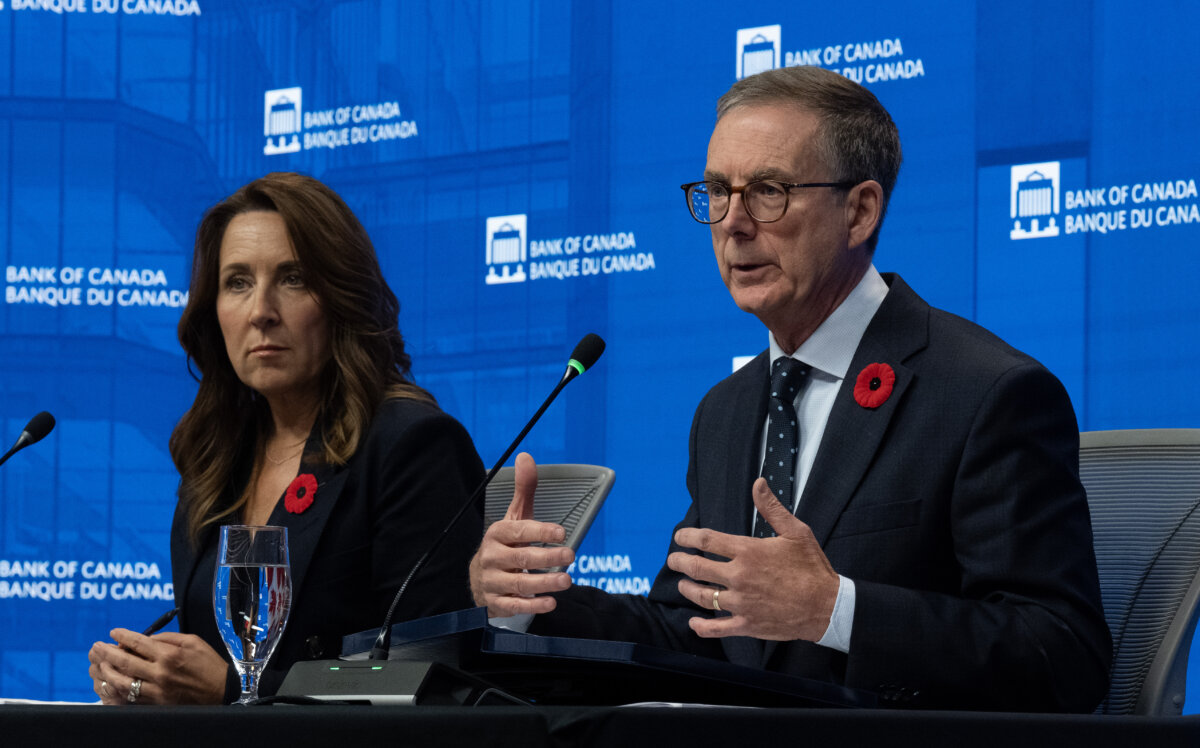

After holding interest rates steady for seven quarters in a row, the Bank of Canada raised its key rate from 2.25 percent to 2.5 percent in response to rising inflation.
Bank of Canada Governor Tiff Macklem said on Oct. 28 that the increase was meant to prevent higher global energy prices from leading to generalized inflation in Canada. He also signalled that more interest rate increases may be needed.
The Bank also released its quarterly Monetary Policy Report (MPR), outlining its latest forecasts for inflation and the economy.
Rate Increase Aimed at Inflation
The Bank of Canada had expressed more optimism around inflation projections in early July, when Macklem said the economic data had increased policy makers’ “confidence that the economy is indeed working its way through this period of global upheaval.” At that time, the United States and Iran had reached a ceasefire and were in talks to end the conflict that had roiled energy markets.
After the U.S.–Iran war resumed in July and oil prices rose again, Macklem warned in September that inflation risks had increased. Canada’s inflation rate came in at 3.1 percent for the month of September after sitting at 3 percent in August, which led the Bank to hike interest rates.
Macklem said oil prices were expected to remain “higher for longer,” and could pressure prices for goods. “The governing council has recognized that the risk for inflation has gone up, and that there is now less latitude to provide monetary easing,” Macklem said.
Macklem said further interest rate increases may be needed in the months ahead, but said the bank would be “proceeding with caution” given uncertainty around inflation.
Echoes of Pandemic Inflation
At the press conference after Macklem’s opening statement, he was asked if the rate increase was a response to the central bank’s “delayed” reaction to the post-COVID-19 pandemic inflation wave. Macklem said there was “no question we learned a lot from the pandemic.”
Macklem said the bank had built a new economic model that can more accurately capture how higher energy prices can lead to inflation, and this will help it make decisions on interest rates. However, he noted that COVID-19 inflation was due to the economy being “overheated” and unable to produce all the goods people wanted.
“That’s not the situation we’re in today. We have less slack in the economy today than we had a year ago, but there is still some slack,” Macklem said.
Inflation hit a high of 8.1 percent in June 2022, which led the Bank of Canada to raise its key interest rate from 1.5 percent in June to 2.5 percent in July, before raising it again to 3.25 percent in September. The bank increased rates to 5 percent by July 2023, before eventually easing them again in June 2024.
Global Energy Disruptions
The price of West Texas Intermediate (WTI) is over US$100, as the Russia-Ukraine war, U.S.–Iran war, and Saudi Arabia-Houthi conflict have disrupted global energy supplies throughout 2026.
The bank said there is “no clear path to resolution” in the U.S.–Iran war, which sent oil prices markedly higher in March after Tehran down the Strait of Hormuz waterway.
The bank’s Monetary Policy Report projects that oil prices will fall throughout 2027, reaching around $80 by 2028. It also projects that Canada’s inflation rate will average 3 percent in 2027, up from its earlier July prediction of 2 percent, before falling back to 2 percent by the middle of 2028.
However, the bank’s oil price predictions for January, April, and July turned out to be inaccurate, with oil rising higher following each report.
In addition to oil prices adding inflationary pressures, U.S. tariffs and a lower Canadian dollar are adding to import costs, the MPR said.
Canada–US Trade
The MPR said Canada’s GDP growth has been “weak and volatile” since the United States first imposed tariffs on Canada at the beginning of 2025, but said the economy has adapted to the uncertainty. The bank noted that while some sectors have been heavily hit by tariffs, the majority of trade between the two countries remains tariff-free.
The average U.S. tariff rate on Canada is currently 7.5 percent, while the average Canadian tariff rate on the United States is 3.9 percent. In July, the average U.S. tariff rate was 5 percent, while the average Canadian rate was 1.5 percent.
The United States has placed a broad range of tariffs on Canada, including recent 50 percent tariffs on $27.6 billion worth of Canadian goods. Ottawa responded with its own retaliatory tariffs on $27.6 billion worth of U.S. imports.
The MPR said the direct impact of the latest U.S. tariffs is “concentrated in a relatively small share of Canadian exports.” It said Canada may see more businesses delay expansion and hiring plans in response to tariffs, which could weigh on economic growth.
Oil and Gas Improve Economic Trajectory
The MPR said the outlook for Canada’s economic growth has improved since the July report, with expectations of 1 percent growth in 2026 and 2 percent in 2027. July’s report predicted growth of 0.7 percent in 2026 and 1.8 percent in 2027.
The report said the improvement is due to higher GDP growth in mid-2026, along with higher business investment and consumer spending expected for next year.
The report also said that higher oil prices have boosted the oil and gas sector’s profits, investment and hiring, and government revenue. Additionally, rising U.S. investment in AI is likely to boost demand for Canadian raw materials, metal products, and electrical equipment, and the depreciation of the Canadian dollar makes the country’s exports more competitive, according to the report.
However, the bank’s more optimistic projections run counter to those of the Parliamentary Budget Office, which recently projected growth of 0.9 percent in 2026, down from its forecast of 1.1 percent in June, and 1.5 percent in 2027, down from 1.6 percent.
Risks to Forecast
The MPR said that Canada’s trade relationship with the United States and global energy prices remain the most important risks to Canada’s economic trajectory.
The bank’s economic model assumes that shipping through the Strait of Hormuz will gradually return to normal, which would lower inflation levels, but said further supply disruptions could push prices higher and raise inflation further.
The MPR said the Iran war could also be quickly resolved and oil shipments from the region could return to normal sooner. Additionally, if the oil refining infrastructure damaged in the wars is repaired quicker than expected, this could also put downward pressure on fuel prices and inflation.
While the bank’s model also assumes that U.S. tariffs will remain in place and the impacts of trade-related uncertainty on Canada’s economy will gradually diminish, further U.S. tariffs could weaken Canadian exports and business investment. The United States has threatened to raise tariffs on automotive and steel products from 25 percent to 50 percent from Jan. 1, 2027, in response to Ottawa’s counter-tariffs.
The report said Canada and the United States could also reach a trade deal that reduces tariffs and uncertainty, which would increase exports and business investment.