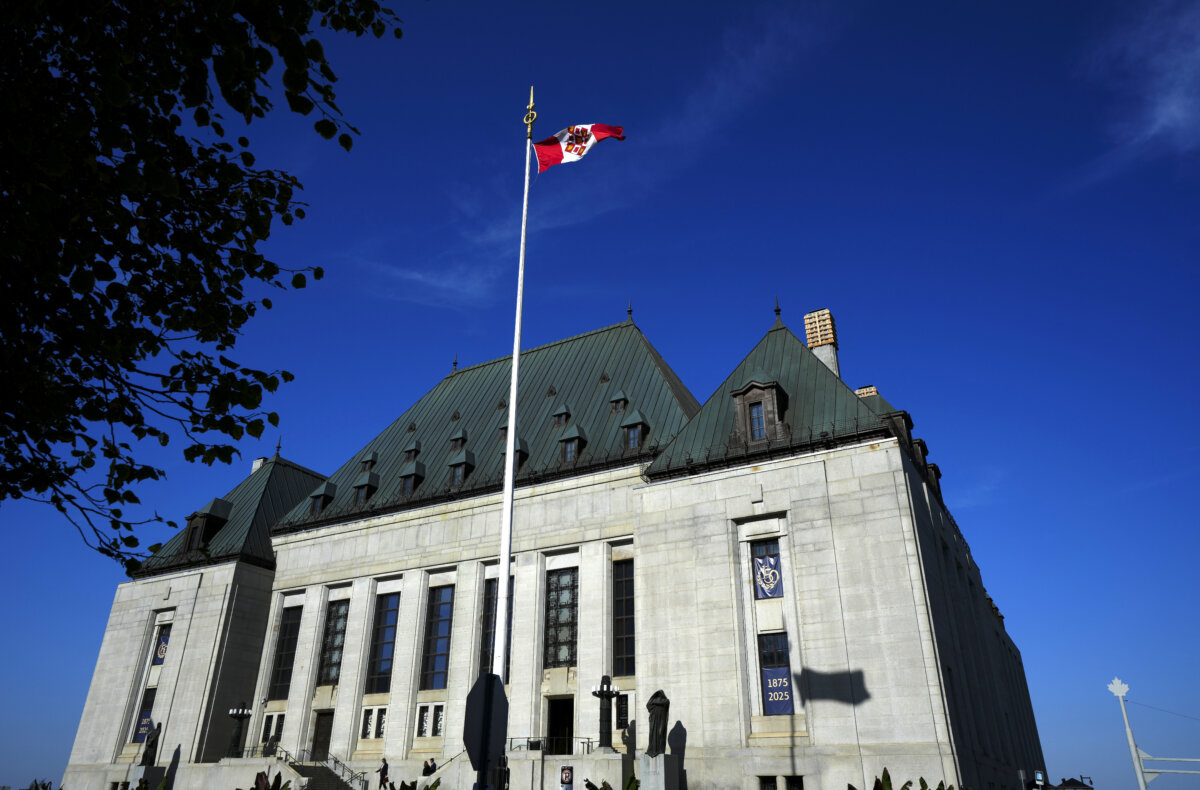

The Supreme Court of Canada has largely upheld Quebec’s Bill 21, the province’s secularism law that bars public servants from wearing religious symbols at work.
The court’s Nov. 27 landmark decision affirms the province’s ban on religious symbols including the hijab and the cross for specified public-sector employees such as teachers and police officers.
Chief Justice Richard Wagner, who wrote the lead majority opinion, said the law is consistent with Quebec’s historic approach to secularism.
Quebec passed the law in 2019 by invoking the notwithstanding clause, a part of the constitution that allows governments to override certain rights, including freedom of religion.
The Supreme Court upheld Quebec’s use of the notwithstanding clause, saying it validly invoked Section 33 of the Canadian Charter of Rights and Freedoms with one exception.
All seven justices agreed unanimously that prohibiting members of Quebec’s National Assembly from wearing face coverings violates the democratic rights guaranteed by Section 3 of the Canadian Charter of Rights and Freedoms, including the right to vote and seek legislative office.
A 4-3 majority led by Justice Nicholas Kasirer affirmed that Canadian courts can issue non-binding rulings about whether a law complies with the Charter of Rights and Freedoms, even when the notwithstanding clause has been invoked.
However, a separate 4-3 majority led by Wagner declined to make that determination in this case. As a result, the Supreme Court has not formally declared that Bill 21 infringes the Charter, with the noted face coverings exception.
The court’s refusal to make the requested declaration means the Supreme Court did not formally declare Bill 21’s religious-symbol restrictions a Charter infringement. It also dismissed claims by the English Montreal School Board that Bill 21 violated minority-language rights and infringed on gender equality.
The school board had argued that Bill 21 limits its ability to hire or promote certain employees. The board also maintains that the Canadian Charter protects its right to manage its education system.
Wagner argued that Bill 21 “does not impede the transmission of either the English language or the cultural references of this minority in a manner that is inconsistent with the preventive, remedial and unifying objectives” of Section 23 of the Charter.
English Montreal School Board Chair Joe Ortona said the board was “very disappointed with the decision.”
“It wasn’t the result we were looking for,” Ortona said, while speaking to reporters in Ottawa. “Even though I know that this decision is very disappointing for a lot of people today, the sun comes up tomorrow.”
He noted that Quebec now has a minority government, and the province’s use of the notwithstanding clause for Bill 21 is due for renewal in 2029. The clause remains valid for a five-year period and can be renewed by the legislature for further five-year periods.
Other groups challenging the law included the Canadian Civil Liberties Association (CCLA), the National Council of Canadian Muslims, and the Fédération autonome de l’enseignement teachers’ union.
The CCLA said the court had paved the way for declarations of rights infringements in future cases.
“This possibility, combined with the Court’s recognition of structural limits in the Constitution against extreme rights violations, sends a message that even shielded laws cannot escape scrutiny entirely,” the group said.
The National Council of Canadian Muslims called the court’s ruling “a dark moment for Canadian democracy.”
“The ruling upholds politicians’ ability to override much of Canadians’ Charter rights, including the right to religion and to conscience,” the group said on X. “While there are a number of dissenting judges, this decision represents a dark day in our constitutional democracy.”
‘Rules of the Game Have Just Changed’
Premier Paul St-Pierre Plamondon called the court’s ruling a “good day for secularism in Quebec,” but said it was not a victory for provincial autonomy.
“The rules of the game have just changed without any political discussion with provinces,” he told reporters in Quebec City.
“From now on, the fact of invoking article 33 doesn’t prevent courts to say what they think about it and they will do so without the participation of provinces. So it raises the question: is it really the mission of courts to enter the political arena?”
He was asked if he was concerned the federal government might use its power of disallowance to invalidate a provincial law.
Disallowance is a historical constitutional power in Canada that allows the federal government to invalidate and cancel a law passed by a provincial legislature. It was last used in the 1940s.
St-Pierre Plamondon said such action would be “even more serious than if the Supreme Court had invalidated the notwithstanding clause and secularism today.”
Interim leader of the Coalition Avenir Québec Mathieu Lévesque described the court’s decision as a “victory for the Quebec nation and for the Coalition Avenir Québec, whose actions have today been fully validated.”
“It is thanks to the CAQ that the secularism law exists, that our model of living together, our values and our way of life are respected in Quebec, starting with a fundamental principle: the separation of state and religion,” Lévesque said in a social media post. “It was the CAQ that had the courage to act on this issue.”
Bill 21 became law in Quebec in June 2019, prohibiting public-sector workers in authoritative roles—such as public school teachers, principals, vice-principals, police officers, Crown prosecutors, government lawyers, and judges—from wearing religious symbols while on duty.
It also requires people who provide or receive public services to keep their faces uncovered, with limited exceptions for reasons such as health conditions or disability.