
Australia and the Philippines signed an updated defense agreement on Nov. 15 intended to speed up joint military activities, including maritime patrols, as Manila seeks to strengthen its defenses in the disputed South China Sea.
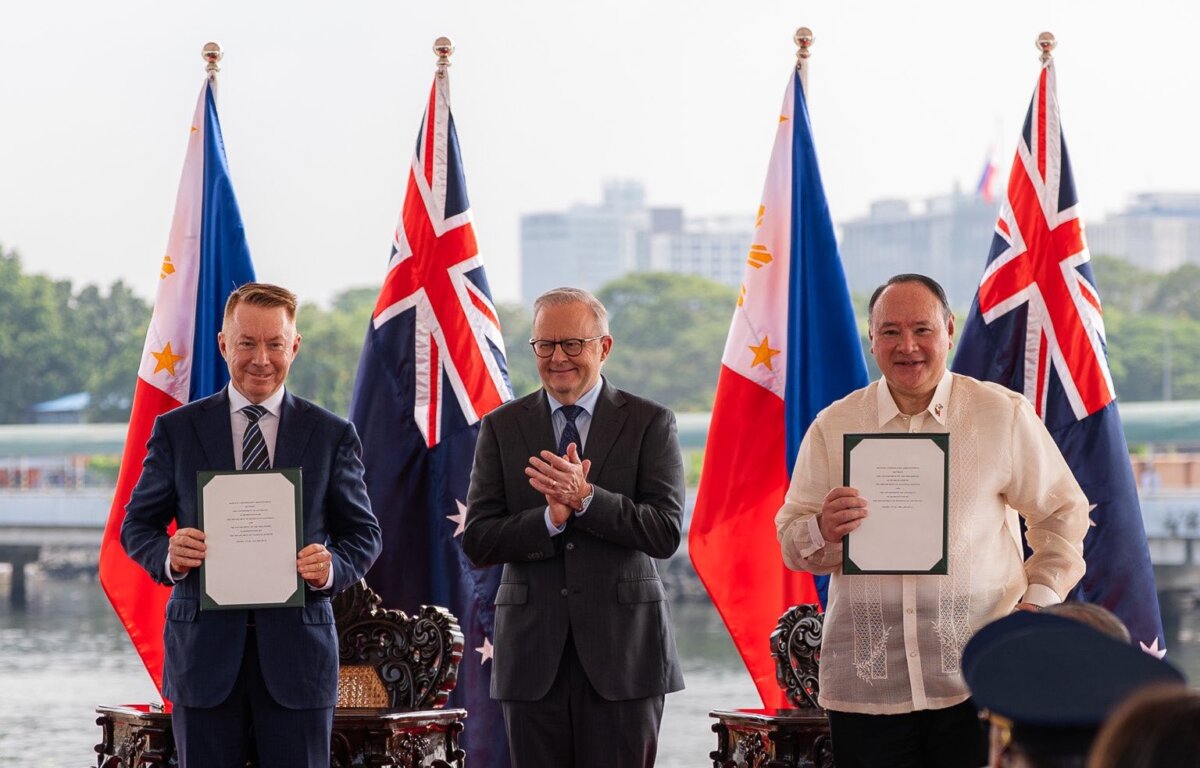
Philippine Defense Secretary Gilberto Teodoro Jr. and Australian Ambassador Marc Innes-Brown signed the arrangement in Manila, with Australian Prime Minister Anthony Albanese witnessing the ceremony. It supersedes and expands on a defense cooperation memorandum dating to 1995.
Teodoro said the new arrangement would help the two militaries coordinate maritime patrols and other activities more quickly, including operations with additional partner countries.
The signing took place under the backdrop of repeated confrontations between Chinese and Philippine vessels in waters where Beijing’s expansive maritime claims overlap with those of Manila.
Faster Joint Military Operations
The arrangement is intended to simplify how the two countries organize military activities under their existing Status of Visiting Forces Agreement, which entered into force in 2012.
The visiting-forces agreement provides a legal framework for Australian military personnel participating in approved activities in the Philippines. The new arrangement is intended to reduce the administrative steps needed to carry out those activities.
“It is the anti-red tape measure of our SOVFA,” Teodoro said, referring to the visiting-forces agreement.
He said the arrangement would also make it easier to organize joint air and land activities and speed up military assistance during natural disasters.
According to the Australian government’s Nov. 15 announcement, it covers improved monitoring of activities at sea, information sharing, military planning, training, and defense infrastructure development.
Australian Defense Minister Richard Marles said it would create further opportunities for joint military exercises, maritime operations, and infrastructure projects.
The signing completes an effort launched in August 2025 to expand and modernize the countries’ 1995 defense cooperation memorandum.
South China Sea Dispute
The Philippines has sought closer defense cooperation with regional partners amid repeated confrontations with Chinese vessels in the South China Sea.
In an Aug. 7 joint statement, Teodoro and Marles expressed concern over dangerous actions by Chinese coast guard vessels near Second Thomas Shoal that injured Philippine navy personnel. They also cited water-cannon attacks and vessels being rammed as conduct that could increase the risk of escalation.
Teodoro said the new agreement would strengthen Manila’s ability to deter threats in waters under Philippine jurisdiction, including the West Philippine Sea—the Philippine name for parts of the South China Sea that Manila claims.
“It will bolster our credible deterrence posture in areas where we have jurisdiction,” he said.
Albanese, however, rejected the suggestion that the agreement is directed against China.
“This isn’t aimed at any one country,” he said at a Nov. 15 press conference aboard the Australian naval support ship HMAS Stalwart in Manila.
He said Australia supported national sovereignty, international maritime law, and freedom of navigation, noting that most Australian trade passes through the South China Sea.
Wider Defense Cooperation
Australia and the Philippines already conduct extensive military activities together.
Albanese said their cooperation involves as many as 200 activities and approximately 2,500 to 3,000 Australian military personnel. Australia also made its largest contribution to the annual Balikatan military exercises in 2026, he said.
The agreement follows an Oct. 28 meeting at which the defense chiefs of Australia, Japan, the Philippines, and the United States committed to establishing a Combined Coordination Center in the Philippines and expanding joint exercises.
That four-country initiative is separate from the bilateral arrangement signed on Nov. 15.
Australia separately announced additional maritime security assistance for Southeast Asian partners, including drones, secure communications equipment, and training to improve their ability to detect maritime and cybersecurity threats. The government did not specify a funding amount or say that all the assistance would go to the Philippines.
Asked whether the new agreement would mean more resources or more frequent Australian freedom-of-navigation operations in the South China Sea, Albanese did not announce an expansion.
He said Australia would continue those operations despite differences with Beijing and had no intention of changing its approach.