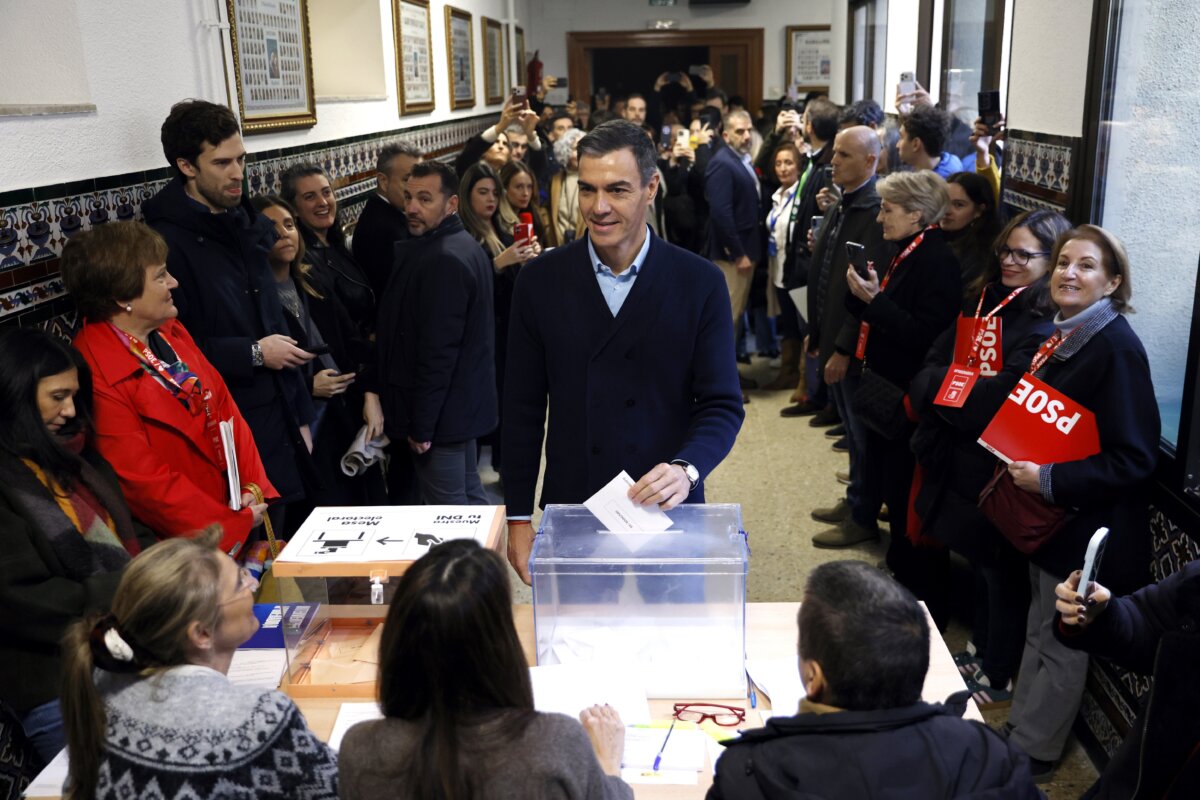

MADRID—Spaniards go to the polls on Nov. 29 in a snap general election that could end Socialist Prime Minister Pedro Sánchez’s eight years in power and bring the national-conservative party Vox into national government for the first time.
Sánchez called the early election on Oct. 5, three days after Congress rejected his government’s housing decrees. He asked voters to give him a “much broader” progressive left-wing majority.
Polling results, published before Spain’s blackout on opinion polls began on Nov. 24, put Alberto Núñez Feijóo’s center-right Popular Party (PP) ahead but suggested it would need the support of Vox, led by Santiago Abascal, to secure the 176 seats needed for a majority in the 350-seat Congress. Pollsters 40dB and Sigma Dos projected around 190 seats for the two parties combined, while state polling institute CIS put the Socialists ahead.
Housing is the top concern for Spanish voters, according to a November CIS report, followed by the economy, job quality, and immigration.
Corruption cases involving Sánchez’s party and family, and concerns about the integrity of the voter rolls have also been major campaign issues.
“Almost everything is at stake: freedom, democracy and the historical continuity of the Spanish nation,” Hermann Tertsch, a Spanish member of the European Parliament for Vox, told The Epoch Times.
Sánchez has taken aim at the idea of a PP government with Vox, saying in an interview with the daily El País in October that it would be “a 50-year step backward.”
Immigration gained prominence in the campaign after a July border crisis in Ceuta, a Spanish city of about 84,000 people on the North African coast. Feijóo spent part of the Nov. 28 day of reflection there—a day of electoral silence before a general election.
On July 30 and 31, about 72,000 immigrants entered Ceuta from Morocco, according to the Interior Ministry. Juan Jesús Vivas, the president of Ceuta, has put the number at “close to 100,000.”
Immigration and Ceuta
The crossings were made a month after the June 30 deadline of Spain’s extraordinary regularization program for illegal immigrants and asylum seekers already living in the country. The government had estimated about 500,000 beneficiaries. It received 1,174,978 applications.
The PP and Vox say the program encouraged the largely illegal crossings. A nonbinding resolution drafted by the PP’s group in the European Parliament and adopted on Sept. 17 by 339–225 votes said the policy “acts as a pull factor.”
Sánchez has said that “nobody could anticipate the magnitude of the crisis” in Ceuta, and argued that regularizing illegal immigrant workers has benefited the pension system because they now pay into social security.
 Spain’s center-right wing opposition People’s Party (PP) leader Alberto Nunez Feijoo waves during an election campaign rally in Barcelona on Nov. 27, 2026. (Josep Lago/AFP)
Rodrigo Ballester, a Spanish policy analyst and former European Commission official, told The Epoch Times that pressure from Vox has led the PP to take a firmer line on immigration.
A coalition of the two could “stop granting nationality so lightly” and speed up deportations, he said, though such choices are, with current laws, “very limited by judges at both the national and European level.”
Corruption Cases
Feijóo responded to the election call on Oct. 5 by describing the vote as a choice “between corruption and decency.” Tertsch called corruption “the main issue.”
The court cases involve former senior figures of the Socialist Party and two members of the prime minister’s family. In June, the Supreme Court sentenced José Luis Ábalos, a former transport minister and senior party official, to more than 24 years in prison over kickbacks from COVID-19-era mask contracts.
Former Socialist Prime Minister José Luis Rodríguez Zapatero is under investigation for alleged influence peddling regarding a 53 million euro state loan to the airline Plus Ultra in 2021, which he denies.
In July, a provincial court convicted the prime minister’s brother, David Sánchez, of malfeasance over a public job created for him and barred him from office for nine years. The prime minister’s wife, Begoña Gómez, has also been ordered to stand trial before a jury on charges of alleged influence peddling and embezzlement.
A Civil Guard report filed with the National Court in October alleges that a former judge, working with former Socialist Party member Leire Díez, approached a drug-trafficking clan about harming the judge who investigated David Sánchez, Spain’s public broadcaster RTVE reported. The former judge denies it.
“They tried to hire a drug trafficker to kill a judge who was investigating Sánchez’s brother. Imagine that. It happened, it has been published, everything is known, and nothing happens,” Tertsch said.
“Zero corruption does not exist, but zero tolerance does,” Sánchez said in the final televised debate on Nov. 26. He has called his failure to detect Ábalos’s corruption his biggest mistake in office, maintains that his wife and brother are innocent, and says his party had nothing to do with Díez’s actions.
“I am a politician of integrity, and my government is a clean government,” he said.
Dispute Over Voter Rolls
The PP and Vox have questioned postal voting and voter rolls during their campaigns.
On Oct. 5, Abascal urged his supporters not to vote by mail, saying on Antena 3 he did not trust “absolutely anything” Sánchez might do.
On Nov. 27, the PP filed a complaint with the Central Electoral Board, alleging “serious incidents” in the delivery of postal voting documents by the state-owned postal service Correos. The postal service says the documents were all made available to applicants.
On Nov. 27, Justice Minister Félix Bolaños responded on La Septima by accusing the PP and Vox of spreading “wholesale lies” about the postal vote.
The dispute over the rolls also stems from a 2022 law granting citizenship to descendants of those exiled during the Spanish Civil War and the Franco era.
“After the law was published, the sister of Sánchez’s infamous former transport minister fraudulently reinterpreted it,” Ballester said. Under the new reading, he said anyone who had emigrated between 1936 and 1955 was presumed an exile, without having to provide specific proof.
 Leader of the VOX, Santiago Abascal looks on his party’s final rally before the General Election in Valencia, Spain, on Nov. 27, 2026. (David Ramos/Getty Images)
Only 901, or 0.8 percent, had submitted proof that their ancestors were exiles. But the Supreme Court allowed about 190,000 of their adult children to vote.
Ballester said the risk of fraud was “so vast” that the court stepped in, though its order left the children untouched.
“As a result, 190,000 voters with no tie to Spain will cast ballots on polling day, and the authorities refuse to say where,” he said.
Spain has no separate constituency for voters living abroad, so they vote in their province of origin or last residence. Ballester argued that those with neither could be assigned to constituencies where a small number of votes could make a difference and encouraged to vote a certain way.
“The risk is real and the electoral impact would be decisive,” he said. He pointed to the last election, in which a dozen seats were decided by a few hundred or a few thousand votes, adding he was “shocked” that the Organization for Security and Cooperation in Europe (OSCE) had not sent observers.
“We do not rule out election rigging,” Tertsch said.
The OSCE’s election office, which visited Spain in late October, reported that everyone it consulted “expressed a high level of confidence in the electoral process” and recommended against a mission.
During the debate, Sánchez accused his rivals of spreading claims of fraud and asked whether they would accept the election results. In response, Feijóo said he would resign if he did not become prime minister and challenged Sánchez to do the same.
Washington and Beijing
Sánchez brought his disagreements with Washington into the campaign on day one, when he listed among his government’s achievements its refusal to raise defense spending to 5 percent of gross domestic product, the NATO target backed by U.S. President Donald Trump and all of NATO’s 30 other member countries. Feijóo challenged him over Spain’s reduced 2.1 percent NATO commitment in the Nov. 26 debate.
In March, Sánchez denied U.S. forces the use of the Rota and Morón bases in southern Spain for strikes on Iran, leading Trump to threaten to cut off trade with Spain.
“Sánchez has made us enemies of almost every Western country,” Tertsch said.
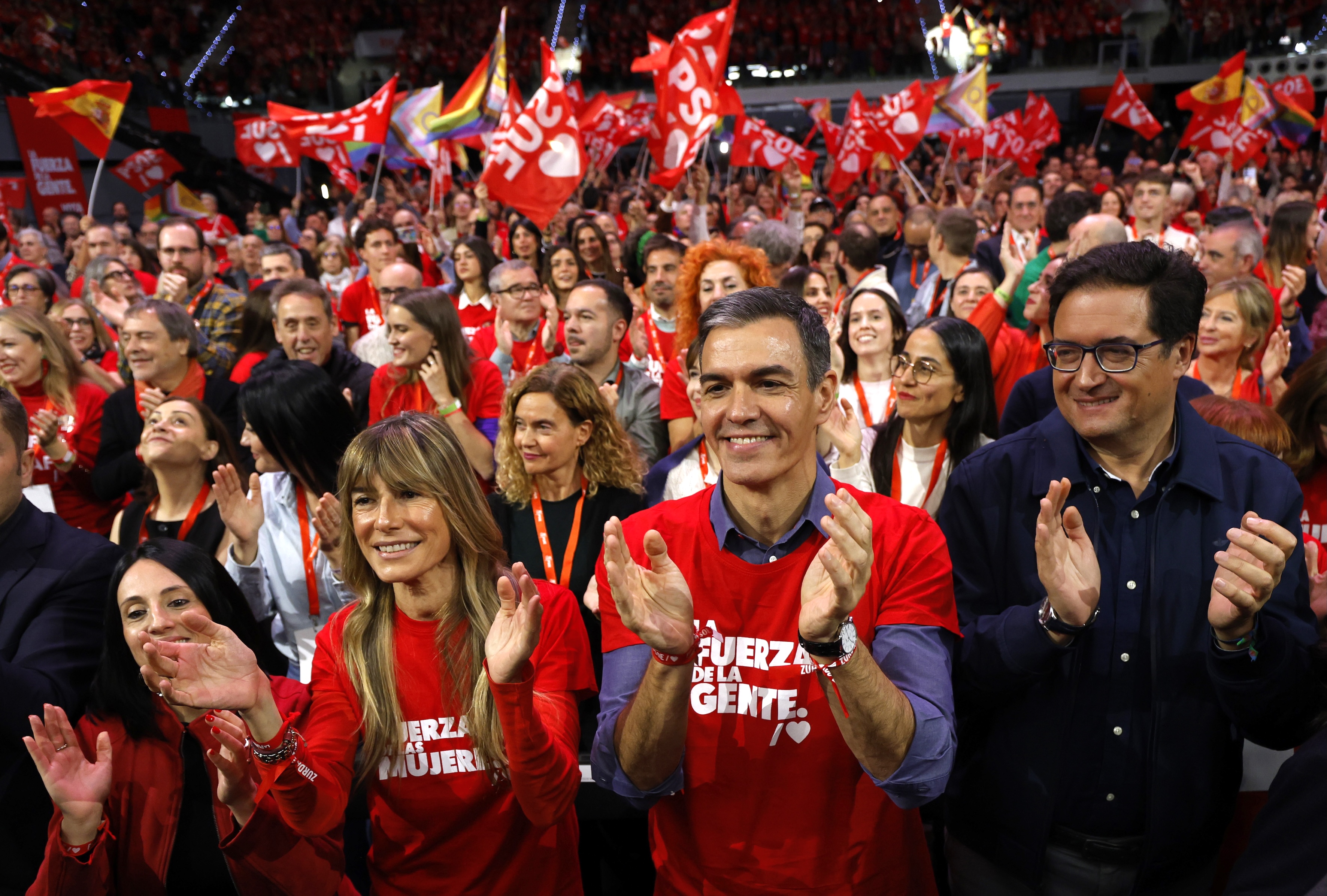 Prime Minister of Spain Pedro Sánchez and his wife Begoña Gomez attend a PSOE rally at the La Caja Mágica in Madrid, Spain, on Nov. 27, 2026. (Pablo Blazquez Dominguez/Getty Images)
“To oppose the United States, he wanted to position himself as the champion of relations with China,” Ballester said.
Government contracts with the China-based telecom firm Huawei have drawn warnings from Washington and Brussels. In July 2025, the chairmen of the U.S. Senate and House intelligence committees asked for a review of intelligence sharing with Spain after its Interior Ministry awarded Huawei contracts worth 12.3 million euros for wiretap systems.
Tertsch called Huawei’s role in Spanish security systems “an enormous security danger” for Spain and its allies.
He and Ballester both said a right-wing government would improve relations with Washington.