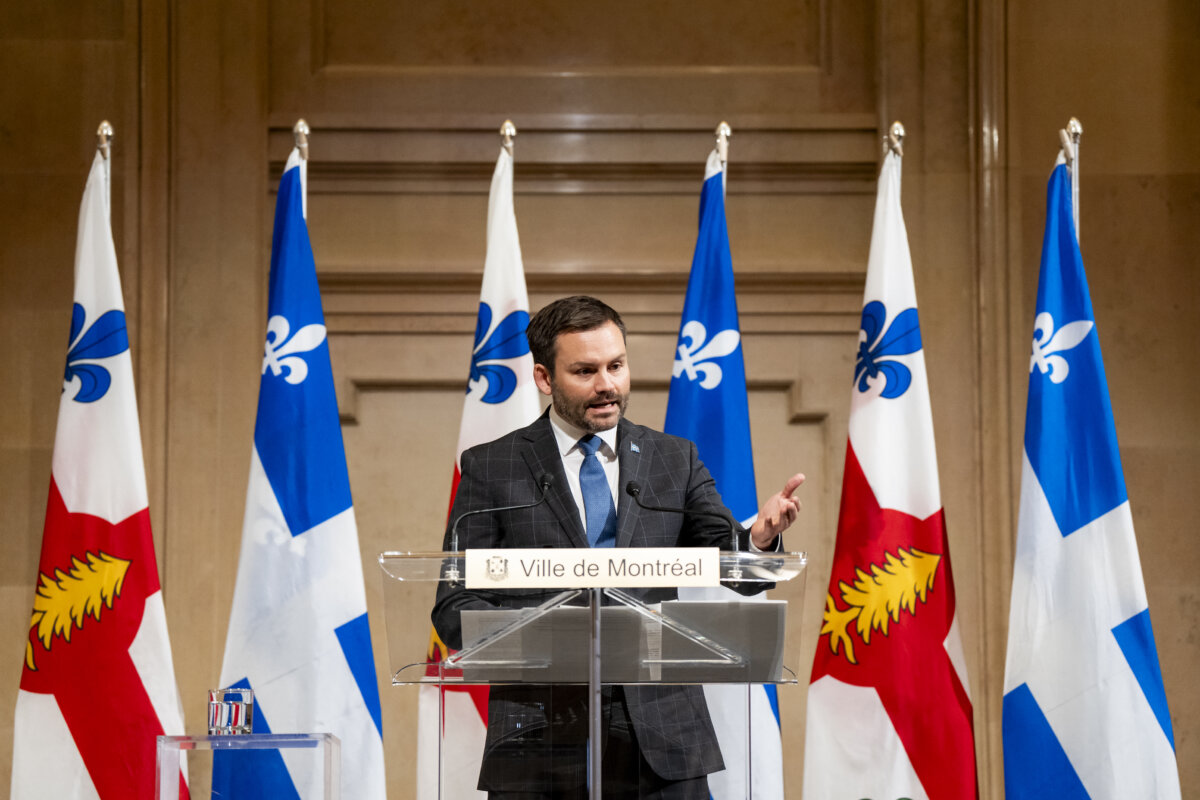

The Quebec government is challenging a court decision requiring provincial lawmakers to swear allegiance to the King, as uncertainty grows over whether the National Assembly can open as scheduled on Dec. 1.
Premier Paul St-Pierre Plamondon has announced his government plans to appeal a Quebec Superior Court justice’s decision this week to suspend the provincial law making the oath to the King optional for members of the legislature.
Quebec Superior Court Justice Ian Demers ruled on Nov. 23 that members of the National Assembly must swear allegiance to King Charles III to sit in the provincial legislature. He warned that failure to respect the constitutional requirement could jeopardize the validity of laws passed by the assembly.
St-Pierre Plamondon called the ruling a “disgrace” while addressing reporters in Montreal on Nov. 24, adding that he will not take an oath to the Crown.
“I find it, quite frankly, enigmatic and problematic that there is an attempt to force elected officials to swear an oath to the King of England — through a judge who is exercising judicial power against 127 elected representatives from all parties, all of whom agree that this must come to an end,” the premier and Parti Québécois leader said.
St-Pierre Plamondon told reporters during a press conference in Quebec City the same day that he is exploring options to ensure the National Assembly opens on schedule next week.
“We’re committed to finding solutions so that we preserve our dignity in terms of personal integrity but also in terms of respect of Quebec’s democracy,” St-Pierre Plamondon said.
Quebec Justice Minister Marie-Claude Sarrazin said the province is seeking permission to appeal the decision and asking the Quebec Court of Appeal to suspend the lower court’s order while the appeal proceeds.
“There is no question of forcing Quebec members to swear an oath to the king,” Sarrazin said in a social media post. “We refuse to make an oath before Quebecers that we do not believe in.”
MNAs in Quebec have not been forced to swear allegiance to the Crown since shortly after the October 2022 provincial election. Prior to this change, three Parti Québécois MNAs refused to swear the traditional oath to the Crown after being elected, preventing them from taking their seats and exercising their legislative functions.
The change came into effect after the previous Coalition Avenir Québec government’s introduction of a workaround known as Bill 4, which passed unanimously on Dec. 9, 2022. The legislation allowed MNAs to swear an oath pledging loyalty to the people of Quebec instead of the reigning monarch.
The judge in his ruling this week suspended the 2022 law pending a final determination of its constitutionality, finding that there was a strong basis for concluding the province had exceeded its constitutional authority by making the oath optional.
“The Constitution is not an à la carte menu where a subject complies with whatever suits them,” Demers wrote in his decision. “A subject’s convictions should instead motivate constitutional amendments. They cannot become the amendment. Any other proposition invites constitutional disorder, if not chaos.”
The ruling grants the emergency order sought by lawyer Lawrence David and the Consumer Law Group, who asked the court to pause enforcement of the 2022 law that had made the oath to the Crown optional.
Constitutional Argument
St-Pierre Plamondon said Quebec should not have to adhere to the constitutional rule, arguing “the Constitution of Canada of 1867 was never consented upon.”
“It’s not a democratic constitution through which people accepted or voted,” he said while in the provincial capital. “I’m sorry, but a constitution that was never accepted by the population and that comes from military conquest and colonialism is nothing in terms of democracy compared to 127 members of parliament duly elected that make a law and say that’s what we want.”
The judge also noted in his ruling that nothing prevents Quebec, another province, or the federal government from establishing a republican system, but said doing so “requires an assent that goes beyond mere consensus. It requires unanimity.”
Canada is considered a constitutional monarchy. Its system evolved gradually from British colonial rule into full legislative independence rather than breaking away through a revolution, keeping the Crown as a legal foundation while transferring law-making power to elected representatives.
A republic, like the United States, is a form of government in which the head of state is not a hereditary monarch. In a constitutional monarchy such as Canada, the monarch serves as head of state, while elected representatives exercise political authority through democratic institutions.
Quebec’s opposition parties support doing away with the traditional oath to the Crown, but have emphasized that the assembly’s first sitting should not be postponed.
Quebec Liberal Leader Charles Milliard said his party is “open to any solution that would allow parliamentary proceedings to resume.”
“This constitutional debate must not, under any circumstances, serve as a pretext for the Parti Québécois to postpone the resumption of parliamentary proceedings once again,” he said in a social media post. “No political subterfuge will be tolerated.
Quebec Conservative Leader Éric Duhaime offered similar sentiments in his post on X.
“These battles against the monarchy must in no way prevent or delay the resumption of parliamentary proceedings next Tuesday,” he said. “The top priority is for elected representatives to sit so they can leave more money in the pockets of Quebec taxpayers.”