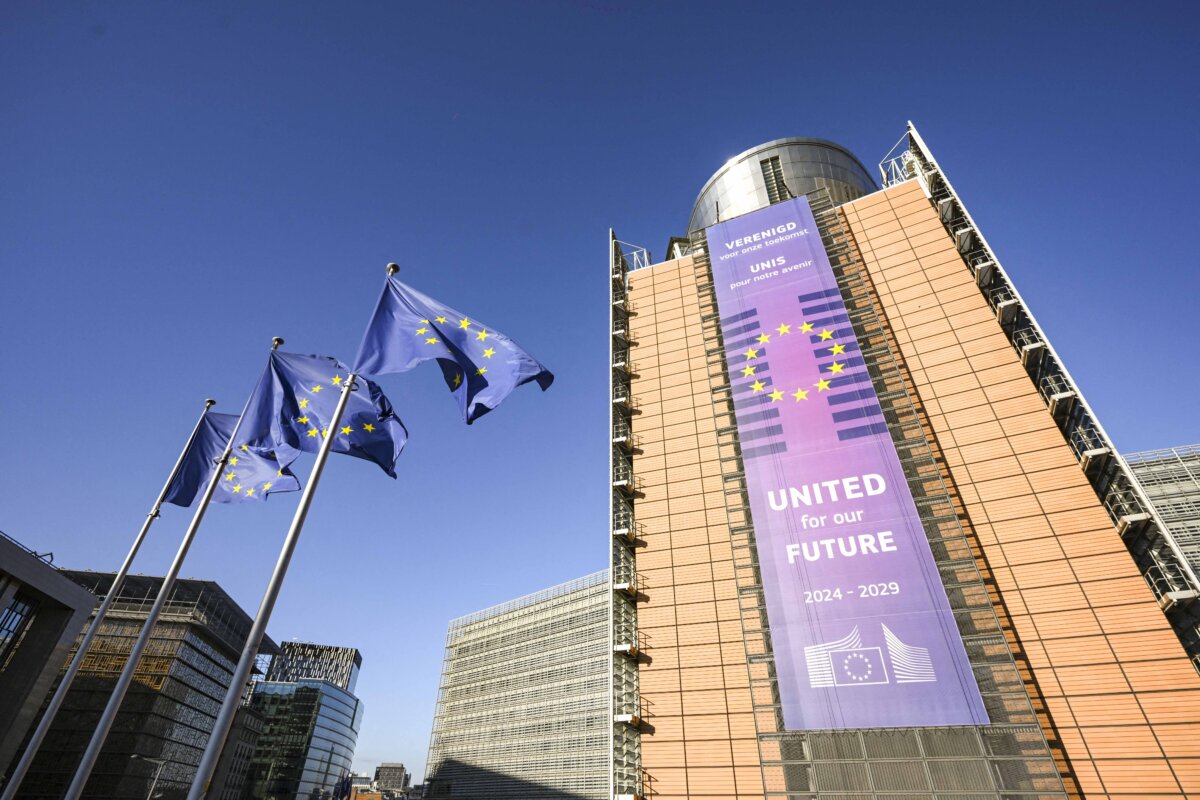

The European Commission said on Nov. 19 that it was targeted by a cyberattack through the use of artificial intelligence tools.
“I can confirm that the Commission has recently taken necessary steps in response to a detected cybercampaign,” European Commission spokesman Thomas Regnier said at a press briefing.
“As a protective and preventive measure, we temporarily took down several applications and most of them have since been restored.”
“The investigation is still ongoing. We are taking any necessary steps, based on the findings as they come,” Regnier said. “This was an AI-generated cybercampaign.”
He said that the incident was detected on Oct. 22 and there was no evidence of any data breach affecting European Commission staff as a whole.
He did not say who the commission thought was behind the attack and said he was not aware of any ransom demand following the incident.
CERT-EU, the cybersecurity service for European Union institutions, bodies, offices, and agencies, warned about AI attacks earlier this month.
On Nov. 5, it said that in recent weeks, CERT-EU had “observed several threat actors around the world that have used ARTEX, an AI-powered penetration-testing framework, to automate their campaigns.”
“ARTEX rapidly identifies and exploits misconfigurations in addition to targeting traditional software vulnerabilities,” it said.
It said that it had observed similar instances of AI-driven activities against its constituency and that it was highly likely that these activities involved the use of ARTEX.
In an Oct. 7 post, Texas cybersecurity firm CrowdStrike said that ARTEX is a recently released “open-source agentic penetration testing” tool developed in China.
The attack comes amid heightened concern over cybercrime across Europe.
On Nov. 12, Europol, alongside global partners, said it dismantled the criminal infrastructure behind Gootloader, CastleRAT, and StealC malware.
It said that in coordinated actions, law enforcement seized 235 servers and 257 domains, “severely crippling these malware distribution networks.”
The operation targeted “cybercrime-as-a-service” models, in which these tools enabled further crimes such as ransomware attacks and data theft.
It said that during the operation, more than 6 million victim credentials were identified in the criminal infrastructure owned by the cybercriminals and seized by the authorities.
“The suspects were using these credentials, stolen from the victims after they infected them, to sell them and later be used for other cyber-attacks such as ransomware,” Europol stated.
Heightened Cyberthreat Environment
A number of high-profile cyberattacks have been conducted in recent weeks.
Equinor, Europe’s largest supplier of pipeline gas, has been working to contain a cyberattack targeting its internal information technology systems.
Equinor first reported that it had been the victim of a cyberattack on Nov. 17.
“There are no indications that data has been stolen,” it said in a statement. “The attack has not affected Equinor’s operations and production.”
In a Nov. 18 update, Equinor said that it had “gained a clearer understanding” of how the attack was carried out and which systems were affected.
Last month, the Norwegian National Security Authority (NSM) raised its cyberattack risk assessment to “high”—its second highest rating—for the first time, saying that businesses should “immediately” prepare for potential cyberattacks.
“NSM has not publicly issued this type of assessment before,” it said on Oct. 27.
“Over the past six months, we have seen a tripling of successful cyber operations against Norwegian businesses,” NSM Director Arne Christian Haugstoyl said. “Several of these have had serious consequences and still pose a potential for damage to national security.”
In at least eight European countries, cyberattackers have remotely adjusted supermarket refrigerators’ temperatures, causing them to overheat, following a series of attacks in France in October.
The cyberattacks, which hit Belgium, Estonia, Germany, Ireland, Italy, the Netherlands, Portugal, and Sweden, caused food to spoil. The incidents in France cost retailers tens of millions of euros, Thierry Cotillard, president of grocery giant Les Mousquetaires, told local media outlet BFM TV.
Although two pro-Russian hacker groups claimed responsibility for the attacks, the Kremlin has denied involvement.
Reuters and Chris Summers contributed to this report.