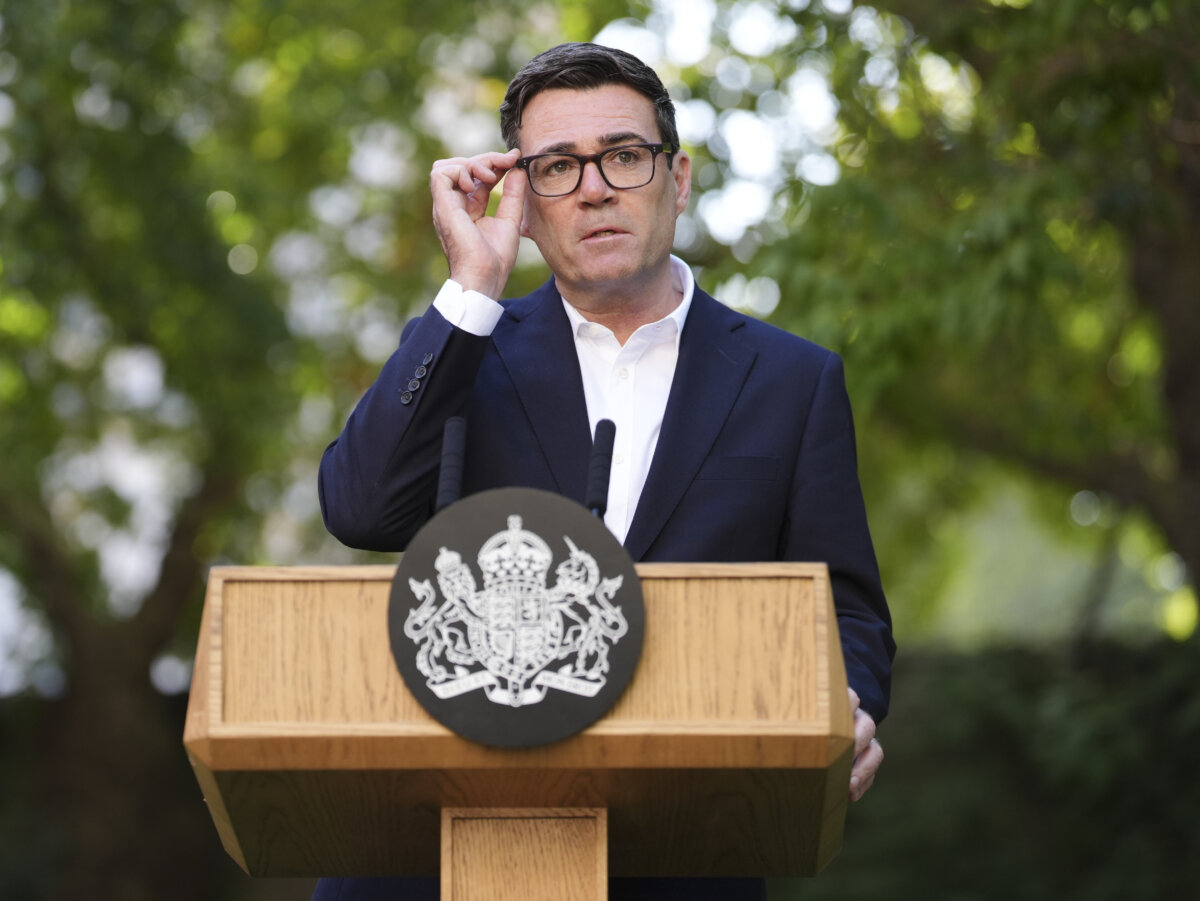
The UK has outlined the deals it hopes to strike with the European Union at a summit in Brussels on Nov. 20.
The summit comes as British Prime Minister Andy Burnham has said he wants to pursue a “reset” with the EU, a decade on from the Brexit referendum in which the country voted to leave the bloc.
During the meeting, Burnham will speak with European Commission President Ursula von der Leyen and President of the European Council António Costa.
In a factsheet published on Nov. 17, the UK government presented the broad shape of the package of the hoped-for agreements, including a youth experience program, a food trade deal, and closer cooperation on carbon emissions.
The youth experience scheme would allow young people limited, time-capped opportunities to live, study, work, and travel in the EU.
The government said the youth scheme is different from freedom of movement, which is a condition EU member states must all subscribe to, as it is capped and time-limited rather than open-ended.
The proposed food-and-drink trade agreement, according to the government, is projected to add up to 5.1 billion pounds (about $6.68 billion) per year to the economy by cutting paperwork and easing pressure on prices, while an emissions-trading linkage could contribute as much as a further 3.8 billion pounds (about $4.9 billion) annually and shield critical industries such as British steel and aluminum exports worth about 6.5 billion pounds (about $8.5 billion) from the EU’s carbon border adjustment mechanism.
The document also states that the government remains committed, for the rest of this Parliament, to not rejoining the EU, the single market, the customs union, or freedom of movement, as was promised in the Labour manifesto for the 2024 election.
It further says UK taxpayers will not be contributing to the EU budget as a result of any of these deals, but rather will shoulder proportionate administrative costs for shared systems, consistent with other international agreements.
Broader Reset
Alongside the potential summit agreements, Burnham is also seeking a broader reappraisal of the Brexit deal reached between the previous Conservative government and Brussels after years of negotiations and multiple changes of prime minister.
In a speech in London on Nov. 16, Burnham said that, in his view, the UK was worse off a decade on from the vote to leave the EU.
“It’s like the Emperor’s new clothes—where no one is prepared to say the obvious truth. Well, I do try to say things as I see them. And to be frank, we have lost more than we have gained in the last 10 years,” he said.
“[The] hard Brexit we were given is not good enough for Britain.”
Burnham said that any new deal with Brussels would not be about “re-running the arguments of 2016,” saying, “The world has changed so much since then.”
He went on to say that “Britain is not in a position to turn its back on a potential deal that could add up to 0.4 percent to GDP,” and that any such deal would have to pass three tests.
“First, it has to be consistent with our manifesto and red lines. Second, it has to improve the Brexit deal to bring it closer to what people thought they were getting in 2016. Third, it has to pass the Makerfield Test—producing real improvements in people’s everyday lives in areas of the country that have felt neglected for too long,” Burnham said.
Makerfield is the name of his constituency as a member of Parliament, which he won in a by-election earlier this year and which enabled him to be made leader of the Labour Party and prime minister.
However, Burnham’s proposals are not uncontroversial and have faced vociferous opposition from other political figures in the UK.
Conservative Party leader Kemi Badenoch, writing in the Daily Mail on Nov. 19, criticized the prime minister’s ambitions as “the worst of both worlds.”
“Out of the EU, but paying them money. A rule-taker run by EU courts and having to take more immigration,” she wrote, adding that Burnham’s claims that the move would help grow the economy are wrongheaded.
“I know growth does not come from politicians. It comes from people who work hard, doing real jobs, businesses investing and producing goods and services of real value,” she continued, saying that although the UK does have “some serious economic problems,” these are not a result of leaving the EU.
Reform UK leader Nigel Farage, who campaigned to leave the EU for decades, said in a video posted on X on Nov. 19 that it was “remarkable” that Burnham wished to make such a deal. Farage also argued that the country never actually got “Brexit.”
“Far more regulation, and all of it overseen and adjudged by the European Court of Justice. If that is not a betrayal, I don’t know what it is,” he said, arguing that the UK establishment has “never accepted the 2016 referendum vote.”
“There is a fundamental democratic problem. I know how these institutions work. You can see an abject surrender from the British Prime Minister,” Farage added, saying that he would be traveling to the Belgian capital.
“If there has to be another fight on these issues, then Friday in Brussels is where it starts.”