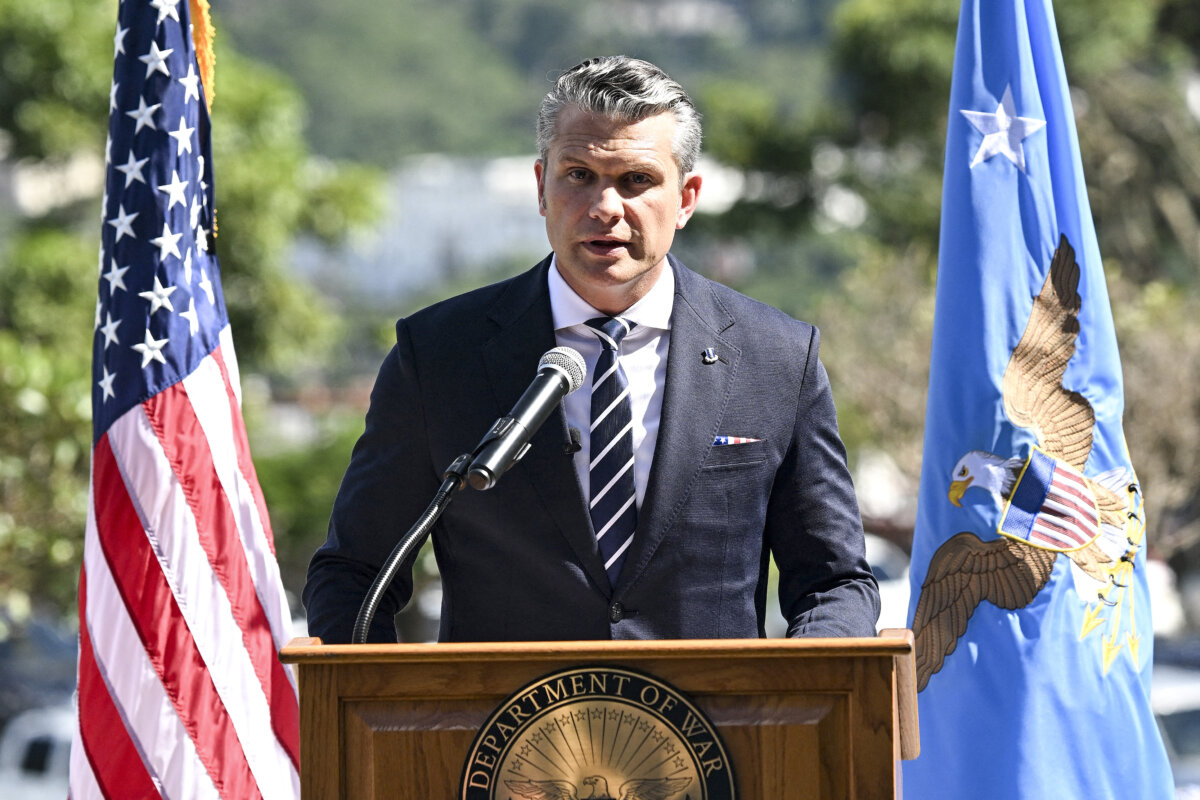
Secretary of War Pete Hegseth met with acting Venezuelan President Delcy Rodríguez in Caracas on Nov. 18, to sign a deal establishing formal military-to-military ties between the United States and the South American country.
Addressing onlookers in Caracas, Hegseth said the new agreement includes U.S. and Venezuelan forces “training together, partnering together, sharing intelligence, more defense equipment, and capabilities.”
Hegseth cast the agreement as part of a broader effort to target cartels trafficking narcotics throughout the Western Hemisphere.
“Our renewed defense partnership will not simply be cosmetic. Nothing we do at the Department of War is such,” Hegseth said. “It requires the removal and eradication of all narcoterrorist networks usurping territory inside Venezuela today.”
The Pentagon has not published the full text of the agreement, and has not responded to requests for comment about Hegseth’s visit to Caracas on Wednesday.
Hegseth’s visit to Caracas came less than a year after U.S. special operations forces carried out an armed raid to capture Venezuelan leader Nicolás Maduro and his wife, Cilia Flores, and brought him to the United States to face criminal prosecution.
Maduro and his wife have been charged with narcoterrorism conspiracy, cocaine importation conspiracy, possession of machine guns and destructive devices, conspiracy to possess machine guns and destructive devices against the United States, and conspiracy to commit torture. They have pleaded not guilty and are set to face trial in June.
“Venezuela has gone from our most aggressive regional threat to a compliant security partner on its way to rebuilding its military alongside the United States,” Hegseth said on Wednesday.
Rodríguez had been serving as the vice president of Venezuela at the time of Maduro’s capture on Jan. 3, and has since filled Maduro’s seat in an acting capacity with the consent of the U.S. government.
Under Rodríguez’s leadership, Caracas has already agreed to allow U.S. access to Venezuelan oil reserves, through North American Blue Energy Partners (NABEP).
“The Head of State highlighted the historical ties between Venezuela and the United States and the importance of military-technical cooperation to confront common threats and promote development,” the Venezuelan president’s office said in a statement addressing Hegseth’s visit.
While the U.S. government has sought collaboration with Rodríguez, Washington has given assurances that it still expects to see new elections in Venezuela.
After announcing the oil deal with NABEP in August, a U.S. official told reporters, “This in no way impedes a democratic transition, nor does it mean that it cements the interim government.”
In October, U.S. Secretary of State Marco Rubio praised the return to Venezuela of María Corina Machado, one of Maduro’s most prominent political opponents.
“The conditions allowing for the safe return of Ms. Machado to Venezuela is the direct result of the U.S. supported reconciliation talks, which has already seen hundreds of political prisoners freed, and hundreds of political opposition figures return from exile,” Rubio said at the time.
Rubio has since said Venezuela needs to overhaul its electoral infrastructure before the country can hold a new election.
Machado said she had spoken with Rubio about the process and said a new election could take place in 2027.