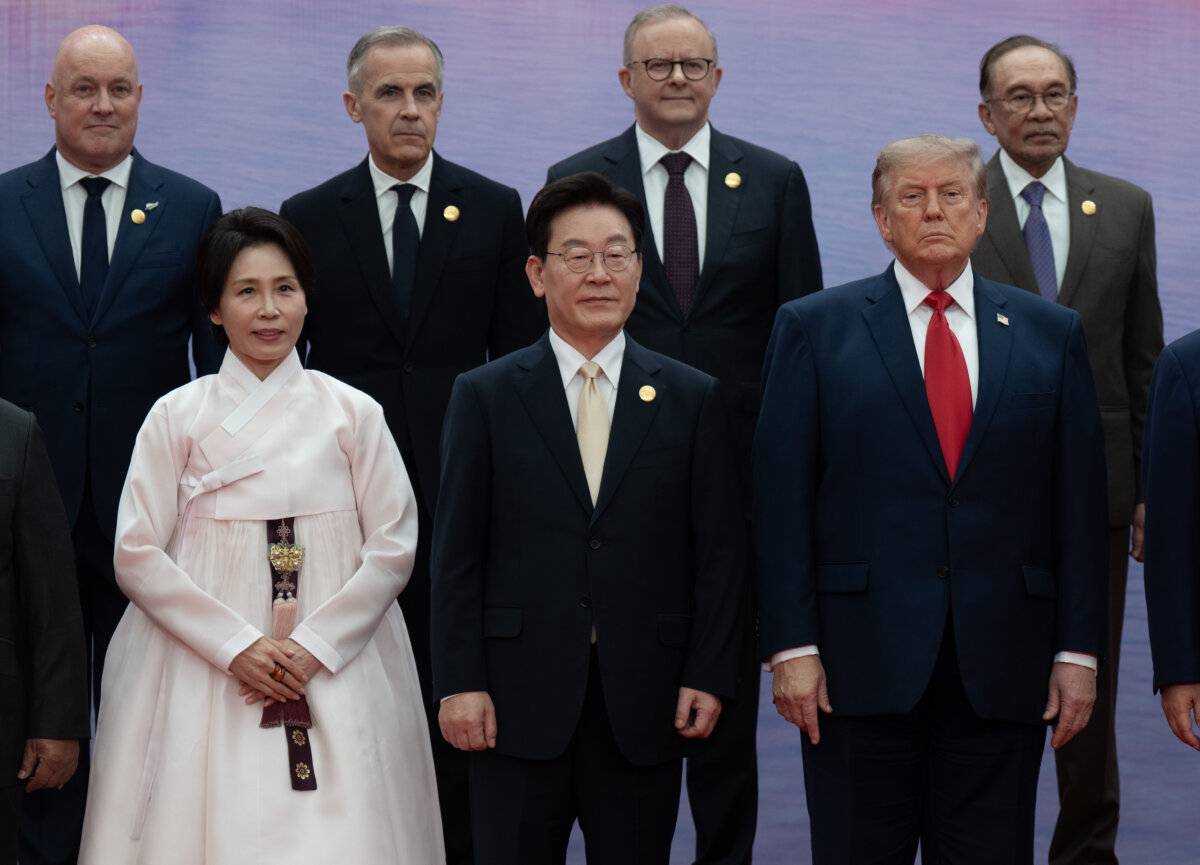


Prime Minister Mark Carney and U.S. President Donald Trump met on the sidelines of the Asia-Pacific Economic Cooperation (APEC) summit in China on Nov. 18, where they discussed efforts to reach a trade agreement.
Carney said in an interview at the New York Times’ DealBook Summit later on Nov. 18 that some progress had been made toward a trade deal with the United States, but “we’re not there yet” in finalizing an agreement.
The Prime Minister’s Office (PMO) said in a Nov. 18 readout that Carney and Trump discussed ongoing work toward a “mutually beneficial trade agreement that would create good jobs, boost affordability, and fully respect Canada’s languages, culture, and sovereignty.”
“They agreed to continue the work and to stay in close contact,” the PMO said.
The meeting came as Ottawa and Washington continue efforts to reach a trade agreement after negotiations collapsed in August. Both countries subsequently imposed additional tariffs on each other. Carney and Trump have recently made more positive public comments about the prospects for a deal.
Carney told reporters on Nov. 3 that the United States had walked back some of its previous demands and was now “asking less” and “offering more.” Trump also said that Washington would “make a deal with Canada very soon,” and that tariffs on American farmers’ products would be removed. Carney more recently suggested that disagreements over the autos sector remain.
Before meeting with Trump, Carney was asked by reporters on Nov. 18 why Canada had been able to reach a trade arrangement with China but not with the United States. Ottawa and Beijing had announced the previous day that China would provide additional tariff relief on about $400 million worth of Canadian exports, including pork and seafood. In exchange, Canada agreed to extend and expand tariff-remission measures for certain Chinese steel and aluminum products. Carney and Chinese leader Xi Jinping also said they want to further advance the Ottawa-Beijing “strategic partnership.”
“Our trading relationship with the United States is much larger, much more complex,” Carney told reporters in response. “There’s a wider range of issues. The United States fundamentally changed its trade objectives, and we are focused on getting the right deal for Canadians.”
The prime minister described the negotiations as a “two steps forward, one step back” process, but said Ottawa remained confident the countries could reach a mutually beneficial agreement.
At the DealBook Summit, while noting that trade progress with the United States is lagging, Carney said Ottawa’s deals with Beijing are moving forward steadily, praising Beijing’s approach to negotiations.
“We reached an agreement, we reduced tariffs and over 90 percent of trade irritants. And, of course, I’m speaking about our trade negotiations with China. They’re very professional. They moved forward in a very linear fashion. And it’s all very rational and moving forward,” Carney said.
Asked when Canada could reach a deal with the United States, Carney said an agreement should have been reached six months ago.
“We’re not going to sign something that doesn’t make sense for Canada,” he said. “If the U.S. doesn’t want to do the deal, we’re busy.”
Earlier this week, senior Trump administration trade adviser Peter Navarro accused Carney of attempting to “play China off the U.S.” after he suggested that if the United States doesn’t reach an auto deal with Canada, Ottawa may move to other players including China.
“You should be far more worried China is going to eat Canada alive,” Navarro said.
China analyst Michael Kovrig said Beijing uses engagement opportunities with countries like Canada to boost its image. “Every warm photo feeds the CCP’s story that its system is legitimate and its power is rising. In Washington it reads as America’s closest partner drifting,” he said on X on Nov. 17.
Carney was asked by reporters whether Trump had expressed any discomfort with Ottawa’s growing ties with Beijing during their interactions. Carney suggested that the issues Canada is exploring with China aren’t areas of concern to the United States, saying the talks involve exporting agricultural and energy products to China, not semiconductors.
Carney added that he respects “the United States’ engagement with China and the efforts of President Trump to stabilize that relationship and use that relationship for positive outcomes.”
However, U.S. officials, including Trump, have in the past publicly expressed concern about Canada signing a pact with Beijing to allow the import of 49,000 Chinese electric vehicles at a reduced tariff rate, down from the previous 100 percent tariffs.
“If Governor Carney thinks he is going to make Canada a ‘Drop Off Port’ for China to send goods and products into the United States, he is sorely mistaken,” Trump said in January, shortly after Carney signed the deal on Chinese EVs in exchange for China easing its tariffs on Canadian canola and other agricultural products.
In addition to Republican officials, Democratic lawmakers in the United States have also expressed concern about Ottawa establishing closer ties with the Chinese communist regime. Two Democratic lawmakers earlier this year introduced legislation to prevent “Chinese-connected vehicles” from entering the United States via Canada and Mexico.
Opposition parties in Canada have also been critical of Carney’s deals with Beijing.
“Prime Minister Mark Carney’s latest trade deal with Beijing is bad news for Canadian workers, jobs and national security,” the Conservatives said in a statement on Nov. 18. “Instead of standing for Canadian workers, Mark Carney has once again chosen to cozy up to a regime with a deeply troubling record on human rights, democratic freedoms and individual liberty.”
Bloc Québécois Leader Yves-François Blanchet said instead of pursuing closer ties with Beijing, Carney should be making more efforts to drop U.S. tariffs.
“Mark Carney’s most important new partner, China, is a communist dictatorship that practices modern slavery, forces children to work, commits genocide against Uyghurs and Tibetans, threatens Taiwan, a modern democracy, and attacks democracies, including Canada, from within,” Blanchet said in a Nov. 18 social media post.
During his virtual appearance at the DealBook Summit, Carney also discussed his relationship with Trump, saying the U.S. president is “very personable” and “listens a lot more in private.”
Carney was also asked at the event what it would take to change Canadians’ views of the United States, given Washington’s tariffs on Canadian goods and Trump’s remarks about making Canada the 51st state.
“What will change views are policy decisions that are taken and that stick. Until policy action changes, it’s hard to change the view,” Carney said.