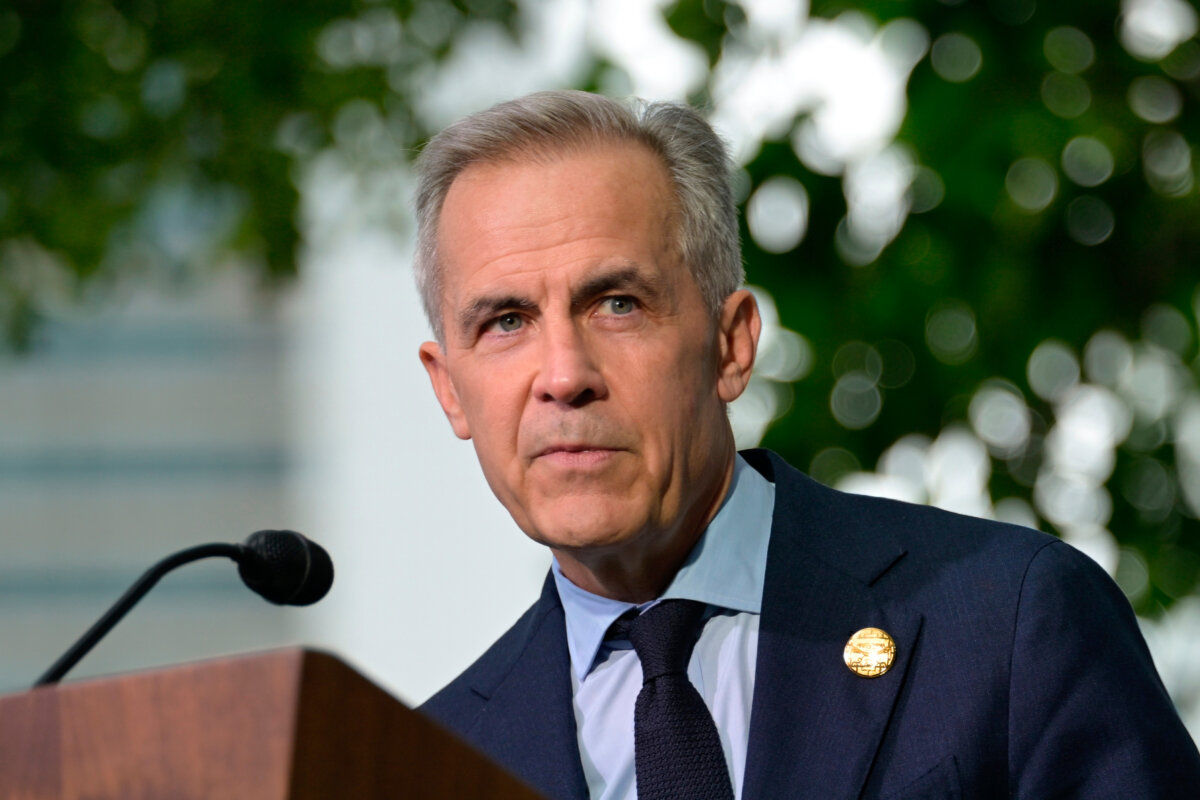
Prime Minister Mark Carney says he raised the issues of foreign interference and human rights with Chinese leader Xi Jinping during talks in Shenzhen, China, ahead of the Asia-Pacific Economic Cooperation (APEC) Economic Leaders’ Meeting.
Speaking to reporters in Shenzhen on Nov. 18, Carney said issues involving foreign interference, transnational crime, and illegal narcotics were “raised” with Chinese counterparts, including during his discussions with Xi.
The prime minister also suggested that a “running dialogue” on these issues won’t be effective in achieving results.
“My experience has been that the most effective way to deal with these issues is to have open, frank conversations—not to give a running dialogue on those conversations—and to move to specific issues and make progress,” Carney said.
Carney said last week that he would raise foreign interference with Xi during their meeting, responding to questions from reporters on a new report that said China continues to operate liaison points in Canada that carry out activities on behalf of Chinese police.
Conservative Senator and Leader of the Opposition in the Senate Leo Housakos noted that the Prime Minister’s Office’s readout of the Nov. 17 meeting between Carney and Xi did not indicate whether Carney raised the issues of foreign interference or intimidation.
The readout said the two leaders discussed a number of issues including collaboration in trade, security, artificial intelligence, energy, and financial, educational, and cultural initiatives.
“If the prime minister needs to stand up and fight for Canadian values and principles, shouldn’t he put at least on the table our concerns to the president of China of what is going on right here on Canadian soil?” Housakos said in the Senate on Nov. 17.
Housakos referred in part to an incident in Toronto in September, where a man wearing a jacket with a Chinese flag attacked Falun Gong practitioners who were protesting outside the Chinese consulate, claiming the public sidewalk they were standing on is “Chinese territory” and threatening to kill them. “Beijing no longer even attempts to conceal its intimidation,” Housakos said.
Ahead of Carney’s trip to China, diaspora and rights groups had asked him to urge Beijing to end its human rights atrocities.
“We believe serious talks and actions will solve the issue,” said Grace Wollensak, a national coordinator with the Falun Dafa Association of Canada, at a press conference on Parliament Hill in Ottawa on Nov. 16, adding that discussions need to be in-depth in order to have meaningful results.
Carney said on Nov. 18 that some foreign markets offer opportunities for trade and investment even when Canada does not “share the same perspectives” with those countries, and that his government calibrates its relationship accordingly.
“There are markets where there are enormous opportunities, but we don’t share the same perspectives. So that means that there’s a series of commercial activities that we just wouldn’t do, and in some cases, none,” he said, citing Russia as an example of an extreme case in which Canada would not engage in any activities.
During Carney’s Nov. 17 meeting with Xi, the two leaders agreed to extend and expand a trade arrangement where Beijing would lift tariffs on around $400 million worth of Canadian exports, including frozen pork cuts and seafood products. In exchange, Ottawa would extend tariff exemptions to an additional 32 types of Chinese steel and aluminum products where Canadian supply is unavailable.
Carney has made efforts to build closer ties with China, in a bid to diversify trade away from the United States in the face of ongoing tariff disputes. The prime minister said Canada began to “recalibrate” its relationship with China in 2025, initially focusing on trade, travel, and clean energy.
During his meeting with Xi, the two leaders agreed to “go further” in their “strategic partnership.”
Opposition parties in the House of Commons warned of economic and national security risks stemming from the new deal between Ottawa and Beijing.
Conservative MP Stephanie Kusie, who serves as her party’s international trade critic, said on Nov. 17 that China would “flood” Canadian markets with their products including steel, and that Canada was deepening ties with a country that does not share Canada’s “fundamental values and freedoms.”
A joint statement from a number of Conservative MPs with shadow minister portfolios on Nov. 18 said that, “Instead of standing for Canadian workers, Mark Carney has once again chosen to cozy up to a regime with a deeply troubling record on human rights, democratic freedoms and individual liberty.”
Bloc Québécois Leader Yves-François Blanchet also criticized Carney’s attempts to develop closer ties to China, saying he’s not opposed to trade, but that it’s important to respect “our deeply held values.”
“Mark Carney’s most important new partner, China, is a communist dictatorship that practices modern slavery, forces children to work, commits genocide against Uyghurs and Tibetans, threatens Taiwan, a modern democracy, and attacks democracies, including Canada, from within,” Blanchet said on social media on Nov. 18.
“A reduction in tariffs, which should be the real priority in negotiations with the United States, would have more of an impact on our economies than all the trips and all the agreements.”
Taiwan Agreement
During the press conference on the sidelines of the APEC summit, Carney was also asked by reporters about timeline in signing a trade co-operation arrangement with Taiwan.
Documents tabled in Parliament in September indicate that Canada and Taiwan finalized and initialled the Canada-Taiwan Trade Co-operation Framework Arrangement in March 2025. Ottawa consulted the provinces and territories two months later. The arrangement has since undergone legal review and been translated into French and Mandarin. It is “currently being considered for signature,” the government said.
Harry Tseng, head of the Taipei Economic and Cultural Office in Canada, has expressed concern that Ottawa may be delaying the signing to avoid upsetting Beijing. He has said the text and legal review are largely complete, with English, French, and Mandarin versions prepared.
When a reporter asked why the Taiwan deal has remained unsigned for over a year, Carney said, “I don’t recognize your characterization of that.”
He added, “There’s been good progress on the economic co-operation agreement, and we’re hopeful that it will be signed soon.”
Beijing considers Taiwan to be a breakaway province, and has a goal of bringing Taiwan under its control.