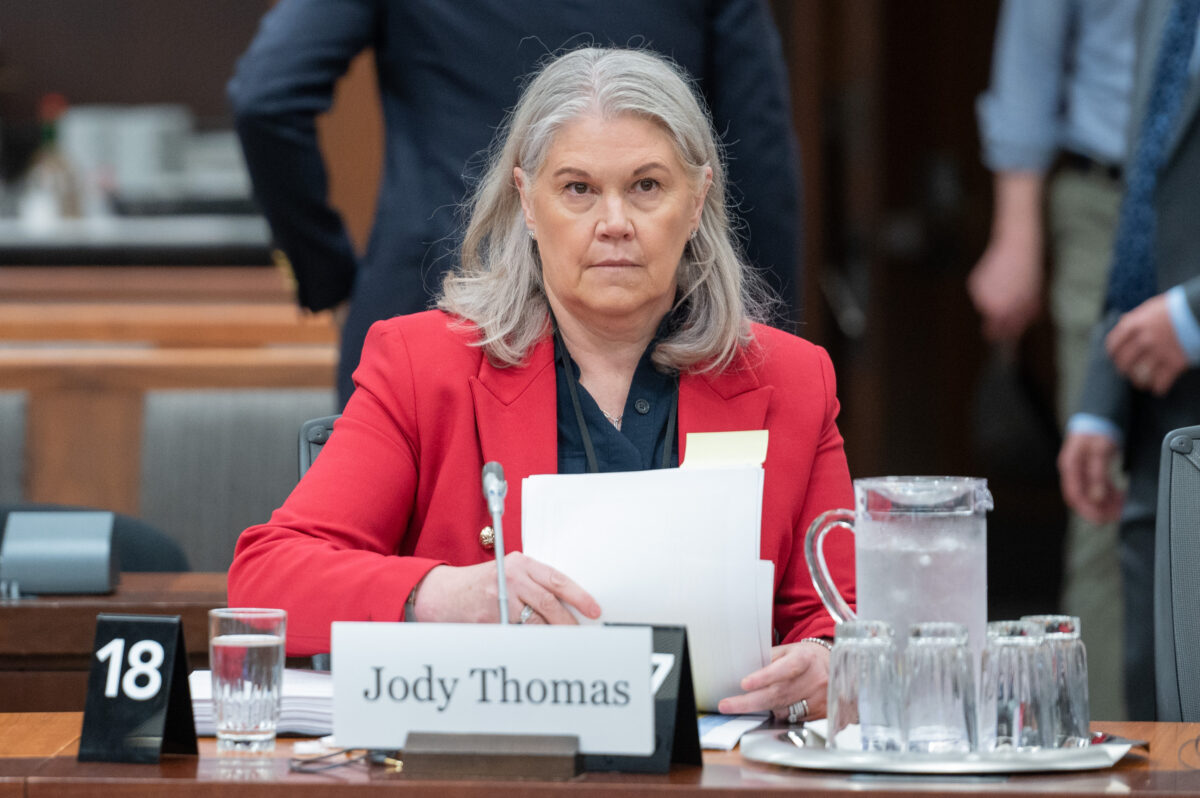
A former national security adviser to the prime minister says Chinese electric vehicles are a national security concern and that she personally would never buy one.
Jody Thomas, who served as Canada’s National Security and Intelligence Advisor (NSIA) to former Prime Minister Justin Trudeau, described Chinese EVs as a “computer on wheels” while appearing on CTV’s “Power Play” on Nov. 17.
Thomas was one of several panelists discussing Prime Minister Mark Carney’s visit to China this week, and the potential outcomes of his Nov. 17 meeting with Chinese leader Xi Jinping.
“I think that anybody who does buy a Chinese EV needs to understand it is a computer on wheels and all of their information about what they do and where they’re going is going back to the Chinese government,” Thomas said, after being asked if she has concerns about EV manufacturing from China.
“And if you’re willing to have that be the use of your information, then certainly buy the vehicle,” she added. “There are people who should never buy an EV, and they all know who they are and they will not.”
Carney met with Xi ahead of the Nov. 18-19 Asia-Pacific Economic Cooperation summit in Shenzhen, China. The meeting came as Carney signalled that he would welcome Chinese automakers considering investments in Canadian manufacturing.
Carney said earlier this week that Canada could turn to Chinese automakers if trade issues with the United States continue, but no new announcement was made after his meeting with Xi about building on the agreement the two leaders reached in January.
Carney announced in January that Ottawa would replace its 100 per cent surtax on Chinese electric vehicles with a 6.1 per cent most-favoured-nation tariff for an initial quota of up to 49,000 vehicles a year. In return, China agreed to lower its combined tariffs on Canadian canola seed from about 84 percent to approximately 15 percent and suspend anti-discrimination tariffs on canola meal, peas, lobster, and crab.
Thomas described the deal as a “significant concern both for the auto industry here, but also for the proliferation of those kinds of vehicles.”
“They are a security concern,” she added. “There’s absolutely no doubt.”
Chinese Auto Deal Concerns
Carney told reporters last weekend that any trade deal with U.S. President Donald Trump must preserve a viable auto industry in Canada. He said talks with Washington remain his priority, but the results could shape whether Canada explores alternatives with European, Chinese, or Japanese automakers.
Carney added that potential Chinese investment was not meant to act as leverage in negotiations with the White House but was “action” and “reaction” to them.
Trump senior adviser Peter Navarro took to social media earlier this week to question Carney’s comments. He called Canada’s possible shift toward Chinese EVs “offensive in the extreme,” and questioned whether Carney was “really threatening to play China off the U.S.”
“You should be far more worried China is going to eat Canada alive—as it is already doing,” he said in the Nov. 16 post that was shared by U.S. Ambassador to Canada Pete Hoekstra.
Ontario Premier Doug Ford has also spoken out against an auto deal with China. He publicly warned Carney against expanding Chinese involvement in Canada’s automotive industry, citing risks to domestic jobs and trade relations with the United States.
Ford has maintained that welcoming Chinese automakers or vehicle imports into Canada could jeopardize Ontario’s access to the crucial U.S. market, where roughly 90 percent of Canadian-built vehicles are exported.
The Conservatives have also voiced concerns about the deal.
Tory Leader Pierre Poilievre has consistently opposed allowing Chinese electric vehicles (EVs) and automakers into Canada. He has framed them as a severe threat to Canadian auto jobs, national security, and trade relations with the United States.
Poilievre warned earlier this year that allowing Chinese EVs onto Canadian roads would be a “strategic error,” that could hurt jobs and argued the vehicles risk becoming “roving surveillance systems.”