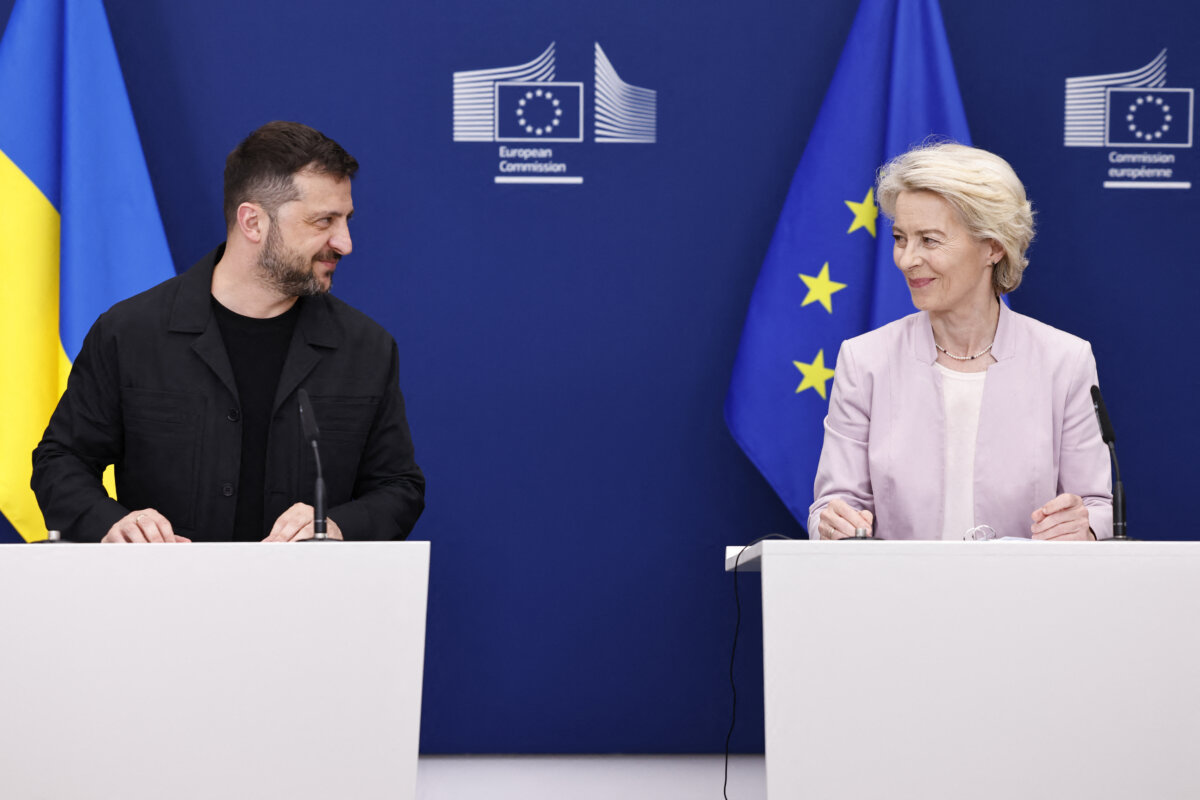

The European Commission proposed a new 45 billion euro ($49.45 billion) loan on Nov. 18 to support Ukraine, which is at war with Russia, amid a 70 billion euro ($76.84 billion) funding gap for 2027.
European Commission President Ursula von der Leyen said on Wednesday that while Ukraine’s financial needs for 2026 were covered, the country needs additional funding for 2027. The proposal, the Instrument for Coordinated Support to Ukraine, would provide 25 billion euros ($27.44 billion) for Ukraine’s military and 20 billion euros ($21.95 billion) for Ukraine’s civilian budget support, she said.
“We think this is the best way to give Ukraine a strong hand at the negotiation table,” von der Leyen said during a Nov. 18 press conference in Brussels. “And Ukraine only needs to repay once Russia pays for the damage it has caused in Ukraine.”
The proposal was unveiled after Ukrainian President Volodymyr Zelenskyy announced on Nov. 16 that Europe’s full negotiating team joined the United States and Ukraine for the first time to discuss ending the war between Russia and Ukraine, which has lasted four years and eight months. The United States, Ukraine, and Russia held trilateral peace talks in Abu Dhabi, United Arab Emirates, last week aimed at reaching a peace deal.
The European Commission’s latest proposal, which would require approval from European Union member states, comes after European Union leaders previously agreed to give Ukraine a 90 billion euro ($99 billion) loan to provide funding for Ukraine in 2026 and 2027.
“Five years since the start of this war of aggression, Europe stands united,” von der Leyen told reporters on Wednesday. “We are as committed as ever to support Ukraine in war and in peace.”
The European Commission president said the additional military support included in the new proposal will give Ukraine the means to continue to defend itself, while the budget support will enable civilian services such as schools and hospitals to keep operating.
European Economy Commissioner Valdis Dombrovskis said the additional funding is necessary as Russia is intensifying its attacks on Ukraine, disrupting the country’s trade by blocking export routes in the Black Sea and targeting Ukraine’s critical infrastructure.
Dombrovskis said the disbursement of funds for Ukraine’s budgetary support would be tied to Ukraine continuing to make reforms, including on public finance management, the rule of law, and the fight against corruption.
The European Commission officials said the loan will be financed by borrowing on behalf of the European Union on international markets.
The proposal includes the option to use Russian assets frozen by European sanctions to help repay the loan, von der Leyen told reporters.
Von der Leyen said she is confident that all 27 of the European Union’s member states will agree to the proposal despite some member states previously expressing reluctance.
“All 27 member states say very clearly that they want to support Ukraine,” she said. “The differences we have is that some member states say, ‘We want to invest in civilian support.’”
The European Commission president said those member states could be indirectly assigned to support the civilian budget portion of the loan instead of the military portion.
Von der Leyen also noted that Ukraine’s remaining funding gap for 2027 would need to be covered by Kyiv’s other international partners.
The proposal will be discussed on Nov. 19 when the “Coalition of the Willing,” a group of countries that supports Ukraine, meets in Berlin.
Zelenskyy thanked von der Leyen in a statement on X on Wednesday, suggesting that strong support for Ukraine is “the best signal to Russia that this war must end.” He noted that the Instrument for Coordinated Support to Ukraine proposal would supplement the European Union’s prior commitments and cover a significant portion of the defense and budgetary needs for 2027.
“We very much hope for the swift adoption of this decision by the European Parliament and the Council and count on the support of all EU member states,” Zelenskyy said.