Estonia says it will close all Russian road border crossing points from Dec. 1, after an attempted arson attack on an Estonian defense company that it believes was an act of sabotage by agents of Moscow.
The authorities in Estonia detained eight people at the weekend after an attempt was made in the early hours of Saturday to set fire to a building owned by drone maker Threod Systems, whose systems are used by 18 NATO member states and Ukraine.
Estonia’s internal intelligence service director general, Margo Palloson, told a press conference that Russia’s military intelligence service, GRU, was behind the attack.
“This was yet another attempt by Russia to carry out an act of sabotage in Estonia,” Palloson told Estonian broadcaster ERR.
“Following clear evidence that Russia’s military intelligence service GRU ordered a sabotage attack against an Estonian defense industry company, Estonia will close all Estonian-Russian border crossing points as of 1 December,” Estonian Foreign Minister Margus Tsahkna announced in a post on X on Sunday.
“Russia must understand that hostile actions against Estonia come with consequences. Attempts to intimidate, destabilize, or undermine our security will not go unanswered.”
He said closing the border crossings would reduce Russia’s ability to conduct “hostile activities” in Estonia and strengthen efforts to prevent sanctions against Moscow from being circumvented.
Kremlin spokesman Dmitry Peskov said the Estonians’ accusation over the Threod incident was part of a pattern of false allegations by European countries.
“They are entirely baseless,” Peskov said on Monday. “We therefore cannot accept such accusations. We do not accept them, we do not condone them, we disagree with them, and we completely reject these accusations.”
‘Estonia Is Building a Wall’: Peskov
“And, of course, a decision such as this to close all checkpoints and border crossings, well, it’s as if Estonia is building a wall,” Peskov said. “As history shows, many countries have built walls, which have brought nothing good to those who erected them.”
Tsahkna said he had informed the foreign ministers of Latvia, Lithuania, and Finland, Estonia’s neighbors and Baltic allies, of the border-crossing closures, but he did not specify how long Tallinn planned to keep the border closed.
 Members of the Estonian army during military training together with British soldiers in Lasna, Estonia, on Feb. 8, 2022. (Paulius Peleckis/Getty Images)
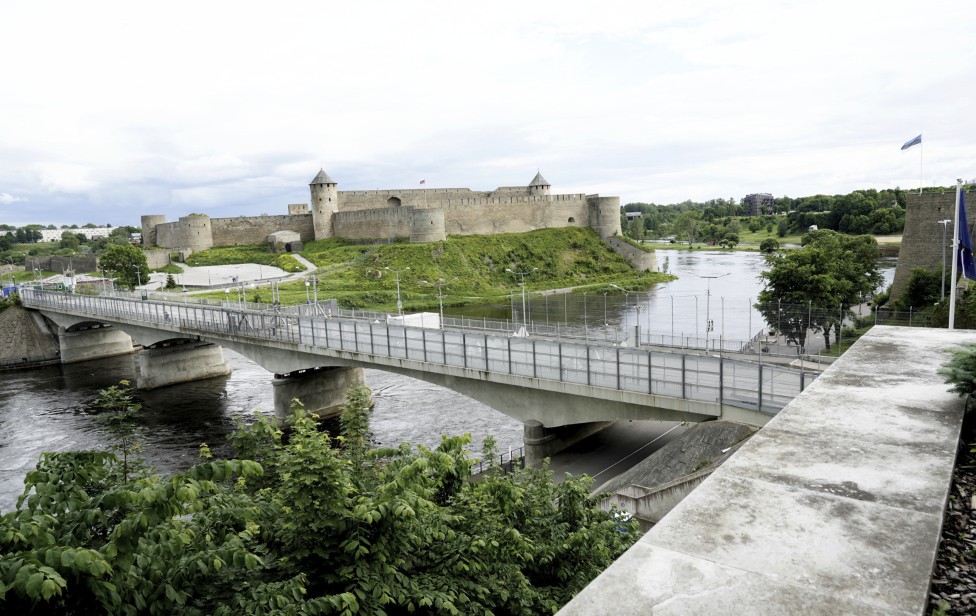
Narva is only 90 miles from St. Petersburg, Russia’s second-biggest city, and is home to a large ethnic Russian minority.
Russian Foreign Ministry spokeswoman Maria Zakharova told state-owned news agency TASS that closing the Estonian border would be another demonstration of anti-Russian sentiment.
“We will verify all this to see if it’s true,” Zakharova said. “If these are their real plans, then they fit into yet another bout of aggressive and unrestrained Russophobia.”
Close Ally of Ukraine
Estonia was part of the Soviet Union until 1991, when it regained its independence. It joined both NATO and the European Union in 2004, and has been a close ally of Kyiv since Russia invaded in February 2022.
Earlier this month, Estonia was among several countries hit by a cyberattack that raised the temperatures on supermarket fridges. The Kremlin denied responsibility for the cyberattacks, but two pro-Russian hacktivist groups sought to claim it.
Around 20 percent of Estonia’s population is ethnic Russian, and there have long been fears that Moscow could intervene on their behalf, as it did in Ukraine. The key difference is that Estonia is a NATO member, unlike Ukraine.
Attila Demko, a security policy expert from Hungary, told The Epoch Times in March 2025 that since Estonia joined NATO, defense strategists have asked whether the United States would go to war or fire nuclear missiles to defend Narva, an Estonian border town near the Baltic Sea—often referred to as the Narva Scenario.
After French President Emmanuel Macron offered to open a debate on whether French nuclear deterrence could protect European allies in a speech on March 5, 2025, Demko said France could face the same question.
“Honestly, anybody who seriously thinks that France will trade Paris for Narva. No, I don’t believe it,” Demko said.
On Friday, Ukrainian President Volodymyr Zelenskyy suggested the United States had proposed Ukraine potentially withdraw from the Donbas region in exchange for NATO membership.
Asked about Zelenskyy’s comments, a U.S. official told The Epoch Times on Saturday, “Many ideas continue to be discussed, but any final deal will have to be agreed to by both parties.”
Reuters contributed to this report.