
Korean War veteran Andrew Barber served aboard Canada’s famed HMCS Haida, patrolling Korean waters to help prevent a resurgence of fighting. Today, he shares his experiences with younger generations to help keep Canada’s military history alive.
Barber was 18 when he joined the Royal Canadian Navy (RCN) in Montreal in September 1951. He was initially assigned to HMCS Donnacona. His parents were “absolutely enraged and apoplectic” when he brought home the application, Barber told The Epoch Times. His father refused to sign it, prompting the young man to say he would find someone else to approve it.
His parents eventually relented and signed the document, allowing their only son, who had five sisters, to enlist in the military.
Before joining the military, Barber worked as an apprentice with Canadian National Railway (CNR), where he earned good money and learned several trades. However, he disliked having income tax deducted from his paycheques. A relative of his brother-in-law encouraged him to enlist, telling him that military service would allow him to keep his full pay.
Upon receiving his first paycheque, though, Barber learned the Navy did deduct income tax.
“And if I could have gotten a hold of my brother-in-law’s brother, Archie, I think I would have strangled him,” the 93-year-old veteran joked, adding that he joined the Navy because World War II veterans at CNR said it was better than crawling in the mud as a soldier.
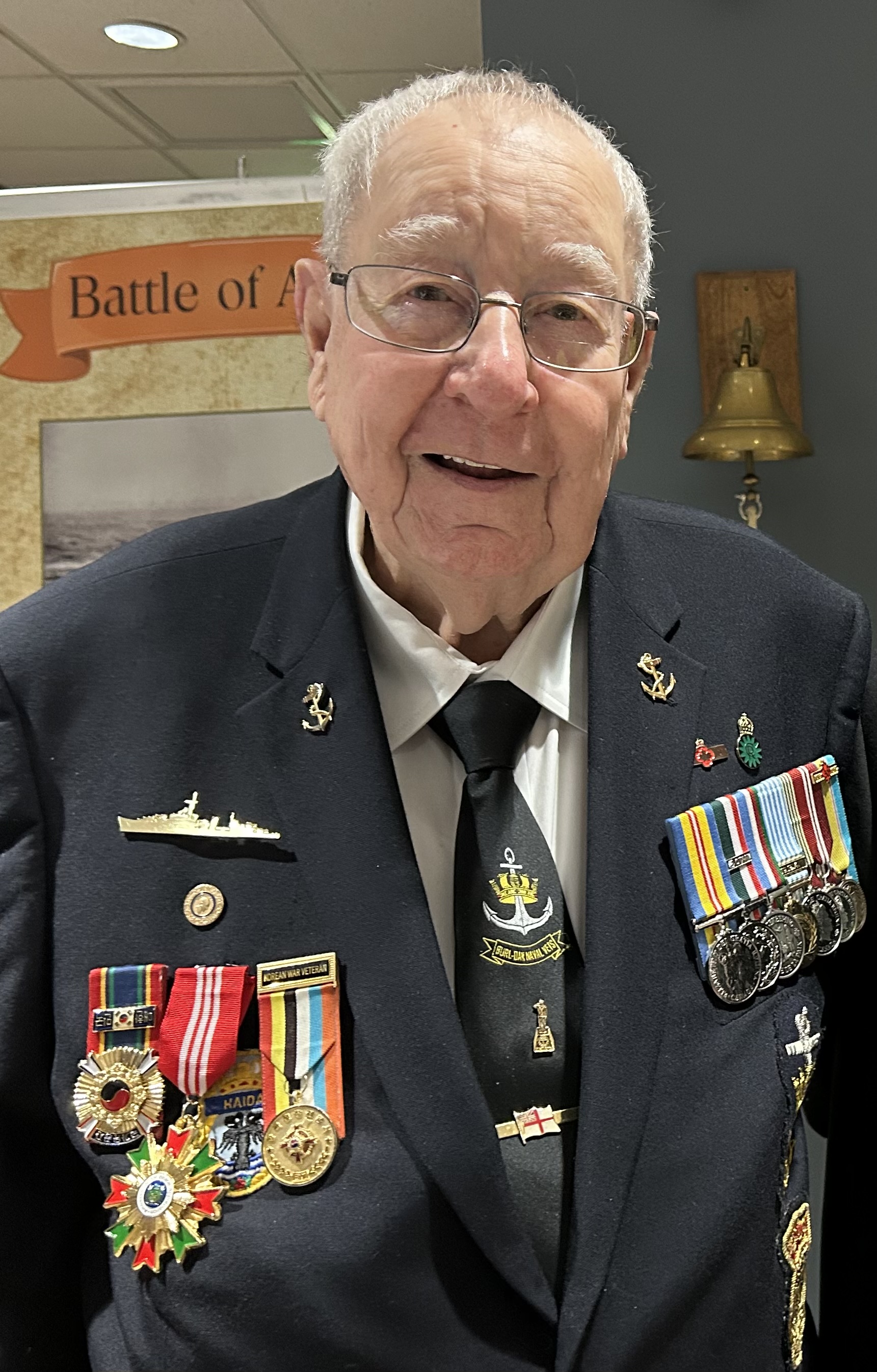 Korean War veteran Andrew Barber, 92, attends a ceremony in 2025 where he received the King Charles III coronation medal for his contributions to Canada. (Photo courtesy Andrew Barber)
Queen’s Coronation
Queen Elizabeth II was crowned on June 2, 1953. Less than two weeks later, on June 15, she attended a coronation fleet review on the River Thames, where ships from foreign and Commonwealth countries, including Canada, gathered in her honour.
Barber stood aboard HMCS La Hulloise with his fellow sailors, watching as the newly crowned queen sailed past. Seamen applauded and cheered as her vessel made its way along the river.
“The lead-up to all that was interesting for a young guy … 21, and just to see all the hustle and bustle and all the pomp and circumstance that was going on,” he recalled.
At the time, Barber said, he did not fully appreciate the historical significance of the event, but was excited to take part, “like a kid in a candy shop.”
He had another encounter with royalty in 2005, when Prince Charles, now King Charles III, visited Canada and attended a monument commemorating Korean War veterans.
To the Far East
Barber was later assigned to HMCS Haida and served as a crewman during the warship’s second tour of the Korean War, joking that the navy “voluntold” him he was going.
The ship sailed to Pearl Harbor, Hawaii, where crews trained for weeks to prove they were ready for a war zone. They then sailed to the Korean Peninsula and arrived off the coast on Feb. 5, 1954.
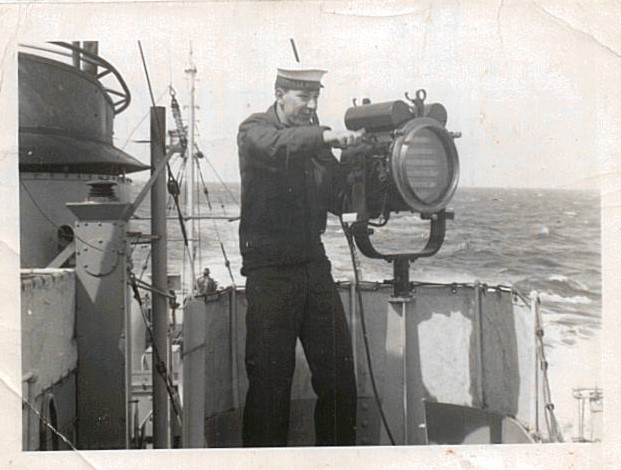
Barber was a leading seaman visual communicator, meaning he used flags, lights, and lamps to communicate with other ships because radio silence was important in a war zone.
Although the July 27, 1953, armistice halted the fighting, United Nations ships such as Haida continued patrolling Korean waters to prevent renewed hostilities and interdict North Korean vessels.
Barber said the ship was parked roughly 10 kilometres off the 38th Parallel, which separated the north and south, while the crew’s objective was to patrol the area and prevent enemy troops from landing on the nearby islands.
“The North Koreans were always, always trying to get into one of the islands to keep an eye on us,” he said, joking that the Canadians “couldn’t be too rough” after capturing the soldiers because of the armistice.
Barber added that the crew was “very anxious” during their 11-month tour, since fighting could have erupted anew at any moment.
A Stormy Departure
HMCS Haida finished its tour in 1954 and sailed for Japan, but Barber recalled that they “were caught in a ferocious typhoon” that nearly sank the ship.
He was on the small bridge with several other officers and watched as waves as high as 30 metres smashed into the ship. He noted that the captain worried the vessel would break in half and sink, while crewmen worried the water would extinguish the boilers and leave them without power.
“We started to capsize, but it was just by the grace of God and wind [that] another series of waves came and pushed us back up,” Barber said.
The typhoon tossed the ship around for 16 to 20 hours and nearly drove it aground near China before it dissipated, allowing the warship to reach Japan severely damaged. Some of the 250 crewmen were taken to a hospital for treatment.
Barber said he “had complete faith in the captain and the crew” to see them through the storm.
The crew returned to Canada on Nov. 1, 1954, and Barber, after serving 23 total months on Haida, was sent to serve on the HMCS Shearwater in Nova Scotia.
Post-Navy Life
Barber was discharged in September 1956 after five years in the navy. He then worked for a telecommunications company and a tax firm for several decades. He married Muriel Nickle in 1957; they were married 52 years and had several children before she died in 2009.
The veteran returned to South Korea four times over the years, including in July to attend a major anniversary event. The “sad part,” he said, was that although 22 Allied nations participated in the war, only 13 veterans attended the event, and he was the only Canadian.
Barber said that, aside from how few veterans attended, the trip was “absolutely fabulous,” and that the gratitude and generosity the Korean residents showed the veterans was “heart-tugging emotional.”
Barber now speaks to schoolchildren about his experiences, shows them artifacts and his medals, and says it is “an honour God gave” him to discuss how “war is the most horrible thing.” He says he encourages children to communicate with others to understand their perspective better, since he believes that can help address conflict.
“That’s what everybody’s got to do. Killing someone does not help the situation,” he said, adding he was proud to have served Canada, and would do it again.