
A small business owner earning $45,000 through a family trust could pay more than three times as much tax as an employee on the same income under the government’s planned trust tax, according to a Senate inquiry.
The question arose on Nov. 6 during an examination of Labor’s impending 30 percent tax trust income.
Liberal Senator Andrew Bragg put it to Treasury officials that a business owner on $45,000 would pay double what a worker pays.
Treasury Chief Adviser Neena Pai replied, “I think the answer is yes, but I can point to many examples where the opposite is true.”
But the real gap is wider than double, because of the way Australia’s income tax works.
From July 1, 2028, the government plans (pdf) a minimum tax of 30 percent on the income of discretionary trusts, often called family trusts, where a trustee decides each year which family members receive the income.
The Tax System in General
The income tax system is charged in steps.
In 2028/29, the year the trust tax begins, a worker pays nothing on the first $18,200 they earn, then 14 cents in each dollar from $18,201 to $45,000. Higher rates apply only to income above $45,000.
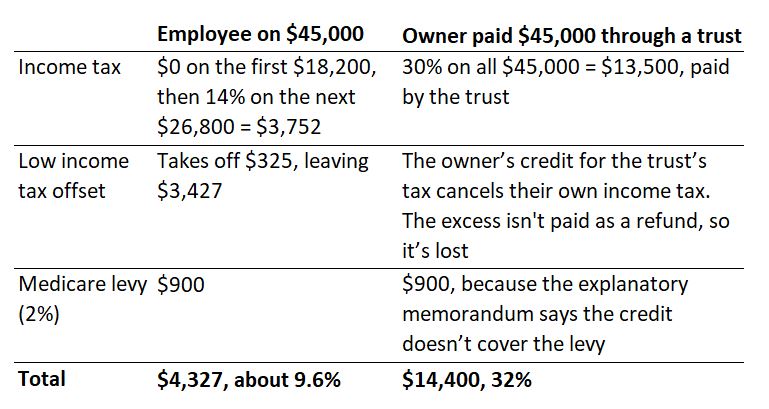
So a worker on $45,000 pays no tax on the first $18,200, and $3,752 on the remaining $26,800. A tax break for low-income earners, the low income tax offset, takes off another $325, leaving $3,427.
Adding the 2 percent Medicare levy of $900 brings the total to $4,327, or about 9.6 percent of their income.
When Bragg referred to a 15 percent rate, he was quoting the rate on just one step, between $18,200 and $45,000, rather than the share of the worker’s whole income that goes in tax. That step rate is 15 percent this year, and will fall to 14 percent from July 1, 2027.
What the Trust Tax Does
Under the government’s new trust tax laws, the trust would pay 30 percent on all $45,000—or $13,500—from the first dollar.
The family member who receives the trust income gets a credit for the $13,500 the trust has paid, which they can use against their own income tax bill.
Yet for someone in the $45,000 plus income bracket, their tax bill normally comes to $3,427, while the credit from the trust tax would cover that amount the remaining $10,073 is non-refundable, meaning the family member can’t pocket it.
The credit also does not cover the Medicare levy, so the trust beneficiary still has to find $900 to pay that.
So for an individual, the total loss of value is $14,400, or 32 percent of their income—more than three times the worker’s $4,327.
A couple each earning $22,500 as employees would pay no income tax and no Medicare levy, because the low income tax offset and the Medicare levy’s low-income threshold would cover them both.
But a couple together sharing $45,000 from a trust would pay $13,500.
The Council of Small Business Organisations Australia gave the committee a real example (pdf) of a sole operator earning $32,000 from a trust. That person pays $1,970 in tax today and would pay $10,200 under the plan, more than five times as much.
Where It Evens Out
The gap shrinks as income rises, because a worker in higher tax brackets are taxed at higher rates.
A worker’s tax only reaches 30 percent of their total income at about $230,000, a figure Pai confirmed at the hearing. Above that level, the trust tax adds nothing extra.
Treasury says families have other choices.
Pai said business owners could pay themselves a wage, which the trust can deduct from its income, or restructure, or lock in fixed shares of income for named family members, which avoids the tax.
Small business groups told the committee a wage brings its own costs, such as superannuation, and takes away the flexibility to pay owners less in lean months.
The government says the tax will stop wealthier families from paying less tax than wage earners by spreading income among relatives on lower tax rates. Pai told the committee that the top 10 percent of earners hold 90 percent of trust wealth across the country.