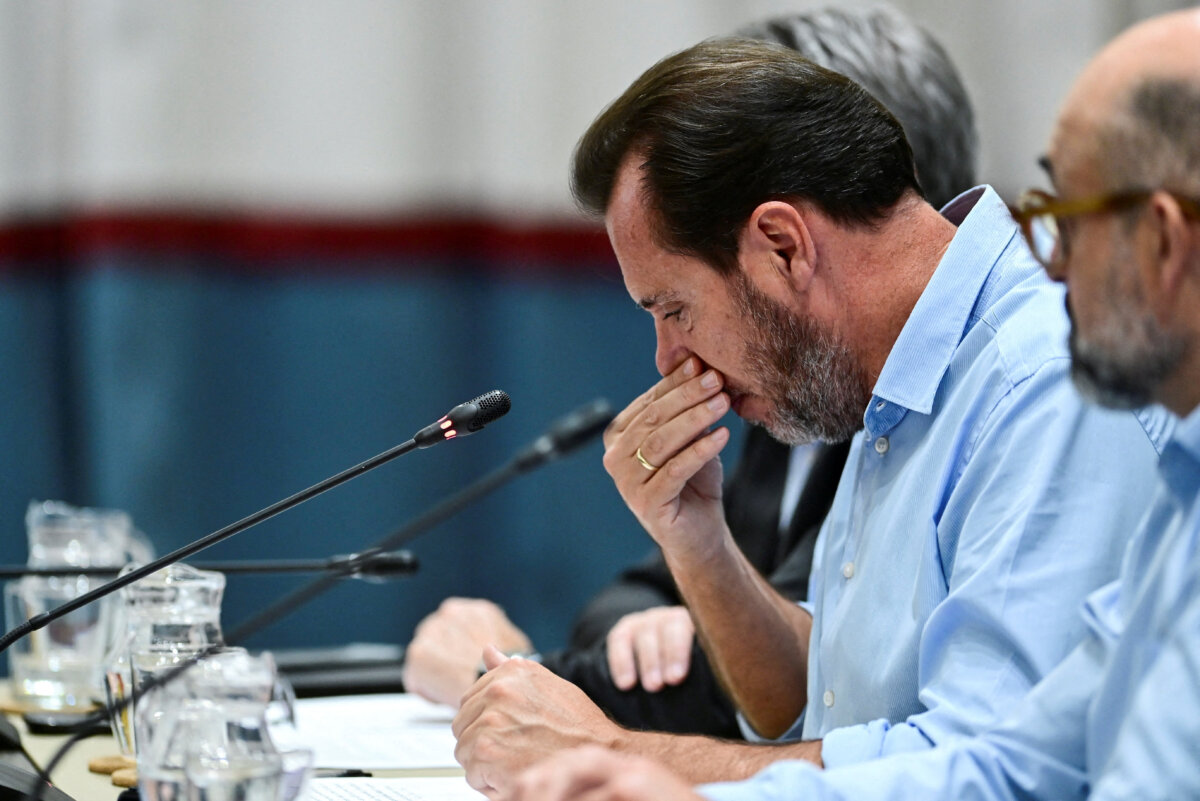

Spanish Prime Minister Pedro Sánchez said on Nov. 4 that his deputy, Carlos Cuerpo, will provisionally run the Transport Ministry following Óscar Puente’s resignation in the wake of a deadly train collision.
The incident on Oct. 28, the second major Spanish train crash in just a year, occurred when two trains heading from Madrid to Andalusia collided.
In a brief televised address, Sánchez praised Puente, who resigned on Nov. 3.
Announcing his replacement by Cuerpo, who is also Spain’s economy minister, Sánchez said, “Cuerpo has shown in this legislature an enormous capacity for management and integrity.”
On Nov. 4, Cuerpo announced the resignation of Luis Pedro Marco de la Peña, chairman of Spanish state-owned rail infrastructure operator Adif.
The death toll remains at 69, and all who perished have now been identified, according to a Nov. 3 post on X from Spain’s Integrated Data Centre, which coordinates information on victims of the disaster.
“Public servants, both men and women, must strive to ensure that Spain regains trust not only in our railway system but also in our political system,” Sánchez said in a Nov. 4 post on X after Puente’s announcement.
“Because it is not true that all politicians are the same, nor that all governments are alike.”
The leader of Spain’s opposition conservative PP party, Alberto Núñez Feijóo, said in a Nov. 4 post on X: “The polls have ousted Puente. He’s out, but Sánchez stays.”
Independent political analyst Eduardo Bayón said Puente’s resignation deprived the PP of its main target.
“The government needs to fill that void with concrete railway security and investment measures, trust in high-speed rail will remain a campaign topic,” Bayón said.
New minister Cuerpo is hoping to hold off a strike by the country’s Semaf train drivers union, due to take place Nov. 10 and 12.
“It is incomprehensible and illogical that train drivers have to call for strike days to force those responsible for guaranteeing railway safety to make every effort and fulfill the commitments that guarantee a change in safety,” Semaf said in a Nov. 2 statement.
In a Nov. 5 post on X, Spain’s public national broadcaster, RTVE Noticias, said that Cuerpo held a meeting on Nov. 5 with the train drivers unions at the Ministry of Transport.
Although Cuerpo serves in Sánchez’s Socialist-led government, he is not a member of the Socialist Party, RTVE Noticias reported in March.
Before announcing his resignation, Puente presented a 30 million euro ($34 million) emergency aid package for victims of the Urda collision and their families.
According to the government’s announcement, families of those killed will receive a direct payment of 72,121 euros (about $81,000), alongside an advance insurance payment of the same amount.
Those injured will be eligible for payments ranging from 2,404 euros (about $2,700) to 84,141 euros (about $95,000), depending on the severity of their injuries.
Spain added that it plans to develop an AI system and digital twin of its railway network to identify anomalies and monitor communications between drivers and controllers.
In his resignation speech, published in full by Spanish news outlet ElDiario on Nov. 3, Puente said he had decided to step down from the role he has held since 2023, but he didn’t say when he would leave the post. He initially rejected calls for his resignation on Oct. 30.
In January, a major crash involving the same companies on the same line killed 46 people. In February, a Senate motion dealing with the country’s railway safety crisis brought by the PP, demanding his immediate resignation, was approved. However, he did not step down at the time.
On Oct. 29, authorities said that investigators had started gathering information about the “degraded” operating conditions that began when the automatic train-protection system failed at 8:31 a.m., according to the document.
Once this system went down, trains switched to a system called “lineside signaling blocking.” In that mode, the control center and train drivers had to communicate by phone or radio to manage the situation.
The investigation into the cause of the collision remains ongoing.
Reuters contributed to this report.