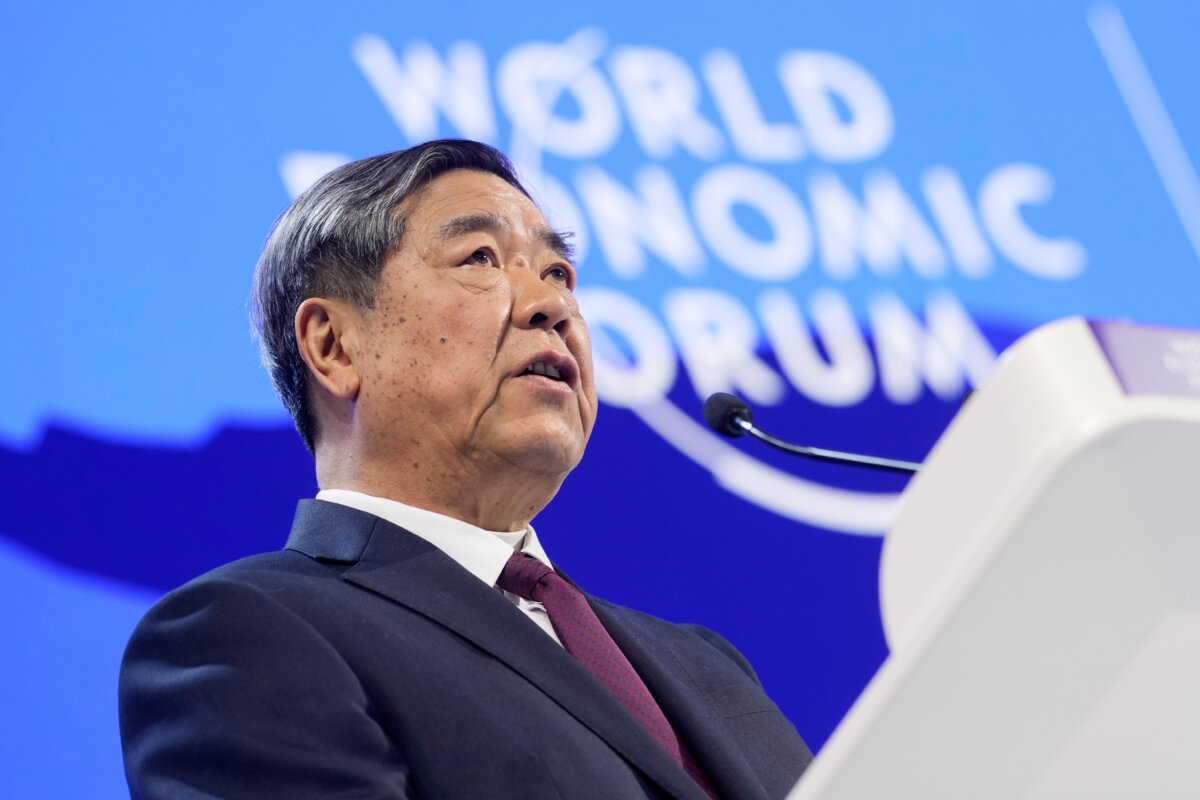

Chinese Vice Premier He Lifeng is scheduled to visit Vancouver on Nov. 8 and 9, the federal government has announced.
Minister of International Trade Maninder Sidhu and Minister of Finance François-Philippe Champagne hope to “advance economic cooperation” with China during the visit, according to a Nov. 4 release from the Department of Finance.
The visit comes ahead of Prime Minister Mark Carney’s scheduled return to China later this month to attend the Asia-Pacific Economic Cooperation (APEC) leaders’ summit on Nov. 18 and 19 in Shenzhen, China.
“This event builds on Prime Minister Carney’s successful visit to China in January, which laid the groundwork for an updated strategic partnership, Minister Champagne’s productive visit in April, and Minister Sidhu’s trip this week,” the government said.
The visit will include discussions under the Canada-China Economic and Financial Strategic Dialogue, with Bank of Canada Governor Tiff Macklem and Superintendent of Financial Institutions Peter Routledge expected to participate, the government said.
He’s visit follows Sidhu’s trip to Beijing this week, where he negotiated an extension of a tariff-relief arrangement with Chinese Commerce Minister Wang Wentao.
The agreement has been in place since Prime Minister Mark Carney visited China in January and signed a number of memoranda of understanding deepening ties with China. China suspended tariffs set to go into effect on Canadian peas, lobster, crab, and canola oil and reduced combined tariffs on Canadian canola seed from 85 percent to 14.9 percent.
In return, Canada maintained tariff exemptions for certain Chinese steel and aluminum products that are in low supply or unavailable in Canada. Ottawa also agreed to allow the import of up to 49,000 Chinese-made electric vehicles (EVs) annually at a tariff rate of 6.1 percent rather than 100 percent.
The tariff-relief deal had been set to expire by the end of this year but will now be valid through the end of 2028.
The EV deal drew criticism from federal Tory Leader Pierre Poilievre who raised national security concerns and warned it could harm Canada’s automotive industry.
“His agreement will allow 50,000 EVs onto our streets jeopardizing our security and auto jobs,” Poilievre wrote in a Jan. 16 social media post.
Ontario Premier Doug Ford also criticized the agreement, calling it a “lopsided deal” that would hurt Canadian auto workers.
The January negotiations came after several years of escalating trade disputes between Ottawa and Beijing. Canada imposed tariffs on Chinese EVs, steel and aluminum in 2024, and China responded with tariffs on Canadian agricultural and seafood products in March 2025.
In his January 2026 visit, Carney said deepening bilateral ties with China “sets us up well for a new world order” and would create more opportunities for Ottawa as it worked to diversify trade beyond the United States.
The upcoming visit by He also comes in the wake of a visit to Canada by Chinese Foreign Minister Wang Yi in May of this year and Champagne’s visit to China in April.
The Canadian Press contributed to this report.