
Prime Minister Mark Carney says Canada and the European Union are working to resolve concerns over the bloc’s carbon border levy, which could affect Canadian exports of carbon-intensive goods.
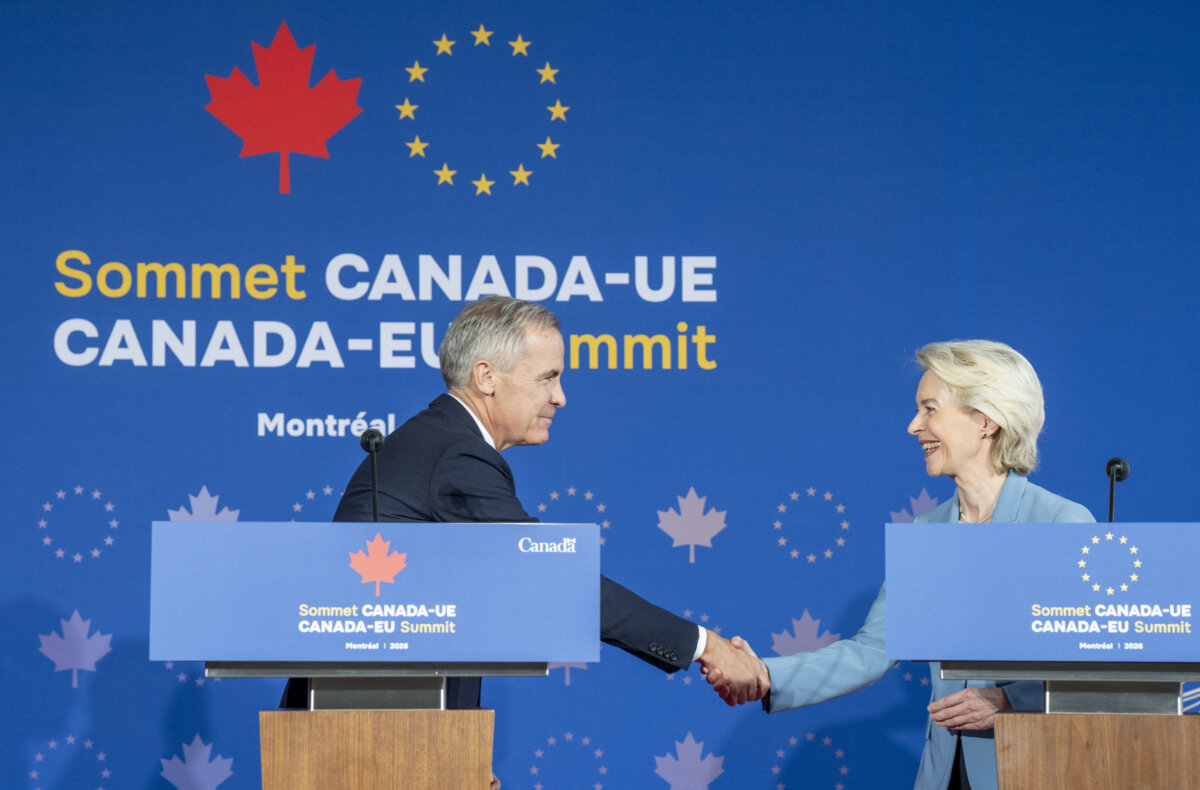
Carney told reporters at the closing news conference of last week’s Canada-EU summit in Montreal that the two sides are seeking common solutions to trade concerns related to the EU’s Carbon Border Adjustment Mechanism (CBAM).
Carney made the comments while responding to a reporter who asked European Commission President Ursula von der Leyen whether the EU would exempt Canadian products from CBAM and its deforestation regulation, and whether Carney would press for such exemptions.
“Those are two of the issues that we worked together to find common solutions on,” Carney said.
Von der Leyen offered a brief response, deferring to Carney’s remarks.
“I couldn’t answer the question better than Prime Minister Carney has just done on the trade irritants,” she said.
Von der Leyen and European Council President Antonio Costa both attended the two-day summit hosted by Carney last week to discuss closer ties and a potential associate membership with Canada.
CBAM is an EU policy that places a carbon cost on certain imported goods based on the greenhouse gas emissions associated with their production. The fee is currently being applied at a lower level, but will be fully implemented by 2034. It applies to selected goods in certain sectors, including aluminum, cement, iron and steel, fertilizers, electricity, and hydrogen.
Under the mechanism, importers must purchase certificates based on the emissions associated with covered products, with adjustments for carbon prices already paid in the country of production.
The EU Deforestation Regulation (EUDR)—requires companies selling or exporting key commodities into the EU market to prove products like wood, furniture, and paper do not come from deforested land.
An internal document obtained by CBC ahead of the summit showed Canadian diplomats had concerns about the carbon tariff, as well as the expenses associated with compliance.
Global Affairs estimated that $2.8 billion worth of goods—or 7.4 percent of exports to the EU—faced carbon import taxes each year. This included goods already impacted by U.S. tariffs such as iron, steel, and aluminum.
The estimates are based on average trade data from 2021 to 2024, suggesting that exposure could rise as Canadian businesses pursue alternative buyers to evade tariffs imposed by the administration of U.S. President Donald Trump.
The Dec. 10, 2025, memo further indicates that Canada is not exempt from the carbon tariff, despite the country’s Comprehensive Economic and Trade Agreement (CETA) with the European Union. The agreement has eliminated 98 percent of all tariffs on goods traded between Canada and the EU since it officially entered into provisional application in September 2017.
Talks Progressing
Canadian Ambassador to the European Union Jonathan Wilkinson told CBC’s “Power & Politics” that diplomatic discussions are progressing, but remain unresolved.
Wilkinson said “the problem” Ottawa was facing with the European carbon border mechanism is that it did not recognize that Canadian producers are already contributing to greenhouse gas reductions by paying an industrial carbon price.
Canada’s headline carbon price for industrial pricing systems is $95 per tonne of greenhouse gas emissions in 2026. It is scheduled to rise to $100 in 2027 and $115 in 2030.
“We made enormous progress addressing those issues,” Wilkinson said during the interview, adding that the EU “will recognize our carbon price,” but added “there’s a bit of work” to do to resolve the matter.
The extent of the credit Canadian producers will receive for carbon prices paid in Canada has not yet been determined. Wilkinson said an agreement between Canada and the EU would not need to be in place until next fall.
Wilkinson argued that Canadian exporters hold a competitive advantage over producers in countries such as the United States, which does not have a comparable federal industrial carbon pricing system and could therefore face higher CBAM charges.
The update from the Carney government comes as Conservatives are calling on the Liberals to find a solution, describing the mechanism as a “threat to Canadian industry” that cannot be ignored.
“Prime Minister Mark Carney has spent months talking up Canada’s relationship with the European Union. But to date, has failed to eliminate this threat to Canadian businesses, just as he has failed to secure full ratification of CETA,” said a statement from the Conservatives.
CETA has been provisionally in force since September 2017 but has not yet been fully ratified. Full ratification requires approval by the EU institutions and the national and, in some cases, regional parliaments of all EU member states.
Out of the 27 EU nations, 18 have finished their internal ratification processes. The remaining nine countries that still need to ratify CETA are Belgium, Bulgaria, Cyprus, France, Greece, Hungary, Ireland, Italy, and Poland.