Authorities are investigating the chain of events and operational measures that may have led to the deaths of 69 people when two high-speed trains collided in Urda, Spain.
The incident on Oct. 28, the second major Spanish train crash in just a year, occurred when two trains heading from Madrid to Andalusia collided.
On Oct. 29, Spain’s independent technical accident investigation authority for railways, maritime transport, and civil aviation, AITAT, published its preliminary technical investigation document.
It said the collision occurred at an estimated speed of 100–120 mph, although the exact speed will not be known until investigators extract data from the on-board event recorder.
Investigators have started gathering information about the “degraded” operating conditions that began when the automatic train-protection system failed at 8:31 a.m., according to the document.
Once this system went down, trains switched to a system called lineside signaling blocking. In that mode, the control center and train drivers had to communicate by phone or radio to manage the situation.
“The chain of malfunctions, instructions and actions would eventually have led to the collision, without the necessary mitigating barriers having acted,” it said.
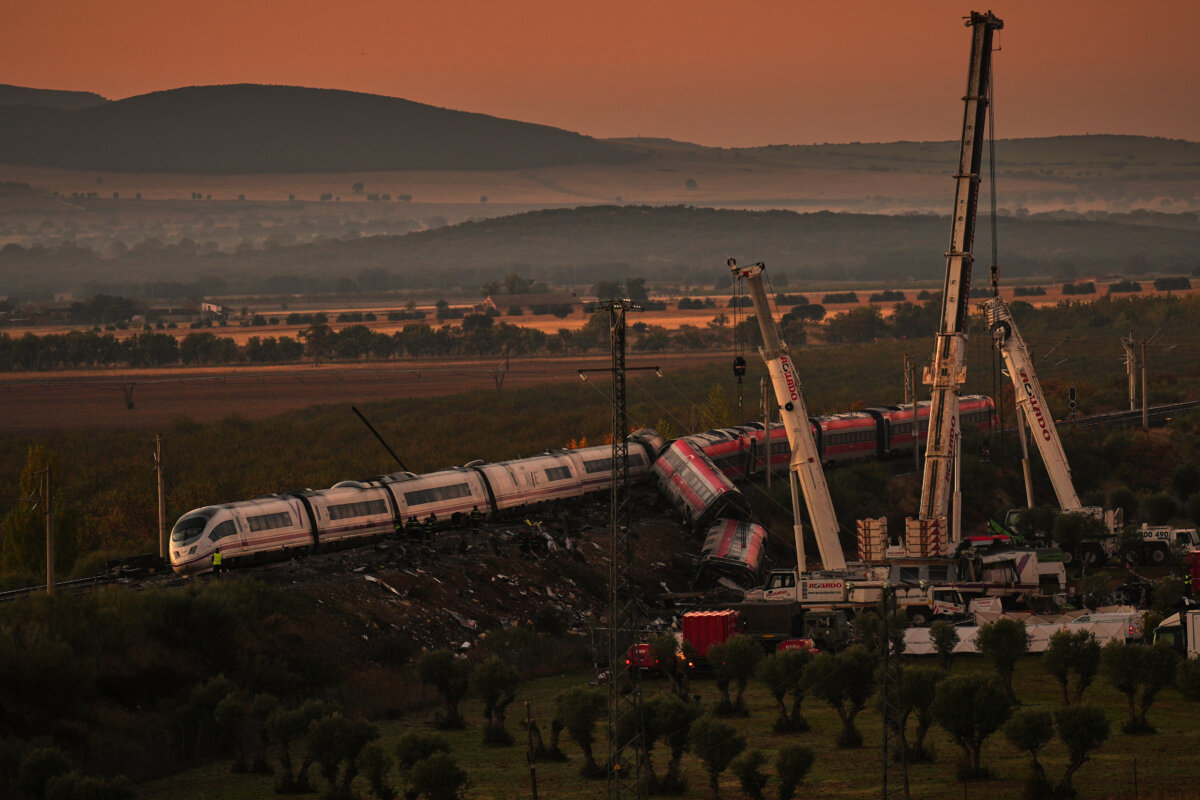
Local television footage showed a derailed train with several carriages still on an elevated section of track, while twisted metal, broken panels, and wreckage lay strewn across an embankment beneath the line.
In a Nov. 1 post on X, the High Court of Justice of Castilla-La Mancha said 54 Spanish nationals and 12 foreign nationals have been identified among those killed in the Urda rail accident, including one American.
Currently, three active missing persons reports involve foreign nationals: two from Australia and one from Japan.
Of those who died, 66 have already been identified.
Fátima Báñez, 59, Spain’s former minister of employment and social security and president of the CEOE Foundation, also died in the crash.
No additional bodies were found when rescue teams overturned a train carriage on Oct. 29, Castilla-La Mancha regional leader Emiliano García-Page said on TVE on Oct. 30.
Identifying the bodies was difficult because many were in pieces, he said. On Oct. 29, rescue teams had placed partial remains in 31 bags.
Raquel Ayllon, a union leader at state-owned infrastructure operator Adif, claimed that controllers worked under difficult conditions.
“Human error is being criticized and questioned very quickly, while people are not really focusing on the central issue: the failure of the safety system,” Ayllon said on TVE on Oct. 31.
Puente said the number of staff working at the control center in Madrid had almost doubled since 2012 and that the controller who made the call had been working for two hours when the crash occurred.
“I have never used the term ‘human error,’ although that is not to say that there was no human error,” he said.
Spain’s transport minister rejected calls for his resignation on Oct. 30.
Hazte Oír, a Spanish conservative association that runs political petition campaigns, called for Óscar Puente’s resignation in a Nov. 1 post on X.
“Dozens of families are still searching for their missing loved ones after Urda,” it said.
Oír’s petition has gathered 118,516 signatures, the group said.
“My duty now is not to focus on discussing whether I will remain in office, but on solving the problem, determining exactly what happened and providing clear explanations,” Puente said at a press conference on Oct. 30.
The country is preparing for an election that Socialist Prime Minister Pedro Sánchez has called for Nov. 29.
Earlier this year, at least 40 people died after a high-speed train derailed and smashed into an oncoming train in southern Spain. The high-speed train, traveling from Málaga to Madrid on Jan. 18, derailed near Córdoba and struck a second train traveling from Madrid to Huelva.
Reuters and Evgenia Filimianova contributed to this report.