
Ontario is projecting a $16.9 billion deficit for the current fiscal year, citing ongoing trade tensions with the United States and rising energy prices as major factors contributing to the province’s economic struggles.
The projected deficit is $3.1 billion higher than the $13.8 billion shortfall forecast in the spring budget and $3.9 billion higher than the $13 billion deficit recorded in 2025–26.
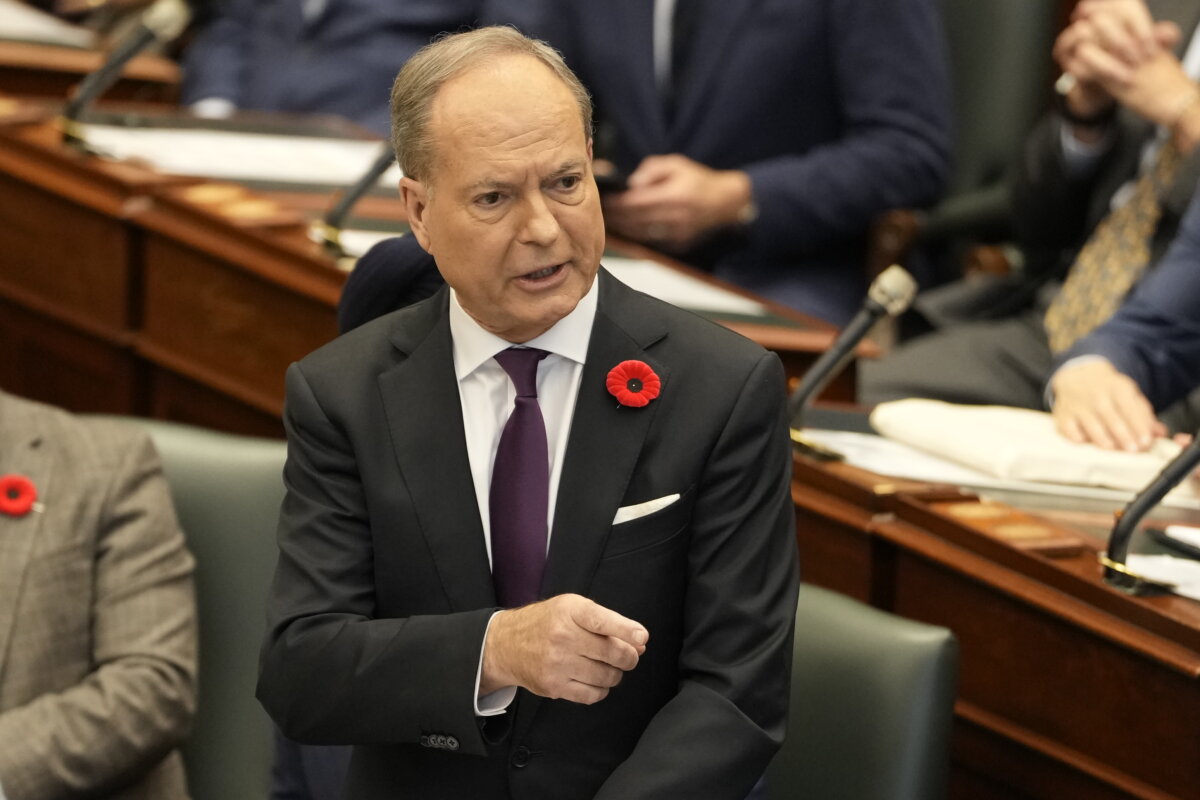
The province also pushed back its target for balancing the budget to 2029–30, according to the fall economic statement, which Finance Minister Peter Bethlenfalvy presented at Queen’s Park in Toronto on Oct. 29.
“Ontario continues to be challenged,” Bethlenfalvy wrote in the introduction to the economic statement. “Workers, families and businesses in every corner of the province are feeling the impact of the unwarranted U.S. tariffs and their impacts on Canada, and government finances are not immune.”
Worsening Deficit Projections
The update forecasts a $12.7 billion deficit for 2027–28, more than double the amount projected in the spring budget. It also forecasts a $6.7 billion shortfall for 2028–29, replacing an earlier projection of a $600 million surplus.
The province now projects a surplus of $200 million in 2029–2030.
The government has delayed its balanced-budget target four times since 2024. The fall update forecasts economic growth of just 0.5 percent in 2026, down from 1 percent in the spring budget. The province also projects employment growth of 0.4 percent.
The province lowered its housing-starts forecasts as well. It now expects 64,700 starts in 2026, down from 64,800 in the spring budget; 65,100 in 2027, down from 70,300; and 71,700 in 2028, down from 76,800.
Ontario NDP Leader Marit Stiles criticized the update as an “admission of failure,” saying it did not include a plan to lower costs for Ontarians struggling to make ends meet.
“Never has a government spent so much and gotten so little for the people of Ontario,” she said. “People are in desperate need of common sense solutions that put money back in people’s pockets.”
Spending Hikes
The fall update projects $247.3 billion in total provincial government spending for the 2026–2027 fiscal year, up roughly $4.4 billion from spring projections.
The figure includes $229.9 billion in program spending and $17.4 billion in interest and other debt-servicing charges, which the province says will grow to $20.4 billion by the 2028–2029 fiscal year.
“Despite ongoing economic challenges, Ontario’s fiscal plan continues to enable the government to respond to changing conditions, while continuing to invest in priorities that matter most to families and communities,” Bethlenfalvy writes in the foreword to the forecast.
Tariff Relief
Ford’s government says it has given out roughly $30 billion in relief and support to businesses and workers affected by U.S. tariffs since April 2025.
These measures have included various forms of tax savings and financial assistance.
The fall economic statement also outlines $8 billion in further tax relief for businesses over the next five years, intended to spur investment in equipment, machinery, and capital assets as well as support job creation and grow competitiveness for Ontario businesses amid trade pressure.
Despite the downward slide in almost all its projections, the province said it’s still committed to a previously announced $210 billion, 10-year infrastructure plan, as well as continuing to fund and invest in education, healthcare, transportation, and energy.







