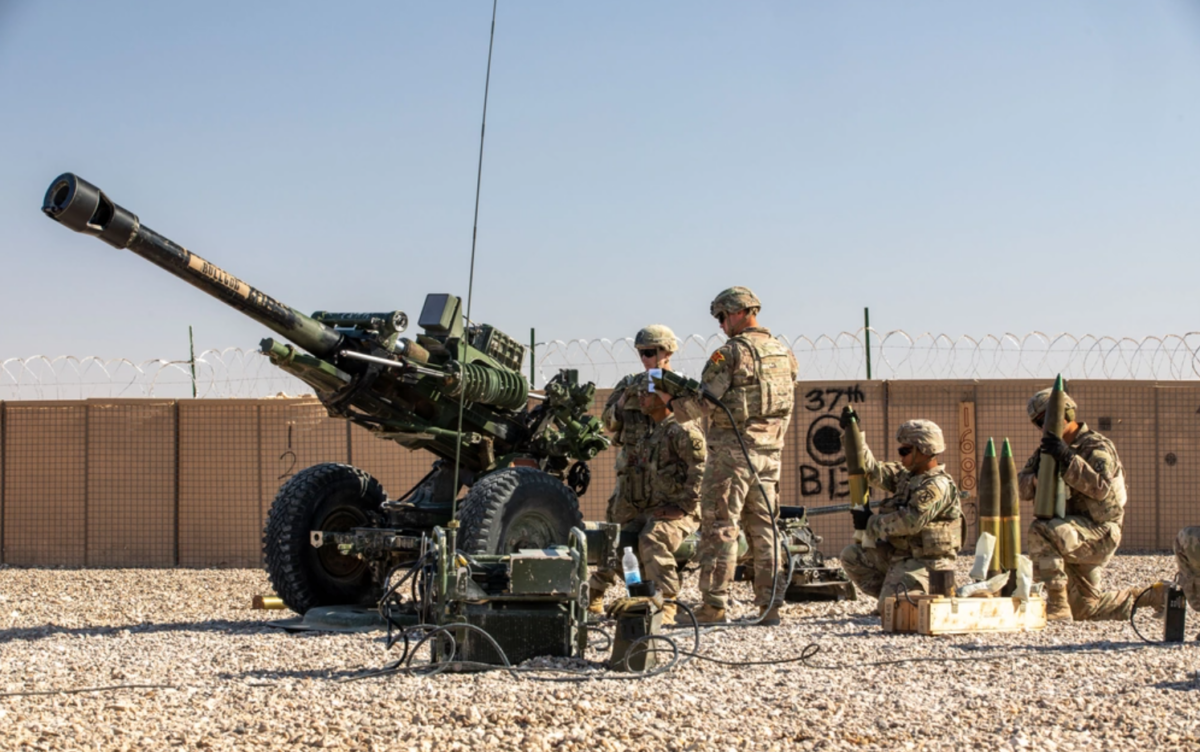

The U.S. military completed its withdrawal of the remaining troops and equipment from Erbil Air Base in Iraq more than 20 years after the United States first launched the Iraq War, the U.S. Central Command (CENTCOM) announced on Sept. 30.
Described by CENTCOM as an “orderly departure” from the air base, the withdrawal marks the end of the U.S. military’s Operation Inherent Resolve in Iraq. The campaign supported a coalition of forces that had fought to defeat ISIS in the country since 2014.
The initial U.S. military presence, dubbed Operation Iraqi Freedom, started with an invasion in 2003 that ousted Iraqi leader Saddam Hussein and lasted until 2011. However, U.S. forces were sent back to Iraq in 2014 in support of a coalition countering ISIS terrorists in Iraq and Syria.
With the U.S. military exiting and the Iraqi government now responsible for its own security, some Iraqi officials have expressed concerns regarding the continued security of Iraq and the surrounding region.
The Sept. 30 deadline for the U.S. military withdrawal from Iraq came as part of a planned transition agreed to in 2024. The United States began withdrawing troops in October 2025 but kept hundreds of troops in the semiautonomous northern Kurdish region.
“This milestone reflects the success of a 12-year campaign that defeated ISIS as an organized military threat in Iraq and across the region,” chief Pentagon spokesman Sean Parnell said in a statement on Sept. 30. “It also marks a transition from a wartime coalition mission to an Iraqi-led security effort supported by a more normal bilateral security relationship.”
Parnell said the United States would continue to support Iraq through targeted training and intelligence, but he noted that the primary responsibility for addressing security challenges such as ISIS and Iran-aligned militias rested with the Iraqi government.
“Job well done to the tens of thousands of American service members, diplomats, and civilian personnel who answered the call in Iraq,” Adm. Brad Cooper, CENTCOM commander, said in a statement.
“Because of your grit, sacrifice, and professionalism, ISIS no longer poses a systemic threat to Iraq’s national security, and Iraqi security forces, including the Peshmerga and other Iraqi Kurdistan Region security forces, now possess the capacity, leadership, and operational independence to unilaterally manage threats to their homeland.”
Combined Joint Task Force-Operation Inherent Resolve, which previously used Erbil Air Base as its operational hub and hosted a majority of the 1,500 American and coalition forces involved in the operation against ISIS, is now headquartered in Jordan, according to CENTCOM. U.S. forces are continuing to execute the mission in Syria in collaboration with the Syrian government and other coalition partners.
Cooper said that although Iraq will now be responsible for its own security, the United States and coalition forces in the Middle East will “remain ready to respond to any ISIS threats that arise.”
U.S. President Donald Trump celebrated the withdrawal from Iraq in a Truth Social post on Sept. 30, suggesting that U.S. involvement in the country was the result of “very bad decision-making.”
“This Day is a victory for the United States, a victory for Iraq, and a decisive victory over ISIS, which has been completely decimated by the Trump Administration, First Term, along with other very bad and dangerous players,” he wrote.
“Prime Minister al-Zaidi, is outstanding, and he will hopefully be able to handle things very well. We came to fight a caliphate. There is no longer a caliphate. We are going home!”
Speaking at an event at the White House on Sept. 30, Trump echoed his Truth Social comments regarding the withdrawal. The president reiterated that he refused to let the U.S. military’s temporary presence in Iraq become permanent.
“I had a choice to stay or to leave, and felt, without question, that it was time for America to go home,” he said.
Trump also contrasted the Iraq withdrawal with the U.S. military’s withdrawal from Afghanistan in August 2021, during which 13 U.S. service members were killed.
In the Afghanistan withdrawal, the U.S. military left behind a significant amount of equipment, Trump said. In contrast, Trump said the withdrawal from Iraq was an “orderly departure.”
“We left all of the equipment, if you remember, in Afghanistan. Everything was left behind,” he said. “I said, ‘I want every screw taken. If there’s a screw lying on the ground, take it.’ … We took everything.”
Iraqi Prime Minister Ali al-Zaidi said the U.S. military withdrawal marked the beginning of a “new phase” for Iraq defined by Iraqi sovereignty, strong institutions, military readiness, unity, and “balanced partnerships.”
The Sept. 30 deadline for the U.S. withdrawal from Iraq was initially linked to a deadline for non-state armed groups in Iraq to disarm. Although some groups agreed to the Iraqi government’s demands, some of the more powerful groups aligned with Iran rejected the disarmament proposal.
Al-Zaidi told The New York Times this month that a new deadline for disarmament had been set for June 2027.
Iraq’s Kurdish regional government’s Peshmerga Ministry said in a statement on Sept. 28 that the U.S. withdrawal came at a sensitive time, when instability threatens the security of both Iraq and the surrounding region.
Kurdish officials said their region has been hit by more than 1,000 drones and ballistic missiles since the start of the war between the United States and Iran in February. The Peshmerga Ministry warned that it was “deeply concerning” that an alternative air defense system had not been established in light of the withdrawal of U.S. forces.
Meanwhile, Iran-allied groups in Iraq have celebrated the withdrawal of U.S. troops from the country.
“The expulsion of the occupation forces, defeated, from the land of Iraq is the beginning of full sovereignty,” Abu Mujahid al-Assaf, a security official with the Kataib Hezbollah terrorist group, said in a statement.
The Associated Press contributed to this report.