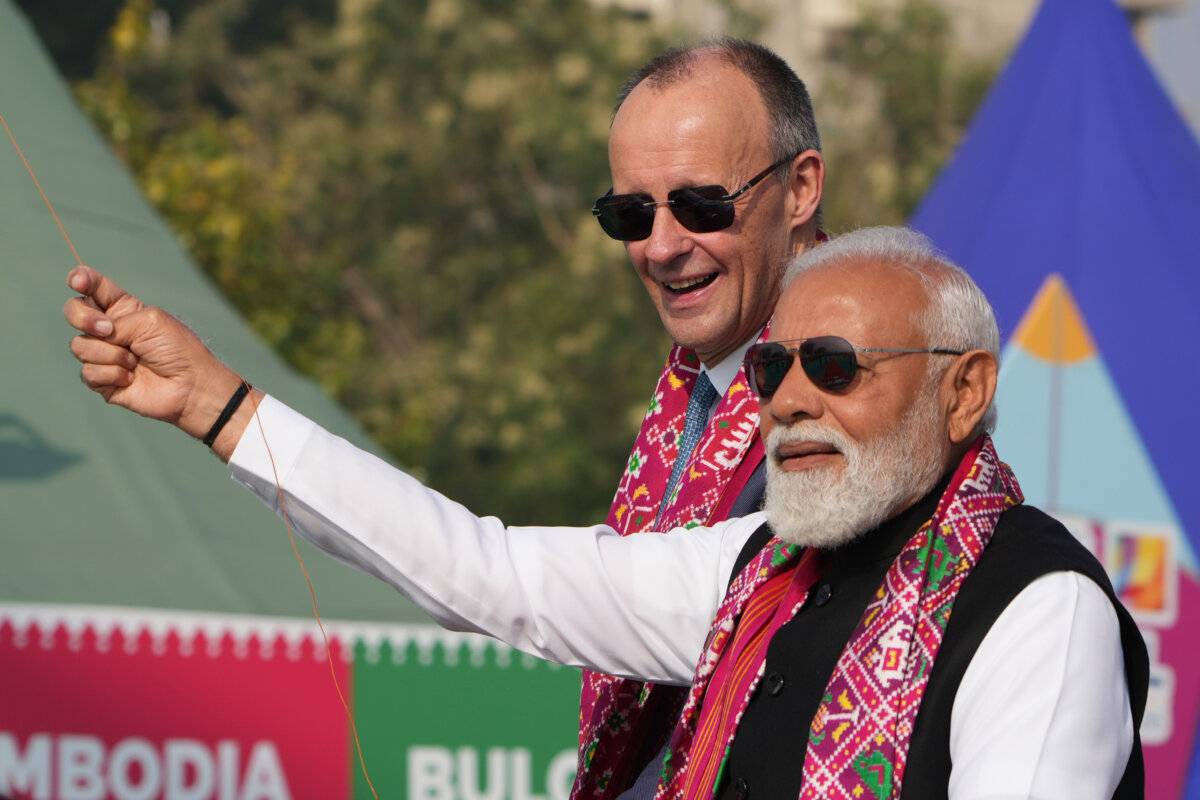

Indian Prime Minister Narendra Modi and German Chancellor Friedrich Merz met on Jan. 12 in the western Indian state of Gujarat, pledging to deepen economic, defense, and strategic ties as Europe’s largest economy looks to strengthen partnerships in the Indo-Pacific region and diversify supply chains.
Merz, on his first official visit to India and his first trip to Asia since taking office, was accompanied by a high-level delegation that included 23 senior German business leaders, according to a joint statement issued by the Indian government on Jan. 12.
Economic cooperation dominated the talks, reflecting rapidly expanding commercial ties.
“Our bilateral trade has reached its highest level ever, surpassing $50 billion. More than 2,000 German companies have a long-standing presence in India. This reflects their unwavering confidence in India and the infinite potential it holds,” Modi said on Jan. 12.
Indian officials said trade in goods and services reached a record high in 2024 and continued to grow through 2025, with Germany accounting for more than one-quarter of India’s total trade with the European Union.
Both leaders reiterated their commitment to concluding an EU–India free trade agreement, noting that it would enhance German–Indian economic ties and improve predictability for businesses.
The German Foreign Office described India as one of the world’s fastest-growing major economies and said it is likely to become the world’s third-largest economy by 2027, while Germany remains India’s most important EU trading partner.
“Germany, as the largest member state of the European Union, and India, as the world’s largest democracy, are united by fundamental values. A highly dynamic India and a highly technological Germany share key strategic interests. This is the foundation on which we build,” Merz said in a Jan. 12 post on X.
Defense, Technology, Climate
On security, Modi and Merz reaffirmed plans to step up defense cooperation, including more joint exercises, training, and exchanges between their armed forces.
India welcomed Germany’s intention to take part in major Indian-led naval and air exercises in 2026 and Berlin’s decision to deploy a liaison officer to India’s Information Fusion Centre for the Indian Ocean Region.
The leaders also supported closer collaboration between defense industries, with a new road map aimed at co-development and co-production of equipment.
The two sides highlighted progress on semiconductors, digital technologies, and research collaboration, while also stressing the need for resilient supply chains.
On climate and energy, the leaders reviewed the Green and Sustainable Development Partnership, under which Germany has committed 10 billion euros (about $11.7 billion) by 2030, largely through concessional loans, to support projects in renewable energy, urban transport, and climate adaptation in India. About half of that amount has already been allocated or spent, Indian officials said.
They also welcomed closer cooperation on green hydrogen and battery storage, linking India’s clean energy ambitions with Germany’s industrial expertise.
Global Issues, Mobility
Modi and Merz said they would strengthen coordination on Indo-Pacific issues and announced a new bilateral consultation mechanism. India welcomed Germany’s growing role in the region, and both leaders voiced support for connectivity initiatives linking Asia, the Middle East, and Europe.
On global conflicts, the leaders expressed concern over the war in Ukraine and supported efforts toward a “just and lasting peace” consistent with international law.
They also welcomed the adoption on Nov. 17, 2025, of the U.S.-drafted U.N. Security Council resolution, which endorsed President Donald Trump’s Gaza cease-fire plan, and reiterated support for a negotiated two-state solution in the Middle East.
The visit also highlighted growing exchanges in education, skills, and mobility. Modi thanked Merz for Germany’s decision to allow visa-free transit for Indian passport holders, a move that Indian officials said would ease travel and strengthen links between the two societies.
Both sides said they would continue cooperation on skilled migration and higher education, including partnerships between Indian and German universities.