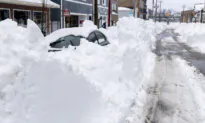

Eastern Canada is dealing with disruptions to air travel, power outages, and a surge in 911 calls caused by a winter storm.
Environment and Climate Change Canada (ECCC) issued orange alerts for large swathes of Ontario as well as areas of Quebec and Nova Scotia the morning of Dec. 29 due to freezing rain, high winds, and blowing snow, with severe weather conditions expected to last for several days in many areas.
ECCC introduced its colour-coded warning system in late November, with yellow representing short-term, localized weather events, orange representing severe weather that could adversely impact health and cause significant damage, and red alerts pertaining to rare weather disasters that could be life-threatening and cause extensive damage and disruption.
Tens of thousands were reported to be experiencing power outages in Ontario and Quebec as of Dec. 29, while freezing rain is forecast to build up to 15 millimetres of ice in the Ottawa and Montreal area through the evening of Dec. 30. As of 6 p.m. EST, power outages were impacting more than 12,000 Hydro-Québec clients and 32,000 Hydro One customers in Ontario.
ECCC also issued advisories for Toronto, London, and towns near Lake Huron and Georgian Bay, saying “dangerous snow squalls” are expected along with icy roads, as well as high winds up to 90 kilometres per hour.
High winds, freezing rain, and heavy gusts of snow Dec. 29 also reportedly led to a surge in 911 calls in Montreal, where the public emergency organization Urgences-santé noted it had been receiving around 100 calls each hour the morning of Dec. 29, mainly due to those who had been hurt falling on icy sidewalks.
Timmins and Sault Ste. Marie in Ontario have been hit particularly hard by blizzard conditions, along with Val d’Or, Que., and areas along the east of the St. Lawrence River that are set to receive 40 to 60 centimetres of snow in the next several days. Multiple stretches of highway and local roads around Timmins and other areas in northern Ontario were closed as of Dec. 29 in response to high winds and heavy snowfall, and there were a number of road closures in northern Quebec.
Areas of northeastern Nova Scotia were also given an orange alert status by ECCC, with winds up to 140 kilometres per hour expected the night of Dec. 29 until the morning of Dec. 30. Large areas of the Maritimes are also currently under a yellow alert for freezing rain lasting for several days, which may also lead to flooding, according to ECCC.
In addition to power outages and dangerous driving conditions, the winter storm has led to numerous flight delays and cancellations.
As of the evening of Dec. 29, Montreal’s Pierre Trudeau International Airport showed more than half of incoming and outgoing flights were delayed by one or two hours, along with dozens of arrival and departure flight cancellations throughout the day, while Toronto’s Pearson International Airport listed almost every incoming and outgoing flight as delayed, along with a number of cancelled flights.
Stanfield International Airport in Halifax also listed a number of cancelled flight arrivals and several cancelled and delayed departure flights the morning of Dec. 29, changing to mainly on time departures and arrivals by mid-morning.
Via Rail also listed 15- to 45-minute delays on its Windsor to Quebec City line due to speed restrictions imposed by rail infrastructure owner CN as of the evening of Dec. 29.
The Canadian Press and Jennifer Cowan contributed to this report.