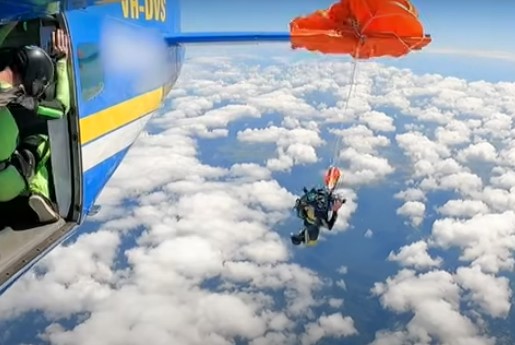

The Australian Transport Safety Bureau (ATSB) has released remarkable footage showing the moment a skydiver became entangled on the tail of a plane by his parachute, forcing him to cut himself free.
The incident unfolded on Sept. 20 after a small Cessna flying members of the Far North Freefall Skydiving club took off from Tully in North Queensland with 17 parachutists on board ready for a 16-way formation jump at 15,000 feet over Mission Beach.
The jump was part of the Big Ways at the Beach event hosted over several days that saw skydivers conducting a number of large group formations.
But as the parachutists started to descend from the plane, the handle on one man’s reserve parachute snagged on the wing flap, triggering the chute and leading to a situation where both he and the pilot had to employ some quick-thinking to get back down to earth safely.
How it Happened
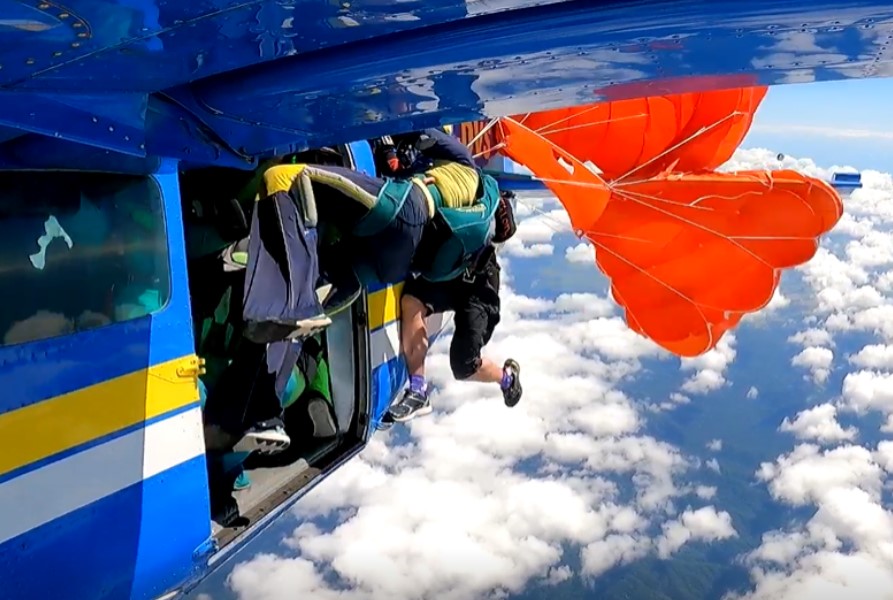
The first skydiver stood up outside the plane’s door, reaching for a small post on top of the aircraft’s body.
As he lifted his knee under the wing and flap, the handle of his chute snagged on the plane’s wing flap, triggering the back-up chute to open.
As it inflated and its lines became taut, the skydiver was pulled off the side of the aircraft, and flew towards the tail.
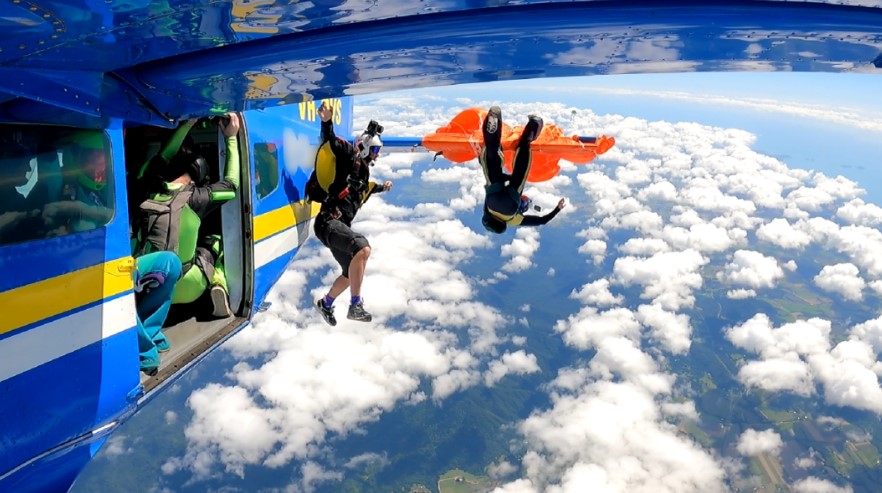
The reserve parachute wrapped around the stabiliser—which keeps the plane balanced—and deflated as the skydiver’s lower legs struck the stabiliser.
When the stabiliser is affected, it can be hard for a craft to maintain a level position.
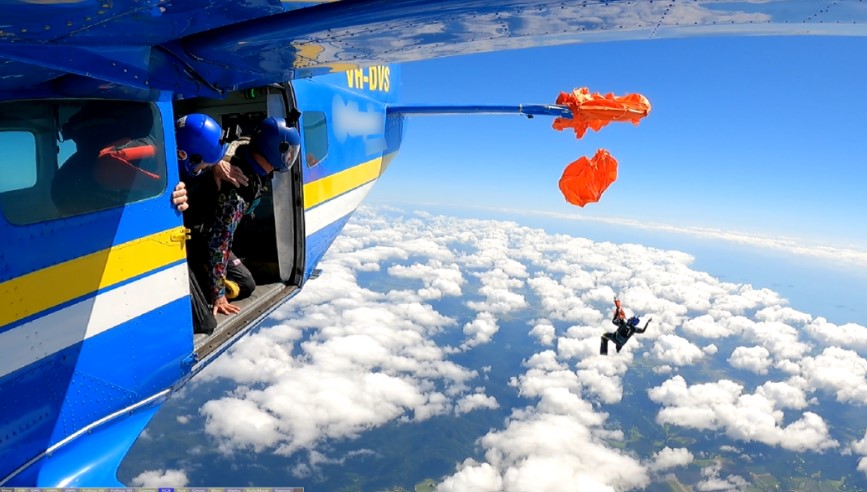
The parachutist was then suspended beneath the tail of the plane before cutting himself free and free falling prior to opening his primary chute, with the camera operator parachutist also free falling at this point.
The parachutist was then able to release their main parachute, which luckily inflated despite being tangled with the remains of the reserve chute.
He made a safe landing.
Flight Thrown Into Chaos
There was one more terrifying moment to endure for the parachutist before he cut himself free—the pilot sped up, not realising he was stuck.
“The pilot recalled feeling the aircraft suddenly pitch up, and observed the airspeed rapidly decreasing,” ATSB Chief Commissioner Angus Mitchell said in a statement.
“Initially unaware of what had occurred, the pilot believed the aircraft had stalled, and pushed forward on the control column and applied some power in response. But upon being told there was a skydiver hung up on the tailplane, they reduced power again.”
The pilot also had to think quickly as the controls started to vibrate and the Cessna experienced significant pressure.
But a safe landing for the pilot would take a little more quick thinking.
“With all parachutists out of the aircraft, the pilot assessed they had limited pitch control, given the substantially damaged tailplane, which still had a portion of the reserve parachute wrapped around it,” Mitchell said.
“With forward pressure they found they could achieve a gradual descent, and retracted the flap, which then allowed slightly more rudder, aileron and elevator control.”
The pilot declared a mayday to Brisbane Centre Air Traffic Control, advising of minimal control.
Despite having their own parachute at the ready, the pilot calculated it would be safe to land.
“In difficult circumstances, the pilot managed to control the aircraft and land safely at Tully,” Mitchell said.
Investigation Outcomes
A number of safety measures and training initiatives will be conducted across the industry as a result of the incident and a number of observations were made.
Investigators said the event comes as a reminder for parachutists to take safety measures, including being mindful of handles and the benefits of carrying a hook knife.
An investigation also found the plane had not been properly weight-balanced, and while that factor didn’t play a part on the day, it sometimes has with horrific consequences.
“Fatal parachuting accidents have occurred in the past due to aircraft being loaded outside centre of gravity limits, which highlights the importance of conducting aircraft weight and balance calculations prior to each load,” Mitchell said.
The pilot did not activate supplemental oxygen at the flight level, which would have reduced any risk of lack of oxygen.
As a result of the incident, the skydiving club in question is making a number of changes, including refining airplane weight and balance software, and issuing a reminder to pilots around the use of supplemental oxygen when an aircraft is at or above 14,000 feet.
The Australian Parachute Federation is also in the process of developing a guide on plane loading, roles and responsibilities that will be presented alongside new training material.
The ATSB found that the parachutists had also opened the plane’s roller door, clipping it in place before they exited, making it easier for the pilot should they have to leave the plane in a hurry.







