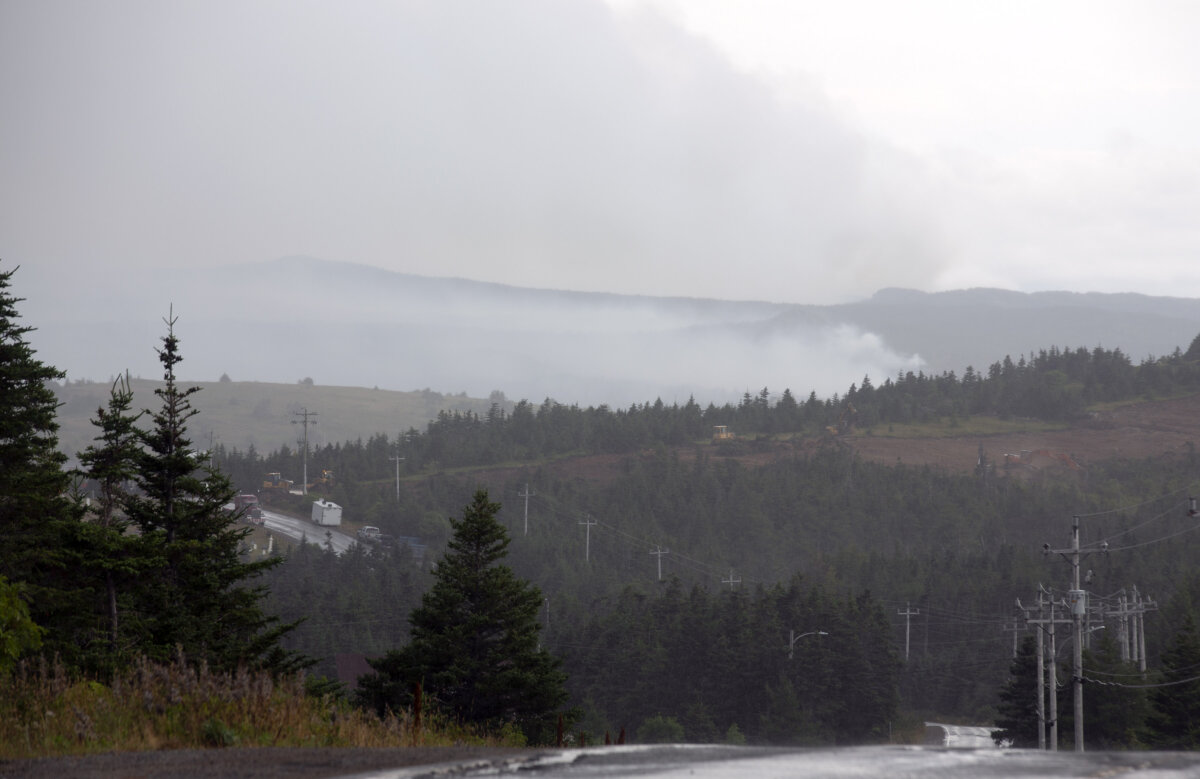

Wildfires continue to blaze across Canada’s East Coast with 39 active fires in New Brunswick, 10 in Nova Scotia, and six in Newfoundland and Labrador.
With 39 active wildfires across the province of New Brunswick, including seven that are considered to be “out of control,” provincial Natural Resources Minister John Herron has warned New Brunswick residents to be ready to leave on short notice.
“If you live in an impacted area, you should be prepared to evacuate on short notice and you should make sure your emergency preparedness kit is ready,” Herron said at a press conference on Friday, Aug. 15.
As of 5 p.m. on Sunday, Aug. 17, the provincial government said 16 fires are being patrolled, two are under control, seven are contained, seven are being monitored, while seven are out of control.
The out-of-control fires include the Old Field Road, Chief’s, Lovalls Lake, Beaver Lake Stream, Jacquet River PNA, Hells Gate, and Jacquet River fires.
The Old Field Road fire in the Miramichi area, which started on Aug. 6, has burned more than 1,400 hectares and had 10 fire fighters, three engines, three tenders, four tractors, and six overhead responders combating the fire on Aug. 17. Herron said this fire captures “an extraordinary amount of attention,” as it is the largest fire today this year in the province.
Residents of Lavillette received an evacuation advisory on the evening of Aug. 15 and were told they should be prepared to evacuate on short notice. However as of Aug. 17, the province says the evacuation advisory has been lifted as the fire is now contained.
The provincial government says that while some rain is expected, the wildfire danger remains high. It says current forecasts predict thunderstorms, which when combined with the ongoing wildfire conditions, present a high risk for additional fires.
Herron said at the Aug. 15 press conference that while more rain is better, too much rain can be problematic, as it can create conditions that make moving equipment around difficult. He also noted that lightning does not always cause a fire immediately, but can smolder for up to two weeks.
A provincewide burn ban is in effect and on Aug. 10, the province closed all Crown land to the public due to “extreme wildfire hazard,” meaning activities such as fishing, camping, and hiking are prohibited, and vehicles are not permitted in the woods. Additionally, trail systems are closed and camping is restricted to designated campgrounds.
New Brunswick Premier Susan Holt made the announcement during an Aug. 9 press conference, noting the province is in an “unprecedented situation” and is looking for ways to prevent more wildfires from starting as “exceptionally” dry conditions continue.
As of Aug. 17, the province has had 289 fires this year to date, which have burned 2,107.6 hectares. Comparatively, last year the province had 222 fires, which only burned 186.2 hectares. The ten year average to date is 212 fires with a burned area of 394.3 hectares.
Nova Scotia
Meanwhile in Nova Scotia, there are 10 active wildfires, with one fire considered to be “out of control” in the Long Lake area of Annapolis County, according to the province’s wildfire management. The fire has burned approximately 1,000 hectares and started on Aug. 13, making this the largest fire this year to date in the province.
Nova Scotia’s department of natural resources (DNR) says there are four 802 skimmers from the Northwest Territories in action, along with two contracted helicopters, 57 DNR firefighters, five P.E.I. firefighters, and 84 local firefighters combatting the fire on Aug. 17. The department says 20 more DNR firefighters and 20 Ontario firefighters are en route to assist in fighting the fire.
The fire has led to the evacuation of more than 100 homes, and the DNR has set up an emergency shelter at the Annapolis Valley Campus of Nova Scotia Community College for evacuees.
DNR spokesperson Dave Steeves said during an Aug. 15 press conference that crews were using bulldozers around the perimeter of the fire to clear land in an attempt to prevent the fire from spreading.
Also speaking at the press conference, Nova Scotia fire protection director Jim Rudderham warned that while the province had rain on the night of Aug. 14, the lightning that accompanied the storm will likely spark more wildfires in the days to come.
There have been 16 new wildfires in the province in the last 7 days, and a total of 133 wildfires this year to date in the province, which have burned roughly 1,092.04 hectares.
Nova Scotia has also implemented a provincewide fire ban, with a $25,000 fine in place for violating the ban. Additionally, travel and activities in wooded areas in the province are restricted, such as hiking, camping, fishing, and using vehicles in the woods, and the fine for violating these restrictions is also $25,000.
Newfoundland and Labrador
In Newfoundland and Labrador, there are six active wildfires as of Aug. 17, four of which are considered to be “out of control.” The largest out-of-control fire in the province is the Kingston wildfire, which started on Aug. 3 and has burned 9,850 hectares.
N.L. Premier John Hogan said at an Aug. 15 press conference that there were 80 Canadian Armed Forces firefighters, 20 Ontario firefighters, and some N.L. firefighters responding to the Kingston wildfire.
An Aug. 17 update from the province indicated that seven water bombers were working the south side of the fire, while four heavy-capacity helicopters, including one S-61, one Super Puma, and two Black Hawks, were working the fire’s edge on the north side of the fire.
The province has recorded 220 wildfires to date this year as of Aug. 17, which have burned an estimated nearly 20,000 hectares.
Various health-care services have been impacted by wildfires in the province. However, N.L. Health Services announced on Aug. 17 that its acute-care facilities in St. John’s would resume operations, namely the Health Sciences Centre, Janeway Children’s Health and Rehabilitation Centre, and St. Clare’s Mercy Hospital.
Newfoundland and Labrador is under a provincewide fire ban and has also implemented a provincewide restriction on all off-road vehicles on, through, or near forested land. The ban is expected to be lifted on Thursday, Aug. 21, but will be reviewed based on the forecasted wildfire index and fire behaviours, the province says.