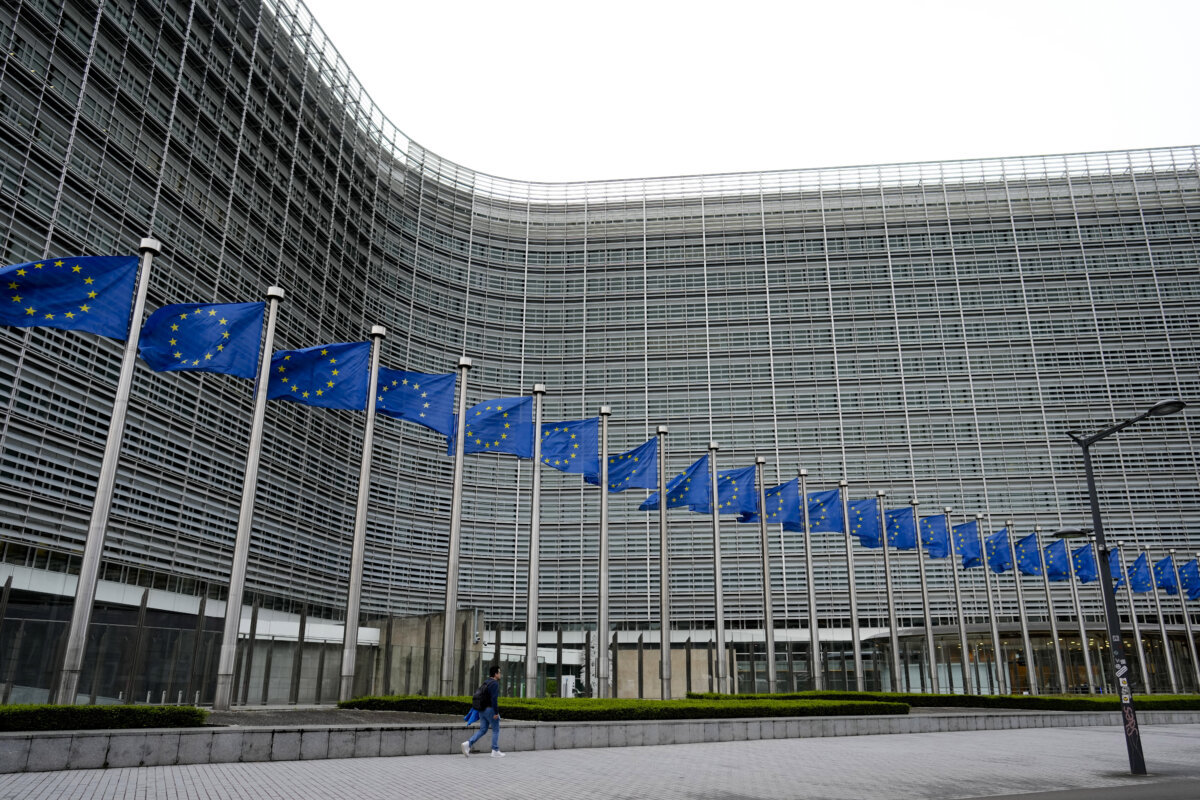
European Union leaders meeting Thursday in Brussels for a two-day European Council summit on geoeconomic challenges, Ukraine and the Middle East will also discuss how to respond to U.S. tariffs.
Ahead of the meeting, Chancellor Friedrich Merz said he supports efforts by the European Commission, the EU’s executive arm, to address U.S. President Donald Trump’s trade deal deadline, now less than two weeks away.
“I’m very much looking forward to my first European Council meeting here in Brussels today,” Chancellor Friedrich Merz said. “I also support the Commission in all its efforts to swiftly reach a trade agreement with the United States.”
European defense and security, migration, preparedness in the face of crises and risks, and internal security are also on the agenda, according to the European Council.
The European Commission is negotiating trade agreements on behalf of member states.
“The interplay between a challenging international context and our internal economic priorities, such as deepening the Single Market, is more important than ever. That is why I want us to discuss the geoeconomic challenges we are facing, addressing both the place of the EU in the world and its competitiveness,” European Council President António Costa said in a June 12 letter to member states.
The EU faces a 50 percent tariff on EU goods, which are currently slated to kick in on July 9. Brussels already faces 25 percent levies on steel, aluminum, and cars, as well as reciprocal tariffs of 10 percent on almost all other goods.
Last month, the EU proposed countermeasures on up to $107.2 billion (95 billion euros) of American imports if negotiations with Washington fail to remove the tariffs.
EU leaders will also address efforts to strengthen its defense readiness. They also want to put more pressure on Russia to “accept a meaningful ceasefire and show a genuine will to negotiate.”
Posting on the social media platform X ahead of the meeting, Dutch Prime Minister Dick Schoof wrote, “Other agenda items include the importance of European competitiveness and the need to work at EU level to get migration under control.”
Ukrainian President Volodymyr Zelenskyy will join the EU summit by videoconference, after meeting Trump on Wednesday. Trump joined leaders of the 31 other NATO member countries at the summit where they endorsed the new defense spending target.
On June 22, Spanish Prime Minister Pedro Sánchez said he had reached a deal for his country to be given an exemption from the 5 percent spending target.
“Spain will, therefore, not spend 5 percent of its GDP on defense, but its participation, weight, and legitimacy in NATO remain intact,” Sánchez said on June 22 in a televised address.
During a question-and-answer session after he made a speech at the summit in The Hague on Wednesday, Trump was asked by a Spanish journalist if he was satisfied with Spain’s contribution to NATO.
Trump replied, “It’s terrible what they’ve done. They’re the only country that won’t pay the full amount. They want to stay at 2 percent. I think it’s terrible.”
He told the journalist that the United States would make Spain pay more in a trade deal.
“You know what we’re going to do? We’re negotiating with Spain on a trade deal, we’re going to make them pay twice as much, and I’m actually serious about that.”
Reuters and Chris Summers contributed to this report.